

On a single lane off Yongkang Road in Shanghai I once counted eleven cafés in four hundred metres — a Japanese-style kissaten with a siphon bar, two competition-grade filter shops, a place selling espresso out of a window the size of a laptop, and a Luckin where office workers scanned a code, waited ninety seconds and left. Shanghai now has more coffee shops than any other city on earth, well past 9,000 of them, and the wave has moved inland. This China coffee culture guide is for visitors who want more than a hotel Americano: where the good roasters are, what things cost, how to order when the menu is a mini-program, and why the beans in your cup may have come from a Yunnan hillside rather than Ethiopia.
How China Got Here in Fifteen Years
Two things happened at once. Starbucks spent two decades teaching a tea-drinking country that a café is a place to sit — then, from 2017, a generation of Chinese chains undercut it brutally. Luckin (瑞幸, Ruìxìng) built an app-first model with coupon prices near ¥10 and now runs more outlets in China than Starbucks by a wide margin. Manner started as a two-square-metre window in Shanghai selling ¥15 lattes with a discount if you brought your own cup. Meanwhile Yunnan, which has grown Arabica commercially since the late 1980s, went from selling anonymous green beans to Nestlé to supplying single-origin lots that Chinese roasters put on the menu by farm name.
The result is a market with three tiers running in parallel: ¥10 convenience coffee, ¥15–20 quality-per-yuan chains, and a specialty scene as good as anywhere in Asia.
Best Time to Visit
Coffee is year-round, but two windows are better than the rest. Late April into May is when Shanghai runs its coffee culture festival across Jing’an and Hongkou — hundreds of pop-up stalls, roasters from other provinces, and street closures. Weather is 18–26°C and made for terrace seats.
November to March is Yunnan’s harvest and processing season. If you are travelling to Pu’er, Baoshan or Menglian, this is when the drying beds are full and estates run tours; Pu’er sits at a comfortable 10–24°C then, dry and sunny, while Kunming stays around 8–20°C. Summer in the lowland coffee areas is wet and there is nothing to see.
Avoid the first week of October and Chinese New Year, when independent cafés — often run by two or three people — simply close for a week. Chains stay open. Fit it into a wider plan with our best time to visit China guide.
China Coffee Culture Guide: Where to Find It, City by City
| City | Best district to browse | What it’s known for | Typical price | Hours |
|—|—|—|—|—|
| Shanghai | Yongkang Rd, Anfu Rd, Wukang Rd, Yuyuan Rd | Highest café density on earth; competition-level filter | ¥18–48 (US$3–7) | 08:00–19:00 |
| Beijing | Wudaoying & Fangjia hutongs, Sanlitun, 798 | Courtyard cafés, strong home-grown roasters | ¥22–45 (US$3–6) | 09:00–20:00 |
| Kunming | Wenlin St, Xiangyun Xiaozhen | Yunnan single origins at source prices | ¥15–35 (US$2–5) | 09:00–21:00 |
| Chengdu | Yulin, Taikoo Li, Xiangnan Li | Café-as-hangout, huge outdoor seating | ¥20–40 (US$3–6) | 10:00–22:00 |
| Hangzhou | Yuhuang Shannan, Tianmuli | Lakeside and hillside roasteries | ¥22–42 (US$3–6) | 09:00–19:00 |
| Guangzhou / Shenzhen | Dongshankou; Nanshan | Cantonese-milk crossovers, fast new openings | ¥18–40 (US$3–6) | 08:30–20:00 |
| Pu’er & Baoshan, Yunnan | Estate cafés outside town | Farm visits, cupping, harvest Nov–Mar | ¥15–30 (US$2–4) | Daylight |
Shanghai is the obvious base, and the density means you can do six shops on foot in an afternoon.
The Chains You’ll See Everywhere
Luckin — ¥9.9–16 with app coupons, pickup only in most stores, no seats. Fine flat whites, aggressively sweet seasonal drinks. Their coconut latte (生椰拿铁, shēng yē nátiě) sold hundreds of millions of cups and is genuinely good iced.
Manner — ¥15–25, tiny shops, competent espresso, ¥5 off if you hand over your own cup. Best value-to-quality ratio in the country.
Cotti, Nowwa, Tims China — the ¥10–18 tier, everywhere, unremarkable but reliable.
Seesaw, M Stand, Arabica, Blue Bottle, Peet’s — ¥28–45, design-led, decent beans. The Starbucks Reserve Roastery on Nanjing West Road is a 2,700 sq m spectacle worth thirty minutes even if you never drink Starbucks at home.
Skip the airport and hotel-lobby coffee entirely at ¥45–60 for something worse than the ¥15 window down the street.
What to Order
Menus are usually bilingual in Shanghai and Beijing and Chinese-only elsewhere. The useful words:
- 美式 (měishì) — Americano. 拿铁 (nátiě) — latte. 卡布奇诺 — cappuccino.
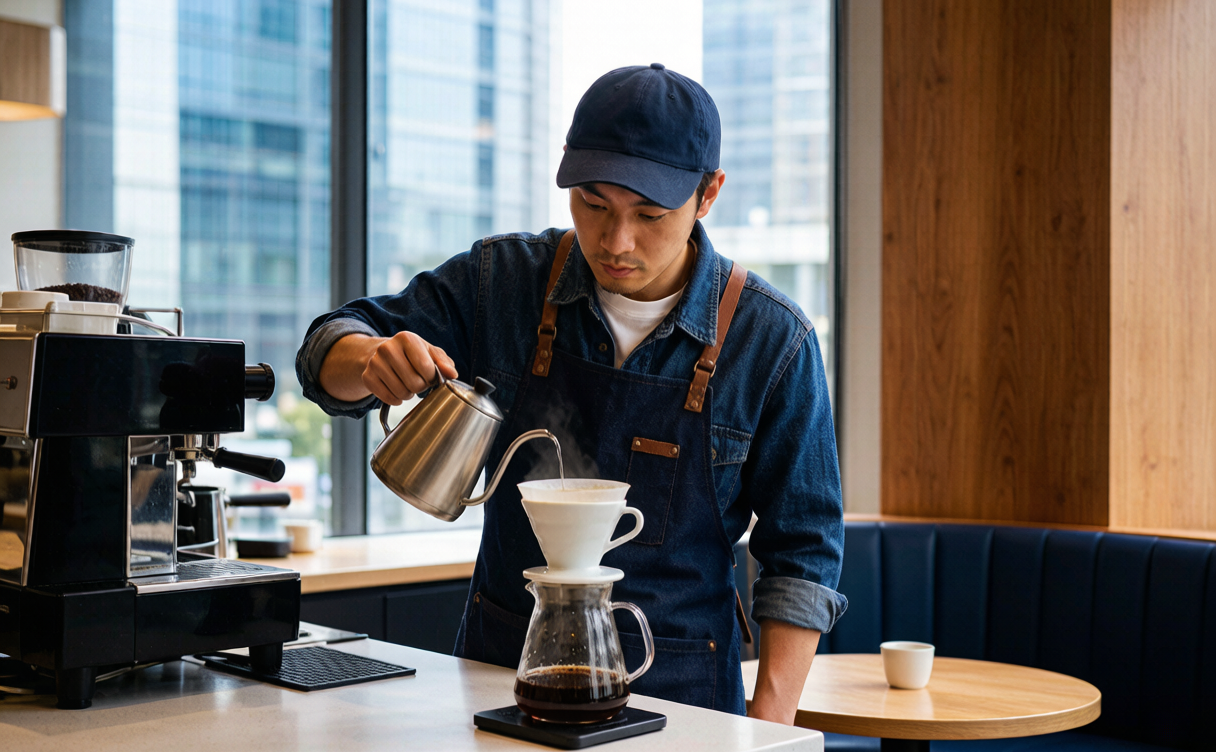
- 手冲 (shǒuchōng) — pour-over, the marker of a serious shop. Expect ¥35–60 for a Panama or a top Yunnan lot.
- 冰 (bīng) iced, 热 (rè) hot, 少冰 (shǎo bīng) less ice, 不加糖 (bù jiā táng) no sugar — say this, because default sweetness is high.
- 燕麦奶 (yànmài nǎi) — oat milk, available almost everywhere, usually ¥3–4 extra.
- Yunnan single origin (云南豆) — ask for it. Good washed lots from Baoshan and Menglian are clean, nutty and citric; the best natural-process ones are excellent and cost half what an imported bean does.
- The local inventions worth trying once: coconut latte, osmanthus latte (桂花拿铁), Chinese-herb and sea-salt cheese variations, and in Yunnan, coffee cut with brown sugar and rose.
Food is usually pastry-only. Eat first.
Sample Itinerary: A Shanghai Coffee Day
08:30 — Jing’an. Start at a ¥15 window near Wujiang Road for a wake-up espresso, standing, like a local.
10:00 — Anfu and Wukang Roads. Metro Line 10 to Shanghai Library, then walk. This is the plane-tree quarter of the former French Concession; three or four good shops within twelve minutes’ walking of each other. Order one filter, sit outside.
12:30 — lunch break. You need food, not more caffeine.
14:00 — Yongkang Road and Jianguo West Road. The densest strip. Ask what’s on the filter bar rather than reading the menu.
16:00 — Nanjing West Road. The Reserve Roastery for the industrial theatre of it.
18:00 — Suzhou Creek. Finish at a warehouse-conversion café on the north bank with the skyline going on across the water.
Five cups is plenty. I have done eight and regretted it by 9pm.
Practical Tips for Ordering
Most chains want you to order through a WeChat or Alipay mini-program by scanning the table QR code. Foreign cards bound to Alipay work for payment, but Luckin’s own app effectively needs a Chinese mobile number — the workaround is Alipay’s built-in Luckin mini-program, which usually accepts an overseas number. In independent shops you can simply speak to the barista and pay by QR, and many will let you tap a foreign card.
Seating etiquette is loose: nobody minds you sitting three hours with a laptop, and Wi-Fi passwords are on the wall or the receipt. Cafés close early — 18:00 or 19:00 is normal in Shanghai, later in Chengdu. Tipping does not exist. For opening hours and festival dates the official Shanghai tourism board site, Meet in Shanghai, is the reliable source.
FAQ
Is coffee expensive in China?
Cheaper than most Western countries at the chain level: ¥10–20 (US$1.40–2.80) for a decent latte. Specialty pour-overs at ¥35–60 (US$5–8) are comparable to London or New York, but you get a lot for it.
Can I use a foreign credit card in cafés?
Bind Visa or Mastercard to Alipay or WeChat Pay before you arrive and you will be fine in 95 percent of places. Carry ¥100 in cash for the handful of tiny shops with a cranky terminal.
Is Chinese-grown coffee actually good?
Yes, now. Yunnan’s washed Arabica used to be flat commodity fare; over the last decade producers in Baoshan, Pu’er and Menglian have invested in processing and the top lots score competitively. Ask for the farm name — good shops will tell you.
Where can I visit a coffee farm?
Around Pu’er and Baoshan in Yunnan, from November to March. Several estates outside Pu’er city run half-day tours with picking, pulping and cupping for ¥150–300 (US$21–42); book through your guesthouse a day ahead, as few take walk-ins.
Do cafés serve food?
Rarely more than croissants and cheesecake. Chinese breakfast is a separate universe and eaten elsewhere — plan to eat before your first cup.
Is it hard to find non-sweet coffee?
No, but say so explicitly. Default drinks, especially chain seasonal ones, carry a lot of syrup. “不加糖” on your phone screen solves it instantly.