

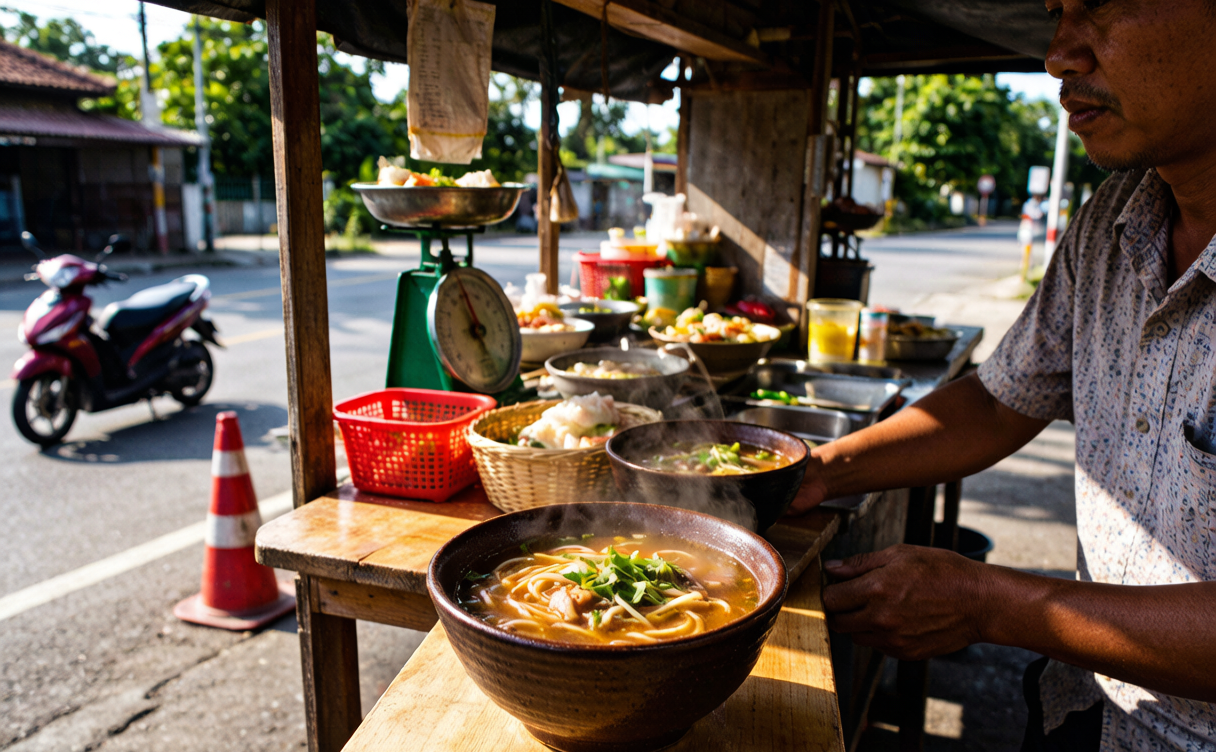
A man in a stained white cap pulls a rope of dough into sixteen strands in under twenty seconds, drops them into a cauldron, fishes them out ninety seconds later and hands you a bowl of clear beef broth with coriander, radish and chilli oil floating on top. It costs ¥14. Two doors down someone is flipping a crepe onto a griddle, cracking an egg on it and folding in a sheet of fried cracker for ¥8. This is the everyday reality of eating here, and it is why any honest budget food China guide has to start by saying the obvious: you do not need to spend much, and the cheap food is frequently better than the expensive food.
What ¥35 Actually Buys
Five US dollars is roughly ¥35. In most Chinese cities that is not one meal — it is comfortably two, with a drink. A generous daily food budget outside Shanghai and Beijing runs ¥80–120 (US$11–17) and involves eating extremely well.
Prices do vary. A bowl of noodles is ¥10–12 in Xi’an or Chengdu, ¥15–18 in Shanghai, and ¥25 in an airport. Tourist streets charge two to three times what the parallel street behind them charges. The single most effective money-saving move in China is walking one block away from the attraction.
Budget Food China Guide: The Dishes to Learn
Memorise these ten and you will never overpay or go hungry.
- Lanzhou beef noodles (兰州牛肉面, Lánzhōu niúròumiàn) — hand-pulled, clear broth, ¥12–20 (US$2–3). Everywhere in the country. Ask for xikuan for wide noodles.
- Roujiamo (肉夹馍) — braised pork in a crisp flatbread, the original Chinese burger. ¥8–14 (US$1–2).
- Jianbing (煎饼果子) — savoury crepe with egg, sauce and a fried cracker. Breakfast. ¥6–12 (US$1–2).
- Huangmen ji mifan (黄焖鸡米饭) — braised chicken and mushroom over rice, from a chain you will see a thousand times. ¥18–25 (US$3–4).
- Malatang (麻辣烫) — you fill a basket from a fridge of skewers and vegetables, it is weighed and boiled in spiced broth. ¥25–35 (US$4–5). Watch the weight.
- Chongqing xiaomian (重庆小面) — fiery sesame-and-chilli noodles. ¥10–14 (US$1.50–2).
- Guilin rice noodles (桂林米粉) — dry-mixed with pickled beans and crisp pork. ¥8–15 (US$1–2).
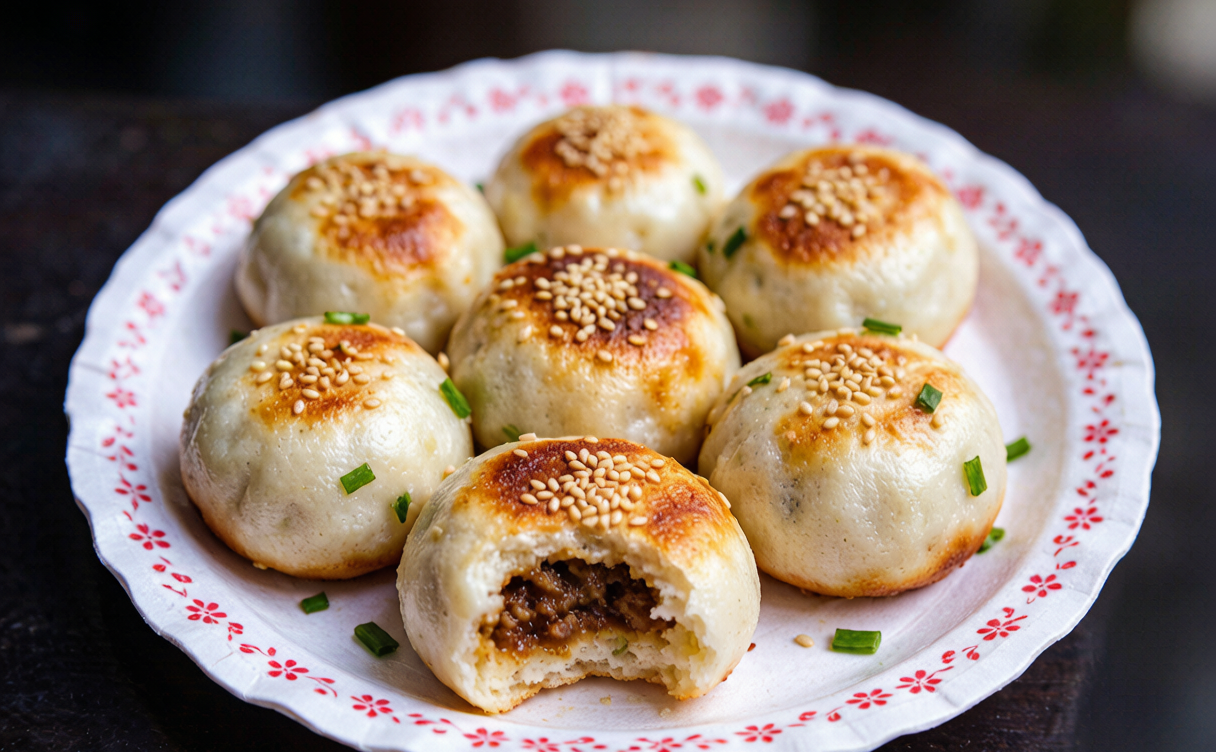
- Shengjianbao (生煎包) — pan-fried soup buns, Shanghai’s best cheap breakfast. ¥10–14 (US$1.50–2) for four.
- Liangpi (凉皮) — cold wheat noodles in vinegar and chilli, ¥10–12 (US$1.50).
- Gaijiaofan (盖浇饭) — any stir-fry ladled over rice at a hole-in-the-wall. ¥15–22 (US$2–3).
Breakfast is cheaper still: steamed buns (包子) at ¥2–4 each, soy milk and fried dough sticks (豆浆油条) for ¥6 the pair, rice porridge for ¥3.
Best Time to Visit
Season affects cheap eating more than you might expect, because the cheapest food is made by families, and families take holidays.
April to May and September to October are the best months overall — 15–26°C across most of the country, street stalls fully operational, night markets running late.
Summer (June to August) is hot and humid at 28–36°C in most cities, but it is peak season for outdoor grilling, cold noodles and night markets. Eat late; nothing good happens on a summer street before 19:00.
Winter (November to March) brings hotpot, lamb soup, braises and steamed buns, and prices dip along with hotel rates. Northern cities run −10°C to 5°C, the south stays 8–20°C.
Two windows to avoid. Spring Festival (late January or February) closes small family-run shops for one to two weeks in a row while their owners go home. National Day, 1–7 October, fills every restaurant in the country. Plan around both using our guide to the best time to visit China.
How to Get There
Getting between the good eating cities is itself cheap if you use the rail network rather than flying.
| From | Mode | Duration | Typical fare |
|—|—|—|—|
| Shanghai Hongqiao | High-speed rail to Hangzhou East | 45–60 min | ¥73 (US$10) |
| Beijing West | Overnight sleeper to Xi’an | 11–12 hr | ¥260 (US$37) hard sleeper |
| Xi’an North | High-speed rail to Chengdu East | 3 hr – 4 hr 30 min | ¥263 (US$37) |
| Guangzhou South | High-speed rail to Guilin West | 2 hr 30 min – 3 hr | ¥140 (US$20) |
| Airport to city (most cities) | Metro or airport coach | 30–60 min | ¥5–35 (US$0.70–5) |
| Around town | Metro single ride | 10–40 min | ¥2–9 (US$0.30–1.30) |
Overnight sleepers save a night’s accommodation and are a legitimate budget tactic. Book on the official 12306 app or a booking site seven to fourteen days out.
The Chains Worth Knowing
Snobbery about chains is a mistake here. Several are genuinely good and all of them are consistent, clean and cheap.
- Laoxiang Ji (老乡鸡) — self-serve trays of home-style Anhui dishes. Pick three plus rice and soup for ¥25–35 (US$4–5). My default when I cannot be bothered to research.
- Shaxian Snacks (沙县小吃) — the tiny red-signed shops on every second corner. Peanut-sauce noodles ¥7, wontons ¥8, steamed dumplings ¥10.
- Lanzhou noodle shops — usually independent but visually identical everywhere, ¥12–20.
- Micun Bibimbap (米村拌饭) — Korean-Chinese stone-pot rice, ¥25–32, with free refills of soup and side dishes.
- Mixue (蜜雪冰城) — the ubiquitous snow-and-ice drinks shop. Lemonade ¥4, ice cream ¥3.
Where to Eat Cheaply in Any City
- Morning markets (早市) and wet markets (菜市场) — cooked-food stalls at the edges sell breakfast for ¥5–10. Best before 09:00.
- University gates — every campus is ringed by shops competing for students with ¥10–15 meals. The single most reliable cheap-eating zone in any Chinese city.
- Shopping mall basements — the B1 food court is fast, air-conditioned, picture-menued and ¥20–35. Not exciting, but useful with children or in bad weather.
- “Fly restaurants” (苍蝇馆子) — grubby single-room places with plastic stools and superb food. Look for the ones full of local men at 12:30.
- Convenience stores — FamilyMart, Lawson and 7-Eleven sell hot boxed meals at ¥15–22 and steamed buns at ¥3. A fine airport-morning fallback.
- Food delivery — Meituan and Ele.me deliver for ¥3–5 and often undercut walk-in prices. Worth setting up if you are staying more than a week.
Avoid: hotel breakfasts you have to pay for, anything on a pedestrianised tourist street with photos of the food outside, and scenic-area restaurants inside the ticket gate.
Where to Stay
Where you sleep decides what you can eat within a ten-minute walk.
Budget (¥60–150 / US$8–21). Hostel dorms and small guesthouses in old-town lanes or near a university. Pick a place beside a wet market and your breakfast problem is solved for the whole stay.
Mid-range (¥250–450 / US$35–63). Chain business hotels — Atour, Hanting Premium, Ji Hotel — near a metro station one or two stops off the tourist core. Cheaper rooms and far better food than the centre.
Splurge (¥800–2,000 / US$113–281). International brands in the CBD. Comfortable, but be aware that CBD dining is the most overpriced in any Chinese city. Eat elsewhere.
Sample Itinerary: A Full Day Under US$15
07:30 — Two pork buns and a hot soy milk at a market stall. ¥9
10:00 — Jianbing from a cart, eaten walking. ¥8
12:30 — Lanzhou beef noodles, wide cut, extra coriander. ¥16
15:00 — Sweet potato from a drum roaster in winter, or a Mixue lemonade in summer. ¥6
18:00 — Malatang, a modest basket, medium spice. ¥28
20:30 — Grilled skewers and a large bottle of local beer at a night stall. ¥30
Total: ¥97, about US$14. Six eating occasions, no compromises, and more food than most people can finish.
Practical Tips
- Payment. Alipay and WeChat Pay run everything, including a ¥3 bun. Bind an international card before you fly; cash still works but small vendors rarely hold change.
- Water. Do not drink from the tap. Boiled water is free and everywhere — stations, hotels, trains, and most restaurants will fill a bottle.
- Spice. Say bú yào là (不要辣) for none, wēi là (微辣) for mild. In Sichuan and Hunan, mild still means something.
- Allergies. Have a translated card on your phone. Peanut oil and sesame are used almost universally.
- No tipping, anywhere. It confuses people.
- Portions are large and takeaway boxes are normal — ask to dǎbāo (打包).
- Visas. Many nationalities now qualify for visa-free entry or 240-hour transit; check the current rules on the National Immigration Administration website before booking, as they change often.
FAQ
How much should I budget per day for food in China?
¥80–120 (US$11–17) per person buys three good meals plus snacks in most cities. In Shanghai, Beijing and Shenzhen, add 30 to 50 per cent. Under ¥60 (US$8) a day is entirely possible if you eat at markets and canteens.
Is cheap street food in China safe to eat?
Generally yes, with judgement. Choose stalls with queues and high turnover, insist on food cooked in front of you and served piping hot, and be more careful with raw salads, cut fruit left out, and cold cooked meat than with anything from a wok or a boiling pot.
Can I eat cheaply without speaking Chinese?
Yes. Point at what other people are eating, use a translation app’s camera on menus, or eat at chains and mall food courts with picture menus. Numbers on a phone screen settle any price question.
Are there cheap options for vegetarians?
Plenty, but you must be explicit — wǒ chī sù (我吃素). Stir-fried vegetables over rice, cold noodles, scallion pancakes, tofu dishes and vegetable dumplings are cheap and common. Note that many broths and even vegetable dishes use meat stock or lard by default.
Is it rude to eat at cheap places rather than restaurants?
Not at all. Some of the most respected cooking in China happens at ¥15 a bowl, and eating where locals eat is read as interest rather than stinginess.