

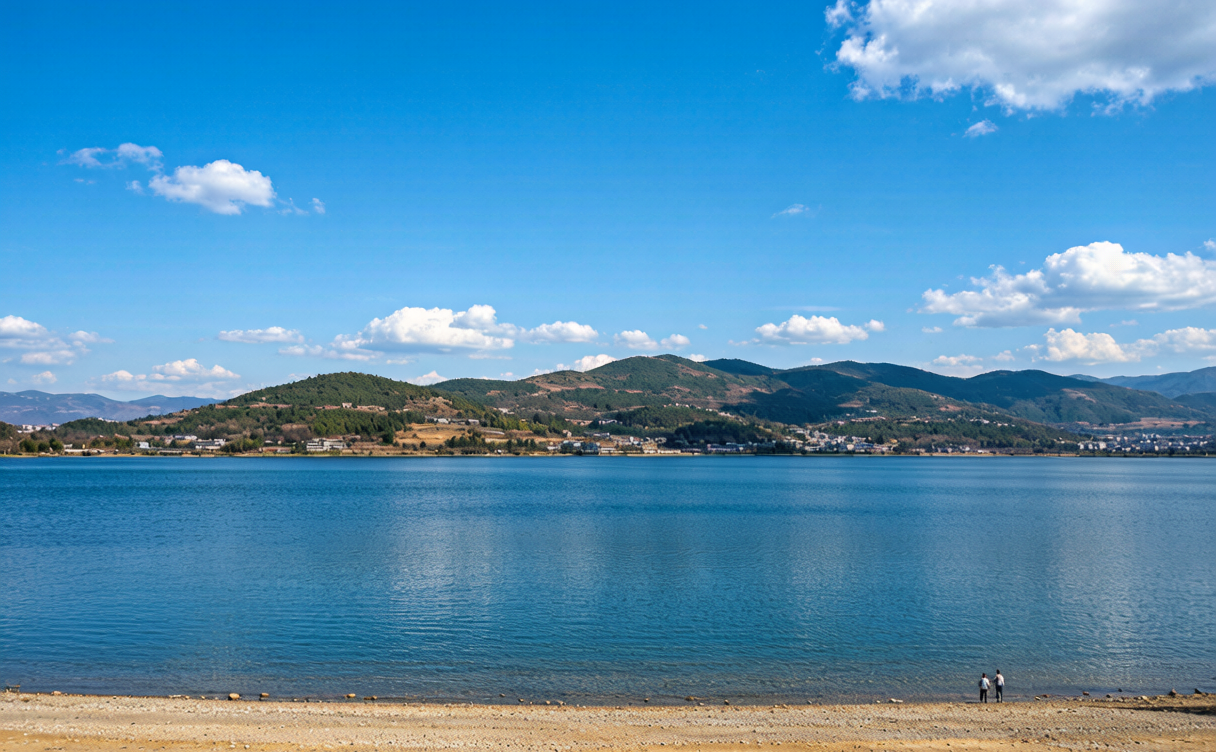
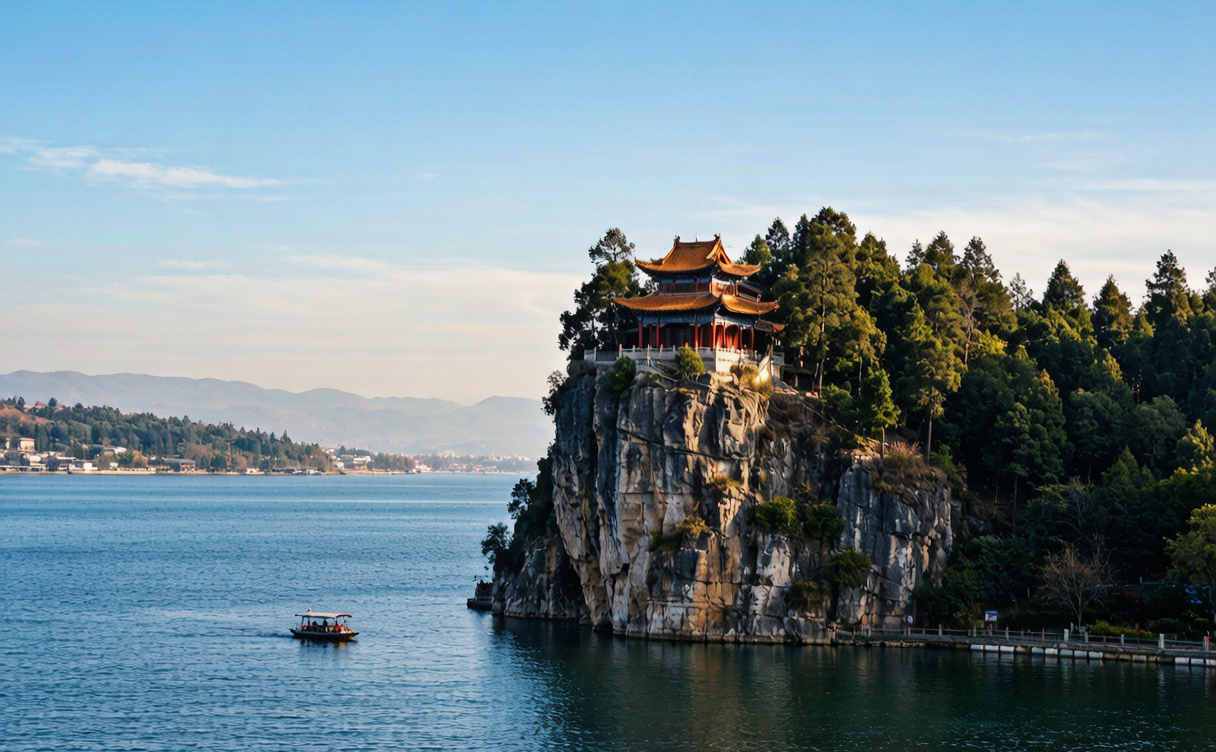
Stand on the Dragon Gate ledge on a clear December morning and Dianchi stops looking like a lake at all. It becomes a sheet of hammered tin, roughly 300 square kilometres of it, pinned between the pine ridges of the Western Hills and the white towers of Kunming. Gulls that flew in from Siberia wheel a few hundred metres below your feet. Behind you, a Taoist shrine has been chiselled straight into red sandstone by one man working with hand tools for most of his adult life. This Dianchi Lake guide covers what deserves your time here, what things really cost, and which parts of the lakeshore I would skip.
The Honest Verdict First
Dianchi is not a swimming lake. Decades of runoff pushed it into serious trouble, and although a long clean-up has helped enormously, summer algal blooms still turn parts of the northern shore green. The value here is not the water but the frame around it: a 1,886-metre-high basin ringed by hills, a cliff temple with one of the best views in southwest China, and a winter gull spectacle locals treat as a civic event. Arrive expecting a Swiss alpine lake and you will be disappointed by noon. Come for the hills, the birds and the light and you will have one of the better days of a Yunnan trip.
Best Time to Visit
Kunming is nicknamed the Spring City (春城, chūnchéng) and the label is earned — the altitude cancels out the latitude, so nothing here gets truly hot or truly cold.
November to March — the best window. Highs of 15–20°C under an intensely blue sky, though nights drop to 2–8°C and hotel heating is patchy. This is also when tens of thousands of black-headed gulls (红嘴鸥, hóngzuǐ ōu) arrive from Siberia and take over Haigeng Dam, landing in late November and leaving in March.
March to April. Blossom season, 20–24°C, hazy but pleasant, and good for hiking before the humidity arrives.
June to August — avoid if you can. Kunming takes most of its annual rainfall in these three months. Afternoon downpours are near-daily and the ridge views vanish into cloud. The upside is wild mushroom season.
September to October. My second choice: clear air, 20–23°C, and thin crowds once the National Day holiday (1–7 October) has passed. For how this fits a wider route, our seasonal breakdown of when to travel in China is worth ten minutes.
One warning: at nearly 1,900 metres the ultraviolet index is brutal even in winter. I have seen more sunburn on the Dragon Gate steps than on any beach.
How to Get There
Kunming is the gateway. Changshui International Airport (KMG) is a major hub and Kunming South is a high-speed rail terminus; getting to the lake from the city is a metro-and-bus job.
| From | Mode | Duration | Cost |
|—|—|—|—|
| Changshui Airport → city centre | Metro Line 6 + Line 3 | 40 min | ¥7 (US$1) |
| City centre → Western Hills | Metro Line 3 to Xishan Park, then park shuttle | 45–55 min | ¥6 (US$0.85) |
| City centre → Haigeng Dam | Bus 44 or Metro Line 1 + Bus 233 | 40–50 min | ¥2 (US$0.30) |
| Haigeng Park → Dragon Gate | Cross-lake cableway | 25 min | ¥40 one way (US$5.60) |
| Chengdu → Kunming | High-speed rail | 7 hr | ¥490 (US$69) |
| Guangzhou → Kunming | High-speed rail | 6 hr 30 min | ¥480 (US$68) |
| Shanghai or Beijing → Kunming | Flight | 3 hr 30 min – 4 hr | ¥900–1,300 (US$127–183) |
Skip the taxi to the Western Hills unless there are three of you — it runs ¥70–90 (US$10–13) and the metro is faster in rush hour.
Dianchi Lake Guide to Tickets, Hours and Real Costs
The lake itself is free. The sites around it are not, but they are cheap:
- Western Hills Forest Park entry: ¥30 (US$4.20), open 08:00–18:00 (last entry 17:00)
- Dragon Gate section: ¥40 (US$5.60) on top of park entry
- Internal Longmen ropeway (park gate to Sanqing Pavilion): ¥25 (US$3.50) one way
- Cross-lake cableway from Haigeng Park: ¥40 (US$5.60) one way, ¥70 (US$10) return
- Haigeng Dam: free, always open
- Yunnan Nationalities Village: ¥90 (US$13), 09:00–17:30
- Daguan Park: ¥26 (US$3.70), 07:00–19:00
- Guandu Ancient Town: free
Budget ¥150–200 (US$21–28) per person for a full day including transport and one meal. Bring your passport — several sites still register foreign visitors manually at the gate.
The Western Hills and Dragon Gate
This is the reason to come. The Western Hills (西山, Xīshān) rise 600 metres straight off the water and, seen from the city, form a reclining silhouette locals call the Sleeping Beauty. A chain of religious buildings climbs the slope: Huating Temple, the largest Buddhist complex in Kunming; Taihua Temple, quieter and heavy with camellias in February; then Sanqing Pavilion, a Yuan-dynasty villa converted into a Taoist hall.
Above them all is Dragon Gate (龙门, Lóngmén). Between 1781 and 1853 a Taoist named Wu Laiqing and his successors carved a passage, chambers and a stone shrine directly out of the cliff face with hand chisels, hanging above a 300-metre drop. The corridor is narrow, low and often single-file; if you are claustrophobic or badly afraid of heights, reconsider here. The payoff is a stone terrace with the entire lake beneath you.
Walking the slope from the park gate to Dragon Gate takes about 90 minutes and is a decent climb. Take the internal ropeway up and walk down — the descent past the temples is more interesting than the ascent. Allow three to four hours for the hill.
The Lakeshore: Gulls, Dams and Old Towns
Haigeng Dam (海埂大坝) is a two-kilometre causeway on the northern shore, free and open at all hours. From late November it is the gull epicentre: vendors sell bread rings for ¥5 and the birds take them from your hand. Go before 10:00 — by noon at a weekend the crowds are heavy and the birds are full.
Daguan Park, closer to town, holds the Grand View Pavilion and a famous 180-character couplet by the Qing scholar Sun Ranweng. Twenty minutes is enough unless you read Chinese.
Guandu Ancient Town (官渡古镇) is free, with a pagoda from 1458 at its centre. It is restored rather than original — treat it as a food stop, not a heritage site.
What I would skip: the Yunnan Nationalities Village, unless you have children in tow. At ¥90 it is a theme-park version of the province’s ethnic architecture, and you will see the real thing in Dali or Xishuangbanna for free.
Where to Stay
Budget — ¥120–220 (US$17–31). Hostels and chain hotels around Kunming Railway Station and Nanping Street. Central, on Metro Line 1 or 3, ¥150 for a decent double.
Mid-range — ¥300–550 (US$42–78). The Cuihu (Green Lake) district is where I stay: leafy, walkable, full of cafés, 30 minutes from the lake. Boutique conversions run ¥350–500.
Splurge — ¥800–1,600 (US$113–225). Lakeside resorts on the northeastern shore near Guandu, several with rooms facing the water. Worth it only for a balcony view.
What to Eat Nearby
- Crossing-the-bridge rice noodles (过桥米线, guòqiáo mǐxiàn) — a scalding bowl of chicken broth into which you tip raw meat, quail egg and vegetables in order. Basic bowl ¥15–25; the full multi-plate version at an old house like Jianxin Yuan runs ¥60–120.
- Steam-pot chicken (汽锅鸡, qìguōjī) — cooked in a lidded clay pot by steam alone, no added water. Clean and restorative, ¥90 for a pot serving three.
- Wild mushrooms (野生菌, yěshēngjùn) — from June to September Kunming goes mushroom-mad. Restaurants near Muji market serve hotpots of porcini, chanterelle and jian shou qing; ¥200–400 for two.
- Grilled goat cheese (乳扇, rǔshàn) — a Bai speciality, fanned onto a skewer and painted with rose jam. ¥8 at street stalls.
Sample Itinerary: One Full Day
- 07:30 — Breakfast of xiaoguo mixian near Cuihu, then Metro Line 3 west.
- 09:00 — Ropeway to Sanqing Pavilion; up to Dragon Gate before the tour groups.
- 10:30 — Dragon Gate terrace, then descend on foot via Taihua and Huating temples.
- 12:30 — Lunch at Gaoyao village below the hill; grilled fish and rice noodles.
- 13:45 — Cross-lake cableway to Haigeng Park, the best ¥40 you will spend in Kunming.
- 14:30 — Walk Haigeng Dam. Gulls in winter, joggers and views the rest of the year.
- 16:00 — Bus to Guandu Ancient Town for snacks and the pagoda.
- 18:00 — Back downtown for steam-pot chicken.
With a second day, pair the lake with the Stone Forest at Shilin, 90 minutes east and part of the UNESCO-inscribed South China Karst.
FAQ
Is Dianchi Lake actually worth visiting?
Yes, but for the Western Hills and Dragon Gate rather than the lake itself. Treat the water as scenery rather than a destination. If you have only one day in Kunming, this is still the best way to spend it.
How much do Dianchi Lake tickets cost?
The lake and Haigeng Dam are free. Western Hills Forest Park is ¥30 (US$4.20) plus ¥40 (US$5.60) for the Dragon Gate section. Ropeways add ¥25–70. A full day rarely exceeds ¥200 (US$28) per person.
Can you swim or take a boat on Dianchi?
Swimming is not permitted and not advisable. Sightseeing boats run from Haigeng and Daguan Park for ¥50–80 (US$7–11), though the cross-lake cableway gives better views for less.
When is the best time to visit Dianchi Lake for the gulls?
Late November to early March, with December and January the peak. Arrive at Haigeng Dam before 10:00 for the best light and the hungriest birds.
Is Dianchi Lake hiking difficult?
The Western Hills climb is a sustained but non-technical 600-metre ascent on paved paths and stone steps, roughly 90 minutes up. Altitude makes it harder than it looks on paper — pace yourself on your first day in Kunming, and use the ropeway if you arrived from sea level that morning. No guide is needed: signage is bilingual and Alipay works at every ticket window.