

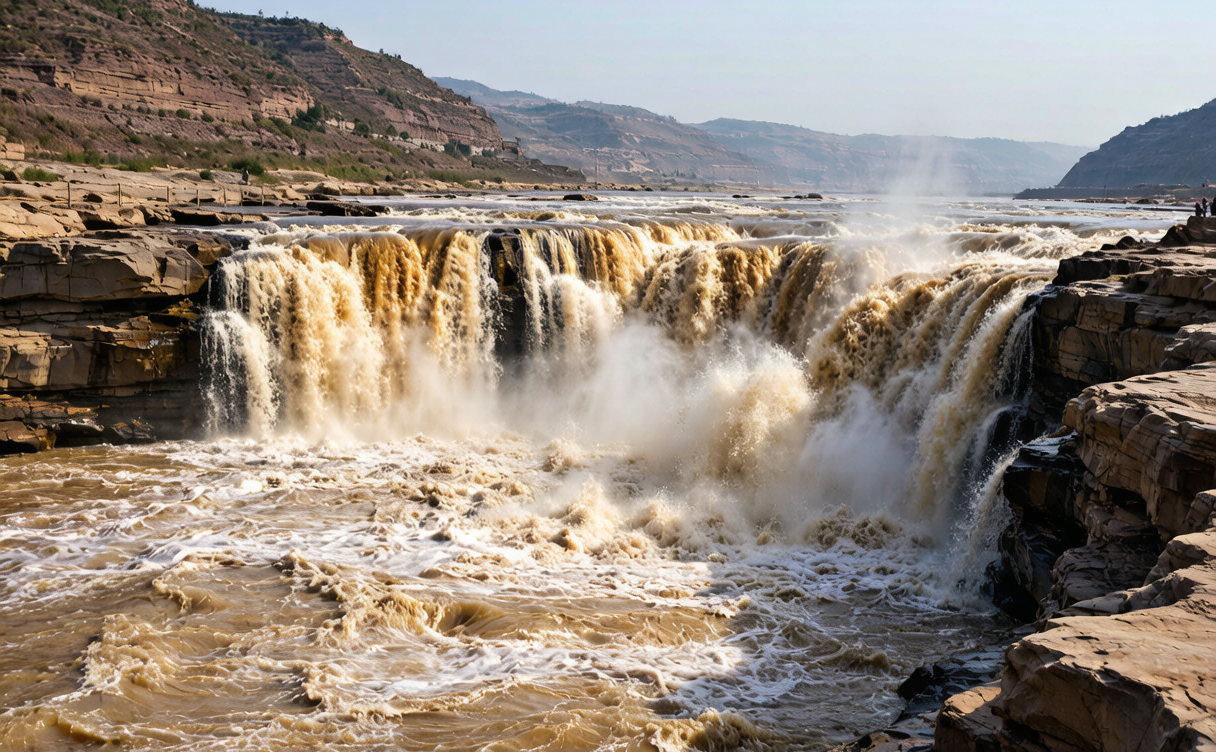
You hear it before the road turns. A low, chest-level rumble that you feel in your sternum, and then the loess plateau simply opens and the Yellow River — three hundred metres wide a moment earlier — is squeezed into a gap barely wider than a tennis court and thrown twenty metres down into a slot canyon. The spray comes back up brown. Within ninety seconds your jacket, your lens and your hair are coated in a fine layer of the same silt that built the North China Plain. This Hukou Waterfall guide covers which bank to visit, what it actually costs, when the flow is worth the six-hour detour, and why I think most people go at completely the wrong time of year.
Two Provinces, One Waterfall
Hukou (壶口, “kettle spout”) straddles a provincial border. The east bank belongs to Ji County in Shanxi; the west bank to Yichuan County in Shaanxi. Both charge separately, both are good, and you cannot cross between them at the falls — the bridge is a long detour.
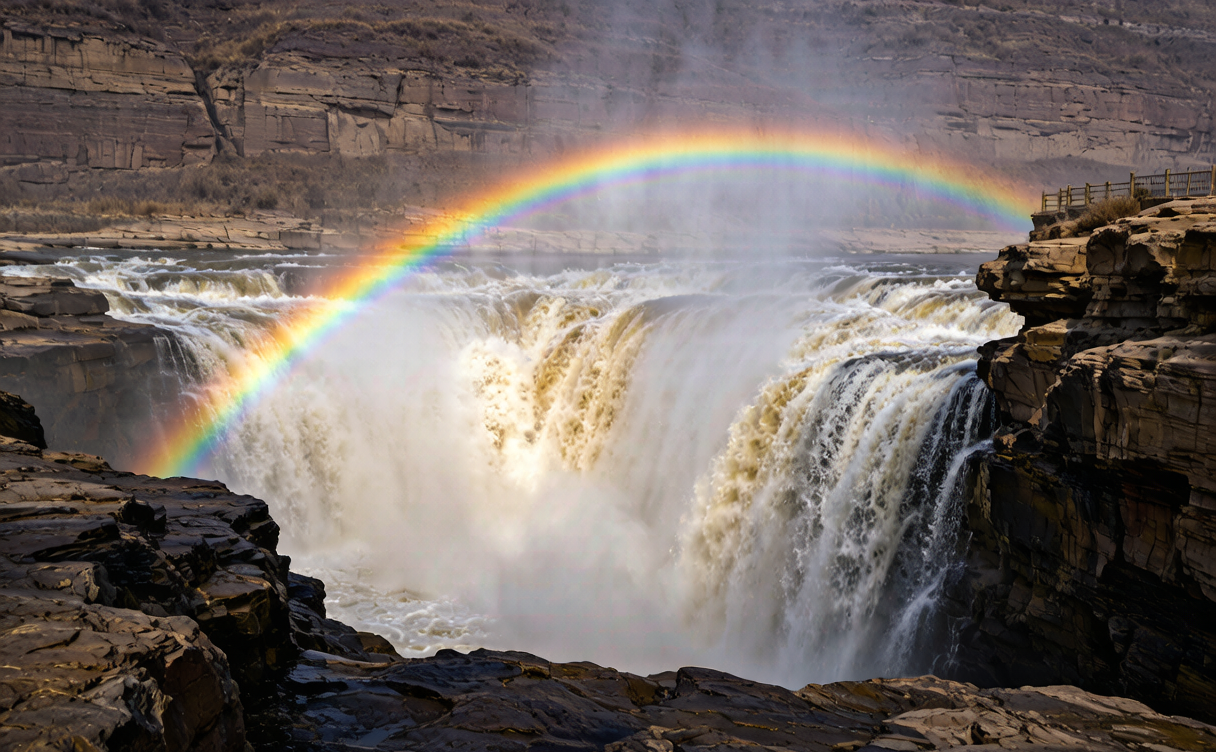
Shanxi side (east bank). Closer to the main channel, with a broad concrete apron that lets you walk almost to the lip. Because you face west, mist rainbows appear here on sunny mornings, roughly 09:00 to 11:00. Access is via Linfen or Pingyao.
Shaanxi side (west bank). More theatrical: waist-drum performers in white headscarves, the saddled donkeys, and the Longdong tunnel — a staircase bored through rock that drops you onto a platform beneath the falls. Rainbows here favour the late afternoon. Access is via Yan’an.
Coming from Xi’an, take Shaanxi. From Beijing, Datong or Pingyao, take Shanxi. Do not attempt both without a car and two days.
Best Time to Visit
This is the decision that makes or breaks the trip. Hukou is entirely dependent on flow, and flow swings wildly.
Late April to mid-May — my pick. The taohua xun (桃花汛), or peach-blossom flood, comes from upstream snowmelt. Volume is strong, the water is loud, and 18–26°C days are comfortable. Crowds are moderate outside the 1–5 May holiday.
September to early November — the biggest water. Autumn rains upstream produce the year’s peak flow, sometimes ten times the winter volume. Skies are clear, air is 12–22°C, and the loess hills turn gold. This is when the falls look like the photographs.
July and August — powerful but risky. Flow is enormous, but the rainy season brings haze, mud and occasional closures when the river runs dangerously high. Highs of 30–35°C on exposed rock are no fun.
Late December to February — the ice falls. Spray freezes into fantastical formations along the gorge walls and the crowds vanish. It is also −10 to 2°C, and the water shrinks to a fraction of autumn levels. Beautiful, but a specialist visit.
March and June are the weak months. Low flow, dusty air. Skip them. Our month-by-month guide to travelling in China sets this against the national calendar.
How to Get There
There is no airport and no railway station at the falls. Every route ends with a two- to three-hour road transfer, and that transfer is the real cost of visiting.
| From | Mode | Duration | Cost |
|—|—|—|—|
| Xi’an North → Yan’an | High-speed rail | 2 hr 15 min | ¥140 (US$20) |
| Yan’an → Hukou (Shaanxi side) | Tourist bus | 2 hr 30 min | ¥60 (US$8.50) |
| Yan’an → Hukou (Shaanxi side) | Chartered car, return | 2 hr 30 min each way | ¥500–600 (US$70–85) |
| Xi’an → Hukou, direct | Chartered day car | 5 hr each way | ¥900–1,200 (US$127–169) |
| Beijing West → Taiyuan South | High-speed rail | 2 hr 30 min | ¥193 (US$27) |
| Taiyuan South → Linfen West | High-speed rail | 1 hr 20 min | ¥95 (US$13) |
| Linfen → Hukou (Shanxi side) | Long-distance bus | 2 hr 30 min | ¥45 (US$6.30) |
| Pingyao → Hukou (Shanxi side) | Chartered car, return | 3 hr 30 min each way | ¥700–800 (US$99–113) |
Buses to the falls run in the morning only and return in the early afternoon; miss the last one and you are staying in Ji County. For two or more people a chartered car costs little more per head and removes the problem.
Hukou Waterfall Guide to Tickets, Hours and Add-Ons
Both banks price almost identically, and both discount heavily in winter.
- Entry, either side: ¥90 (US$13) in high season; ¥45–60 (US$6–8.50) from December to February
- Internal shuttle bus from the gate to the viewing area: ¥20 (US$2.80) return, and worth it — the walk is about 2 km on an exposed road
- Longdong observation tunnel (Shaanxi side only): ¥30 (US$4.20)
- Opening hours: 07:30–18:30 from April to October; 08:00–17:30 from November to March
- Donkey photo with a red saddle and a shepherd in costume: agree ¥20–30 (US$3–4.20) before you climb on, or you will be quoted triple afterwards
Two things nobody warns you about. Buy the ¥10 disposable poncho at the gate — the spray is relentless and it carries sediment, not clean water. And bring a microfibre cloth for your camera and phone, because silt dries into a film that scratches if you wipe it with a sleeve.
What There Is to Do Beyond Looking
Honestly? Look at the waterfall. Hukou is a single overwhelming natural event and the site around it is thin. Give it two to three hours and plan the rest of the day elsewhere.
The walkway along the lip runs about 800 metres and takes twenty minutes end to end; walk it slowly and stop at three or four points, because the falls look completely different from each. The Longdong tunnel on the Shaanxi side is the one distinctive extra — descending inside the cliff and emerging under the curtain of water, roar amplified by rock on all sides, is the memory people come away with.
The river carries around 35 kilograms of sediment per cubic metre in flood, which is why this is the only major waterfall on earth that is reliably yellow. For the geology behind that number, the Yellow River entry at Encyclopaedia Britannica is a solid primer.
One local flourish: the falls appeared on the back of the 50-yuan note of China’s fourth banknote series, issued in 1980. Older visitors still pose holding one up against the view.
Where to Stay
Nobody should base a holiday at Hukou, but you may well need one night nearby.
Budget — ¥100–220 (US$14–31). Guesthouses in Ji County town on the Shanxi side, twenty minutes from the gate, or family-run places at the Shaanxi entrance. Basic, with hot water in the evenings only at the cheapest end. A few offer converted yaodong (窑洞) cave rooms cut into the loess — cool in summer, warm in winter, and far more interesting than a chain hotel.
Mid-range — ¥250–500 (US$35–70). Business hotels in Linfen (Shanxi) or Yan’an (Shaanxi). Both have high-speed rail, reliable heating and enough restaurants for a decent evening. Yan’an is the more appealing.
Splurge — ¥600–1,400 (US$85–197). Nothing near the falls is luxurious, so the splurge belongs at either end of the journey: a courtyard hotel inside Pingyao’s Ming walls, or a five-star in Xi’an.
What to Eat
The loess plateau eats wheat, millet and mutton, and does it well.
- Knife-shaved noodles (刀削面, dāoxiāo miàn) — thick ribbons shaved off a dough block straight into boiling water, Shanxi’s proudest export. ¥12–18 a bowl.
- Buckwheat helao (荞面饸饹, qiáomiàn héle) — pressed noodles in a mutton broth, the standard cold-weather lunch around Ji County.
- Yellow River carp (黄河鲤鱼, Huánghé lǐyú) — braised whole in soy and vinegar. ¥80–140 at riverside restaurants.
- Oil-splashed noodles (油泼面, yóupō miàn) — the Shaanxi side’s version, chilli flakes seared with hot oil at the table. ¥15.
- Ji County apples (吉县苹果) — sold by the bag at the roadside for ¥10–20 a kilo, and unusually sweet thanks to the plateau’s temperature swings.
Sample Itinerary: Two Days from Xi’an
Day 1
- 08:00 — Train from Xi’an North to Yan’an.
- 10:30 — Arrive; drop bags, lunch of Shaanbei lamb and huang momo millet buns.
- 12:30 — Chartered car south to Hukou.
- 15:00 — The Shaanxi side. Walk the lip, then the Longdong tunnel; rainbow chances from about 15:30.
- 17:30 — Drive back; dinner in Yan’an.
Day 2
- 08:30 — Yan’an at leisure, or the loess cave villages on the road north.
- 13:00 — Train back to Xi’an, evening free for the Muslim Quarter.
On the Shanxi side, run the same structure out of Linfen and add a night in Pingyao’s walled old city.
FAQ
Is Hukou Waterfall worth the long detour?
In late April or October, yes — it is the most physically overwhelming natural sight in northern China. In March or June, when flow is low, it is a two-hour drive to look at a large brown stream. Timing is everything.
Which side is better, Shanxi or Shaanxi?
Shaanxi has the Longdong tunnel and the performances; Shanxi has the closer platform and morning rainbows. Choose by where you are coming from.
How much are Hukou Waterfall tickets?
¥90 (US$13) per side in high season, dropping to ¥45–60 in deep winter, plus ¥20 for the internal shuttle and ¥30 for the Longdong tunnel on the Shaanxi bank.
How long do I need at the falls?
Two to three hours inside the scenic area is plenty. Budget a full day door-to-door from Yan’an or Linfen, or two days from Xi’an, Taiyuan or Pingyao.
Is there any Hukou Waterfall hiking?
Not in a serious sense. The site is a flat riverside walkway of under a kilometre with a few stairs. The loess hills around Ji County have rough farm tracks, but there is no marked trail network — this is a viewpoint, not a trekking destination.
Can I visit as a day trip from Xi’an?
Technically yes, at roughly ten hours of driving for two hours at the falls. I would not. Break the journey in Yan’an for a far better trip.