

The first time you search a route on 12306 you get a wall of options — G1234, D311, K599, Z50 — and no explanation of why one takes five hours and another takes seventeen. This China train types guide decodes the letter system, which is genuinely the single most useful thing to learn before booking rail travel in mainland China. The letter in front of the number tells you the train’s speed class, the seats or berths on board, the kind of station it uses, and roughly what you’ll pay. Get it right and you’ll book confidently in two minutes. Get it wrong and you’ll spend a night on a hard seat you didn’t intend to buy.
How to Read a Chinese Train Number
Every service has a prefix letter (or none) followed by digits. The letter is the service class; the number identifies the run and, roughly, its direction — odd numbers generally head away from Beijing, even numbers toward it.
The system splits into two worlds:
- High-speed (G, D, C) — modern EMU trainsets, new dedicated stations, airline-style boarding, mostly daytime.
- Conventional (Z, T, K, numbered) — older locomotive-hauled stock, legacy city-centre stations, sleeper berths, mostly overnight.
Both are safe, punctual and clean by international standards. They serve different purposes.
The China Train Types Table
| Code | Type | Typical speed | Seat/berth classes | Best for |
|—|—|—|—|—|
| G (高铁) | High-speed | 300–350 km/h | Second class, first class, business class | Fastest city-to-city daytime travel |
| D (动车) | Electric multiple unit | 200–250 km/h | Second class, first class; soft sleeper on overnight D | Slightly cheaper high-speed; overnight EMU sleepers |
| C (城际) | Intercity | 160–350 km/h | Second class, first class, occasionally business | Short hops between neighbouring cities |
| Z (直达) | Direct express | up to 160 km/h | Soft sleeper, hard sleeper, hard seat; deluxe soft sleeper on some | Long overnight routes with few stops |
| T (特快) | Express | up to 140 km/h | Soft sleeper, hard sleeper, soft seat, hard seat | Mid-distance overnight, more stops |
| K (快速) | Fast train | up to 120 km/h | Hard sleeper, hard seat, some soft sleeper | Budget travel, smaller cities |
| No letter (普快/普客) | Ordinary | 60–100 km/h | Hard seat, hard sleeper | Remote branch lines and rural stops |
| L / S | Seasonal / suburban | varies | Hard seat mostly | Holiday extra services |
G, D and C: The High-Speed Family
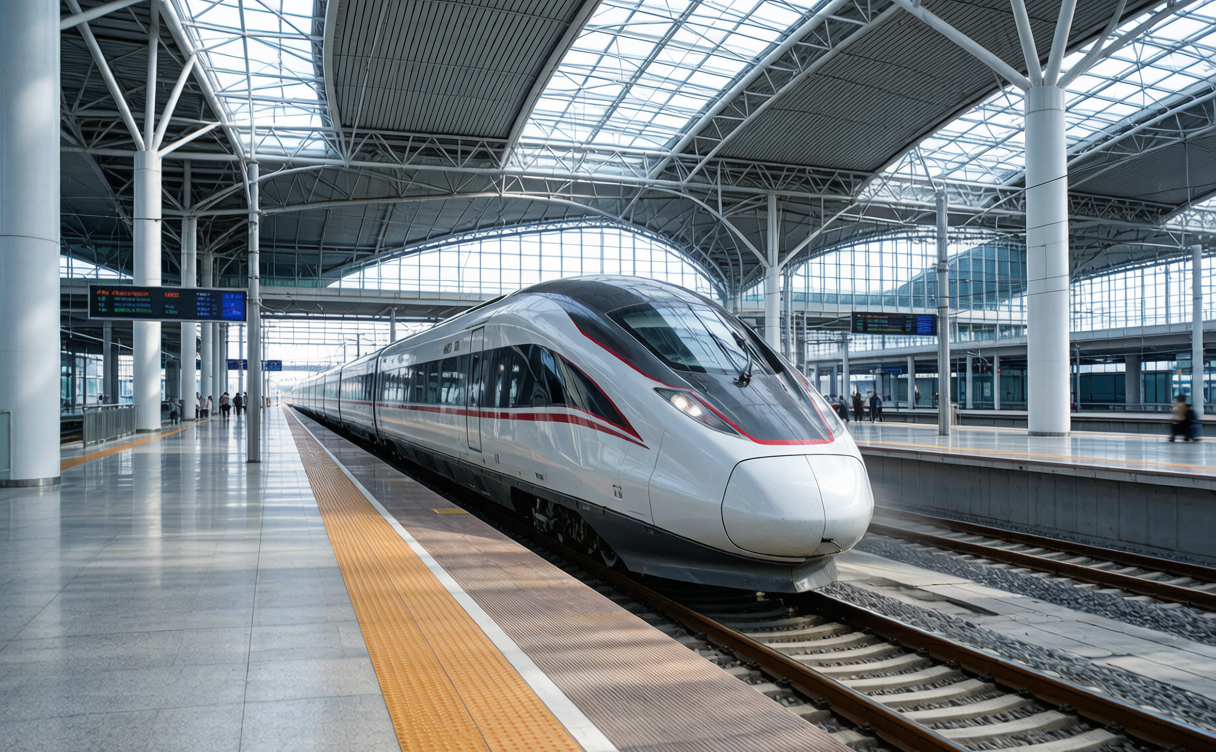
G trains are the flagship. Fuxing and Harmony trainsets run at 300–350 km/h on dedicated lines, covering Beijing to Shanghai (1,318 km) in about 4.5 hours. They use the newest stations, usually on the city edge, and don’t run overnight — the network closes for maintenance roughly midnight to 6am.
D trains are the same technology capped at 200–250 km/h, often on mixed-traffic lines. They’re typically 15–25% cheaper than a G on the same corridor. The exception worth knowing is the overnight D sleeper (动卧): routes including Beijing–Shanghai and Beijing–Shenzhen run modern EMU sleepers with four-berth soft compartments, departing late and arriving at breakfast. These are the most comfortable overnight trains in the country.
C trains are short intercity shuttles — Beijing to Tianjin in 30 minutes, Guangzhou to Zhuhai, Chengdu to Dujiangyan. Think of them as a metro between neighbouring cities.
For booking mechanics, seat maps and how the passport system works at the gate, our China high-speed train guide for foreigners goes deeper.
Z, T and K: The Conventional Network
These older trains are far from obsolete — they reach hundreds of towns the high-speed network skips, and they run overnight, turning a travel day into a night’s sleep plus a saved hotel bill.
Z trains (直达特快) are the best of the conventional fleet: direct expresses with minimal stops, up to 160 km/h, newer stock, and the classic choice for long hauls like Beijing to Xi’an or Beijing to Lhasa in Tibet, China. Some Z services carry deluxe soft sleeper compartments with two berths and a private washbasin.
T trains (特快) make more stops and run slower. K trains (快速) stop at nearly everything and are the cheapest berthed option — noisier and busier, but safe, and often the only service to smaller destinations. If you’re heading somewhere genuinely remote, K trains and unlettered services are your access route, as covered in our off-the-beaten-path China guide.
Seat Classes on High-Speed Trains
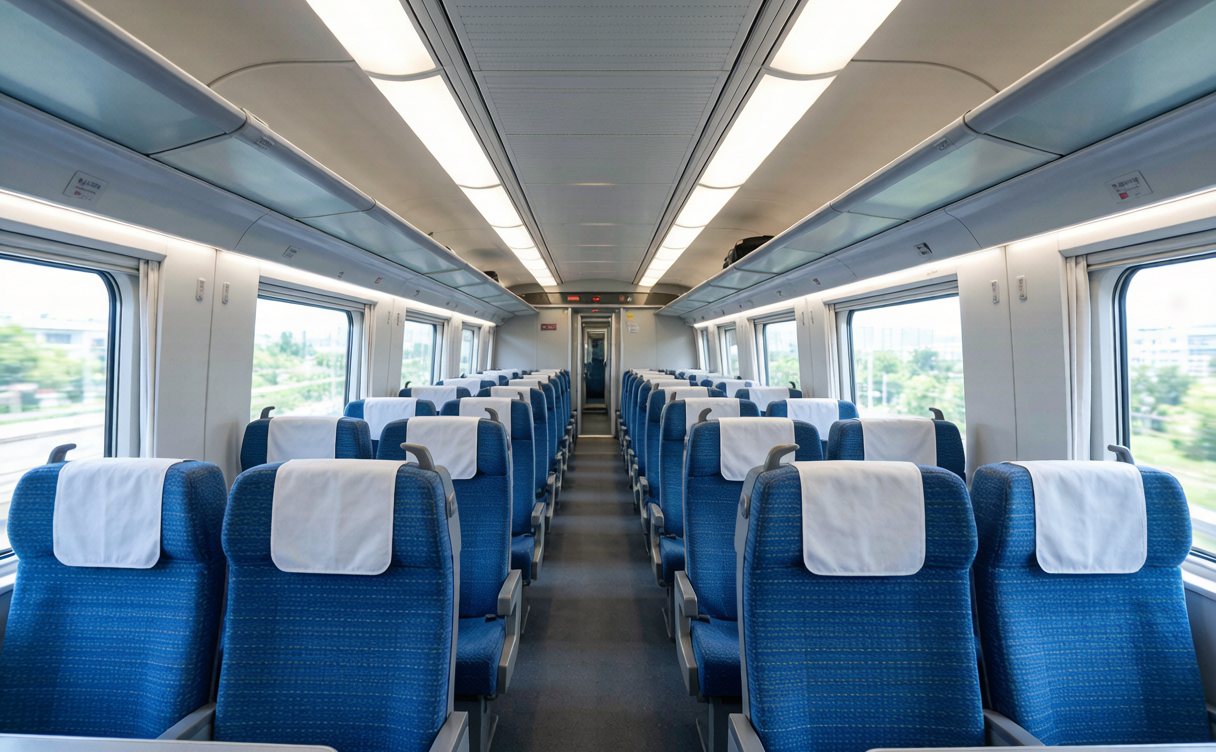
- Second class (二等座) — 3+2 layout, reclining seats, tray table, power socket. What most travellers should book. Beijing–Shanghai around RMB 550 (US$77).
- First class (一等座) — 2+2 layout, wider seats, quieter carriage. Roughly 60–70% more; Beijing–Shanghai around RMB 930 (US$131).
- Business class (商务座) — 2+1 lie-flat seats, meal included, priority lounge. Around three times second class; Beijing–Shanghai roughly RMB 1,750 (US$246).
Second class is fine for journeys up to five hours. First class earns its money on 6+ hour runs or in holiday crowds.
Sleeper Classes on Overnight Trains
- Soft sleeper (软卧) — four berths in a lockable compartment, bedding provided. The default choice for foreign travellers. Beijing–Xi’an around RMB 380–520 (US$54–73).
- Hard sleeper (硬卧) — six berths in an open bay (lower, middle, upper), no door. Clean, just communal. Beijing–Xi’an around RMB 250–330 (US$35–46).
- Deluxe soft sleeper (高级软卧) — two berths, private facilities on some services. Rare and expensive.
- Soft seat / hard seat (软座/硬座) — upright seating. Hard seat is the cheapest ticket in China and fine for a few daylight hours; avoid it overnight.
- Standing ticket (无座) — sold when seats run out on conventional trains. No guaranteed seat.
Choose a lower berth if you want to sit up in the evening, an upper berth if you want privacy and a lower price.
Overnight Sleeper Etiquette
- Lights go out around 10:00pm and come on around 6:00am. Conversations wind down at lights-out.
- Lower berths become communal daytime seating; expect compartment-mates to perch on the edge in the evening. This is normal, not rude.
- Shoes come off and go under the berth. Bring slippers or thick socks.
- Boiling water dispensers are at the carriage end — hence the instant noodles and lidded cups.
- Toilets are at the carriage ends, usually one squat and one Western. Bring tissue and hand sanitizer.
- Keep valuables in the bed with you; a cable lock for your bag is a cheap comfort.
Luggage Rules
There is no check-in or weigh-in, but limits exist: 20 kg per adult, 10 kg per child, each item’s length + width + height under 130 cm on high-speed trains and 160 cm on conventional services. Enforcement is light, but oversized items may be refused at security.
Screening also restricts lighters (limit two), matches, knives with blades over 6 cm, aerosols and alcohol above set limits, and power banks with no visible capacity marking. Sealed spirits are allowed in limited quantity; loose alcohol is not.
Storage is overhead racks, end-of-carriage racks for large cases, and behind the last row of seats — book row 1 or the last row if you have big luggage.
Food on Board
Every high-speed train has a dining car or trolley selling hot boxed meals at RMB 30–60 (US$4–8.50), plus snacks and drinks. Quality is mediocre and prices inflated, so most experienced travellers buy food at the station or bring their own. Free hot water is available on every train.
On long conventional routes, the dining car serves cooked-to-order dishes at RMB 40–90 and is a pleasant place to sit for an hour.
G or Z? Choosing for Long Routes
Under six hours, take the G. For overnight distances the decision is real:
| Factor | G train (daytime) | Z train (overnight sleeper) |
|—|—|—|
| Beijing–Xi’an | ~4.5 hr, RMB 515 second class | ~11–12 hr, RMB 380–520 soft sleeper |
| Cost of the night | Plus one hotel night | Hotel night saved |
| Daytime lost | Half a day | None |
| Sleep quality | N/A | Decent in soft sleeper, variable in hard |
| Scenery | Limited — tunnels and barriers | Dark most of the way |
The rule most travellers land on: G trains under 6–7 hours, Z sleepers for 10+ hour routes where the alternative is burning a full day. Anything between usually favours the G plus a hotel.
Practical Tips
- Book early. Tickets open 15 days ahead and popular G routes sell out within hours during holidays.
- Bring your passport. It is your ticket — the same document for booking, security and the gate.
- Arrive 40–60 minutes early at large stations; gates close 3–5 minutes before departure.
- Check the station name. Beijing South, West and Chaoyang are far apart.
- Pack a power bank with the capacity printed clearly on it.
- Bring a cup. Free boiling water makes tea and instant noodles the standard onboard meal.
FAQ
What is the difference between a G train and a D train?
G trains run at 300–350 km/h; D trains cap at 200–250 km/h and cost 15–25% less. D services also include the only modern overnight EMU sleepers. On the same route, a G is usually 30–60 minutes faster.
Are Z, T and K trains safe and clean for foreign travellers?
Yes. They’re older and busier than high-speed services, but safe, staffed, and used by tens of millions. Soft sleeper on a Z train is comfortable by any standard.
Which berth should I choose on a sleeper train?
Lower berth for comfort and easy access at the cost of shared daytime seating; upper berth for privacy and a lower price. Middle berths on hard sleeper are the least popular.
Can I buy tickets at the station or must I book online?
Both work. The official China Railway 12306 platform sells to foreign passport holders online, and station counters accept passports directly. Booking ahead is strongly advised on G routes.
Do I need to print a ticket?
No. Mainland China moved to paperless e-tickets — you scan your passport at the manual gate lane and staff verify it. Keep the booking reference on your phone as backup.
Written by Karl, last updated August 4, 2026.