

Any useful Chinese dumpling guide has to start by admitting that “dumpling” is a translation problem. In English it’s one word. In China it covers at least a dozen distinct foods with different wrappers, fillings, cooking methods, regions and mealtimes — jiaozi, baozi, guotie, shengjianbao, huntun, shumai, har gow, tangyuan. Ordering “dumplings” in Guangzhou gets you something unrecognisable from what arrives in Harbin. This guide maps the whole family: what each one actually is, how it’s cooked, which region does it best, what you should pay, and how to eat it without scalding your mouth or committing the vinegar-and-soy sacrilege that makes waiters wince.
The Dumpling Family Tree
Three variables define every Chinese dumpling: the wrapper (unleavened wheat dough, leavened dough, rice flour, or wheat starch), the fold, and the cooking method (boiled, steamed, pan-fried, or deep-fried).
Get those three right and the whole category makes sense. A jiaozi and a guotie can be the exact same dumpling — the difference is that one went into water and the other into a pan. A baozi and a shengjianbao likewise share leavened dough; one is steamed, one is fried crisp on the bottom. Regional identity then layers on top, which is where our guide to China’s eight great cuisines is a useful companion read.
The Chinese Dumpling Table
| Dumpling | Region | Wrapper / filling | How it’s cooked | Typical price |
|—|—|—|—|—|
| Jiaozi (饺子) | Northern China | Unleavened wheat; pork-cabbage, lamb, chives-egg | Boiled or steamed | RMB 20–40 / US$3–6 per plate |
| Guotie (锅贴) | Northern, nationwide | Same as jiaozi | Pan-fried, crisp base | RMB 15–35 / US$2–5 |
| Baozi (包子) | Nationwide | Leavened dough; pork, veg, red bean | Steamed | RMB 3–8 / US$0.40–1.10 each |
| Shengjianbao (生煎包) | Shanghai | Leavened dough; pork and soup | Pan-fried, crisp base, steamed top | RMB 8–16 / US$1.10–2.30 for four |
| Xiaolongbao (小笼包) | Shanghai, Wuxi, Nanxiang | Thin unleavened; pork and aspic | Steamed in bamboo basket | RMB 25–60 / US$4–8.50 |
| Guantang baozi (灌汤包) | Xi’an, Kaifeng | Thin wheat; lamb or beef and broth | Steamed | RMB 20–40 / US$3–6 |
| Huntun / wonton (馄饨) | Nationwide | Very thin square wrapper; pork, shrimp | Boiled, served in broth | RMB 12–28 / US$1.70–4 |
| Chao shou (抄手) | Sichuan | Thin wrapper; pork | Boiled, red chili oil or clear broth | RMB 15–28 / US$2–4 |
| Bian shi (扁食) | Fujian | Ultra-thin, meat-paste wrapper | Boiled in clear broth | RMB 10–20 / US$1.40–2.80 |
| Shumai (烧卖) | Cantonese and northern variants | Open-topped wheat wrapper; pork-shrimp or sticky rice | Steamed | RMB 12–30 / US$1.70–4 |
| Har gow (虾饺) | Guangdong | Translucent wheat-starch; whole shrimp | Steamed | RMB 20–38 / US$3–5.50 |
| Tangyuan (汤圆) | Nationwide, southern focus | Glutinous rice flour; black sesame, peanut | Boiled, sweet syrup | RMB 8–18 / US$1.10–2.50 |
Jiaozi: The Default Dumpling
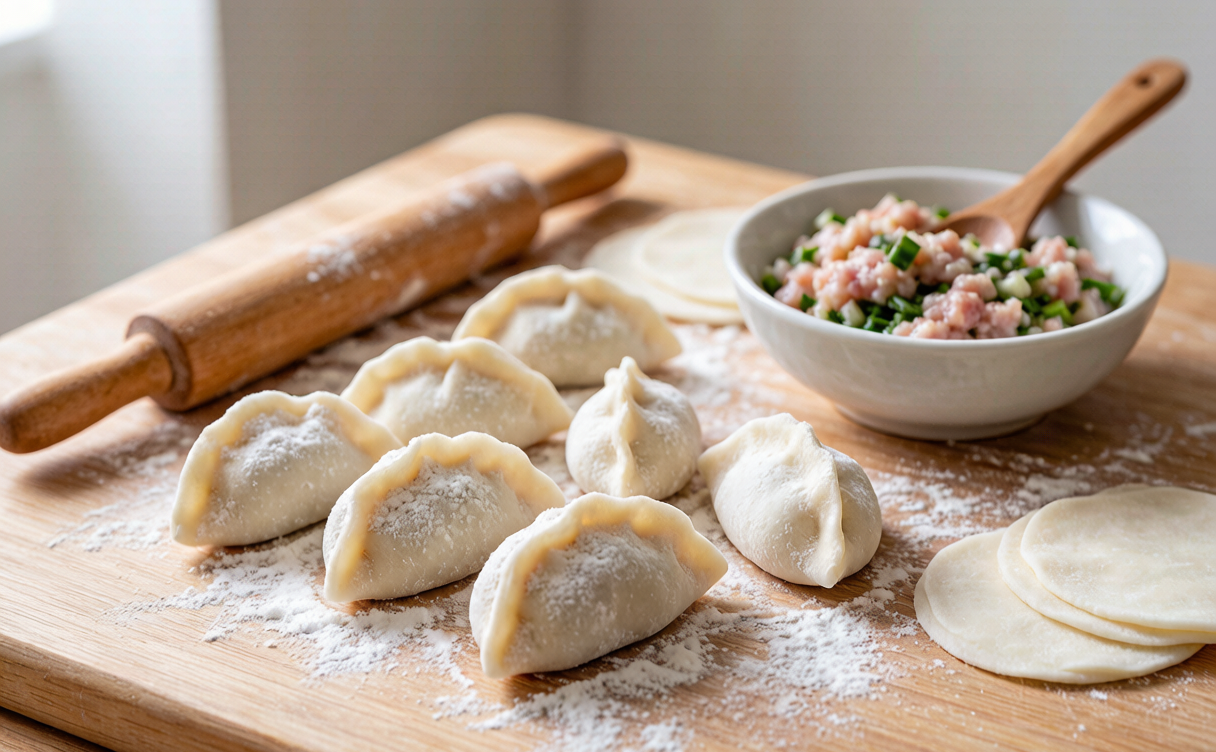
If someone in China says jiaozi, they mean a crescent-folded, unleavened-wheat dumpling, usually boiled. This is the northern staple. Standard fillings: pork and Chinese cabbage, pork and chives, lamb and carrot, egg and chives (the vegetarian default), and in coastal Shandong, mackerel or shrimp.
Boiled (shuǐjiǎo) is the classic; steamed (zhēngjiǎo) gives a firmer wrapper. Pan-fried leftovers become guotie — potstickers — with a lacquered crisp base and steamed top, served as a joined sheet you break apart.
Order by the liang (两, about 50g of dough, roughly 6–8 dumplings) or by the plate. Two liang is a light meal, three is a full one.
Baozi and Shengjianbao
Baozi are leavened, bread-like buns steamed in stacked bamboo baskets — breakfast food across the entire country, filled with pork-and-onion, mushroom-and-vegetable, or red bean paste. The larger Tianjin-style goubuli buns are their own institution. Two or three from a morning stall costs under RMB 15 (US$2).
Shengjianbao are Shanghai’s answer: the same dough, pan-fried so the bottom forms a golden crust while the top steams soft, finished with sesame and scallion. Inside is pork and a slug of hot soup. Bite a small hole first, sip, then eat.
Xiaolongbao: Keep It Brief
Shanghai’s soup dumplings deserve their own article, and we’ve written one — thin-skinned, pleated at the top, filled with pork and a gelled broth that liquefies on steaming. The essentials: lift by the pleat, never the base; rest it on the spoon; nick the side; sip the soup; then eat. The Nanxiang tradition in Shanghai and the sweeter Wuxi version are the two benchmarks. Beyond that, see our China food tour guide for the Shanghai eating route.
Xi’an and Kaifeng make a related but distinct thing: guantang baozi, soup-filled buns often with lamb or beef, thicker-skinned and more robust than the Shanghai style.
Wontons: Three Names, Three Personalities
Wontons share a very thin square wrapper and a small meat filling, but the regional versions diverge sharply:
- Huntun (馄饨) — the northern and eastern standard, served in clear broth with seaweed, dried shrimp and coriander.
- Chao shou (抄手) — Sichuan’s version, folded tighter. The famous hong you chao shou drowns them in red chili oil, sweet soy and garlic. Not a soup — a sauce dish.
- Bian shi (扁食) — Fujian’s ultra-delicate take, the wrapper sometimes made from pounded pork paste rather than flour, giving a springy, near-transparent skin.
Cantonese wonton noodle soup is a fourth branch: shrimp-heavy wontons over thin alkaline noodles in dried-flounder broth, one of the best RMB 25 meals in the south.
Shumai, Har Gow and Cantonese Dim Sum
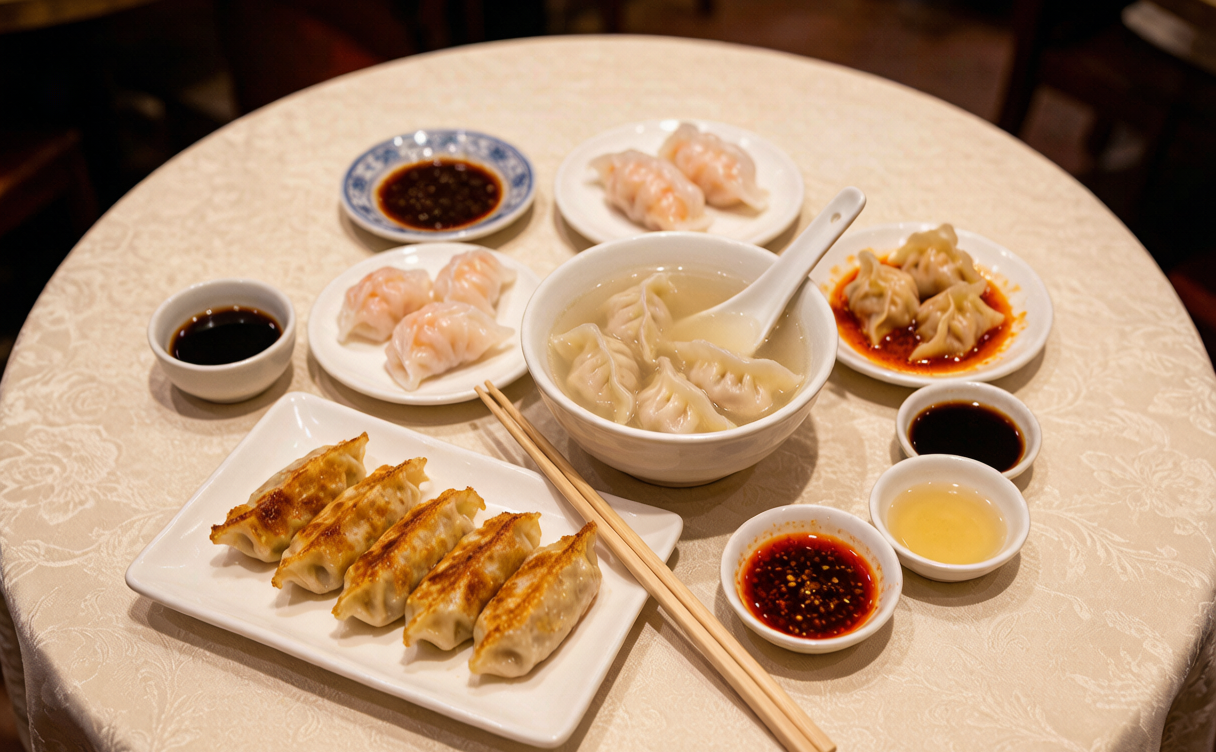
In Guangdong and Hong Kong, China, dumplings are a mid-morning social ritual rather than a meal. Har gow — the pleated translucent shrimp dumpling with at least seven folds — is the benchmark by which dim sum kitchens are judged. Siu mai (shumai) is the open-topped pork-and-shrimp cylinder, often crowned with roe. In Hohhot and northern cities, shumai means something else again: a larger, thinner-skinned parcel of sticky rice and lamb.
Dim sum runs roughly 7:00am to 2:00pm. You tick a paper order card, tea comes automatically, and tapping two fingers on the table is the silent thank-you for a refill.
Tangyuan: The Sweet Outlier
Tangyuan are glutinous rice-flour balls filled with black sesame paste, peanut or red bean, floated in a light sweet syrup or fermented rice soup. They’re eaten year-round as dessert and ceremonially at the Lantern Festival, fifteen days after Chinese New Year. The filling is molten — genuinely dangerous on the first bite. Let them sit for a minute.
Northern Dumpling Culture and Chinese New Year
In the northeast — Harbin, Shenyang, Changchun — dumpling-making is a household event, not a purchase. Families roll wrappers and fold together, and a table of fifty freshly boiled jiaozi with vinegar and raw garlic is a standard winter dinner.
At Chinese New Year, northern families eat jiaozi at midnight because the crescent shape resembles ancient silver ingots and the name puns on the changing of the hour. Some hide a coin in one dumpling for luck. Southern families more often eat tangyuan instead — a persistent north/south food divide.
How to Order and How to Eat
Ordering. Most shops have picture menus or a paper tick-sheet. Say the number of liang or plates, pick a filling, and specify boiled (zhǔ), steamed (zhēng) or fried (jiān). Vegetarians should ask for sù (素) fillings and confirm the broth isn’t pork-based.
Dipping. The northern default is black vinegar (Zhenjiang or Shanxi) with slivered ginger, plus chili oil to taste. Soy sauce alone drowns the filling. Mix your own: roughly two parts vinegar to one part chili oil.
Eating. Soup-filled dumplings get the bite-sip-eat sequence. Everything else goes in whole, or in two bites with the spoon underneath to catch juices.
Where Each Region Does It Best
- Northeast (Harbin, Shenyang) — boiled pork-and-cabbage jiaozi, thick-skinned and generous.
- Shandong (Qingdao, Jinan) — seafood jiaozi, especially mackerel and shrimp.
- Beijing — the all-rounder: jiaozi shops, guotie, and northern-style shumai.
- Xi’an — lamb-filled dumplings and the dumpling banquet, a multi-course parade of shaped dumplings.
- Shanghai — shengjianbao and xiaolongbao.
- Sichuan (Chengdu, Chongqing) — red-oil chao shou.
- Guangdong — har gow, siu mai and the full dim sum repertoire.
- Fujian (Fuzhou, Xiamen) — bian shi and fish-paste dumplings.
Practical Tips
- Order fewer than you think. Three liang of jiaozi is a full meal for one.
- Mix your own dip. Vinegar-forward, chili to taste; the bottles are on the table for a reason.
- Wait 60 seconds. Every soup-filled dumpling is hotter than it looks.
- Eat baozi for breakfast, jiaozi for lunch or dinner, dim sum before 2pm. Timing signals matter.
- Watch for the fold. Handmade dumplings have irregular pleats; perfectly identical ones are usually frozen.
- Cash or QR. Small dumpling shops take Alipay and WeChat Pay; keep RMB 50 in notes as backup.
FAQ
What’s the difference between jiaozi and wontons?
Jiaozi have a thicker unleavened wrapper, more filling, and are eaten with a dipping sauce. Wontons have a very thin, floppy wrapper, less filling, and are served in broth or sauce as a soup dish.
Are dumplings vegetarian-friendly in China?
Reasonably. Egg-and-chive, mushroom, and three-vegetable jiaozi are widely available, and vegetarian baozi are standard breakfast items. Always confirm the broth and check that “vegetable” fillings aren’t cooked with lard.
How much do dumplings cost in China?
A plate of 10–15 jiaozi runs RMB 20–40 (US$3–6). Baozi are RMB 3–8 each. Dim sum baskets are RMB 20–38 each, so a two-person dim sum meal lands around RMB 150–250.
Should I use soy sauce or vinegar with dumplings?
Vinegar, primarily. Black rice vinegar with a little chili oil and shredded ginger is the northern standard; soy sauce is used sparingly if at all. Official city tourism resources like Visit Beijing list traditional dumpling houses if you want to try it done properly.
When is the best time to eat dumplings in China?
Year-round, but winter is dumpling season in the north, and Chinese New Year is when the tradition peaks. Our best time to visit China guide explains how the holiday affects travel and restaurant openings.
Written by Karl, last updated August 4, 2026.