

The first time I visited Beijing Beihai Park, it was a gray Wednesday in early November. I had already done the Forbidden City the day before and was suffering from what I now call “imperial overload” — too many courtyards, too many dynasties, too much marble. I almost skipped Beihai. Big mistake. Within ten minutes of walking through the south gate, I was standing on the shore of a vast lake watching an old man drift past in a paddle boat shaped like a swan, steam from a thermos curling into the cold air, and a white stupa glowing on the island across the water. That tiny scene — quiet, everyday, and utterly beautiful — is the real Beihai. Not a checklist of sights, but a place where Beijingers have come to breathe for almost nine hundred years.
If you’re planning your Beijing trip and want at least one attraction where you can actually slow down, this is it. Here’s everything I learned, including what I’d do differently.
What Is Beihai Park, Really?
Beihai (北海, literally “North Sea”) is one of the oldest, best-preserved imperial gardens in China. It was built in the 12th century during the Jin dynasty and expanded by the Yuan, Ming, and Qing emperors who used it as a private retreat. The layout follows a classic Chinese garden principle: a large lake (the “sea”) with an island at its center, representing the mythical Mount Penglai where immortals were said to live. The White Dagoba on Jade Flower Island is the mountain; the water around it is the sea.
What makes it special for visitors isn’t just age. It’s that the park is still alive. At 6:30 a.m. you’ll find retirees practicing tai chi on the causeway. At noon, families rent boats. At dusk, couples walk the willow-lined eastern shore. It never feels like a museum frozen in time — it feels like a garden that an emperor happened to love, and the city kept using.
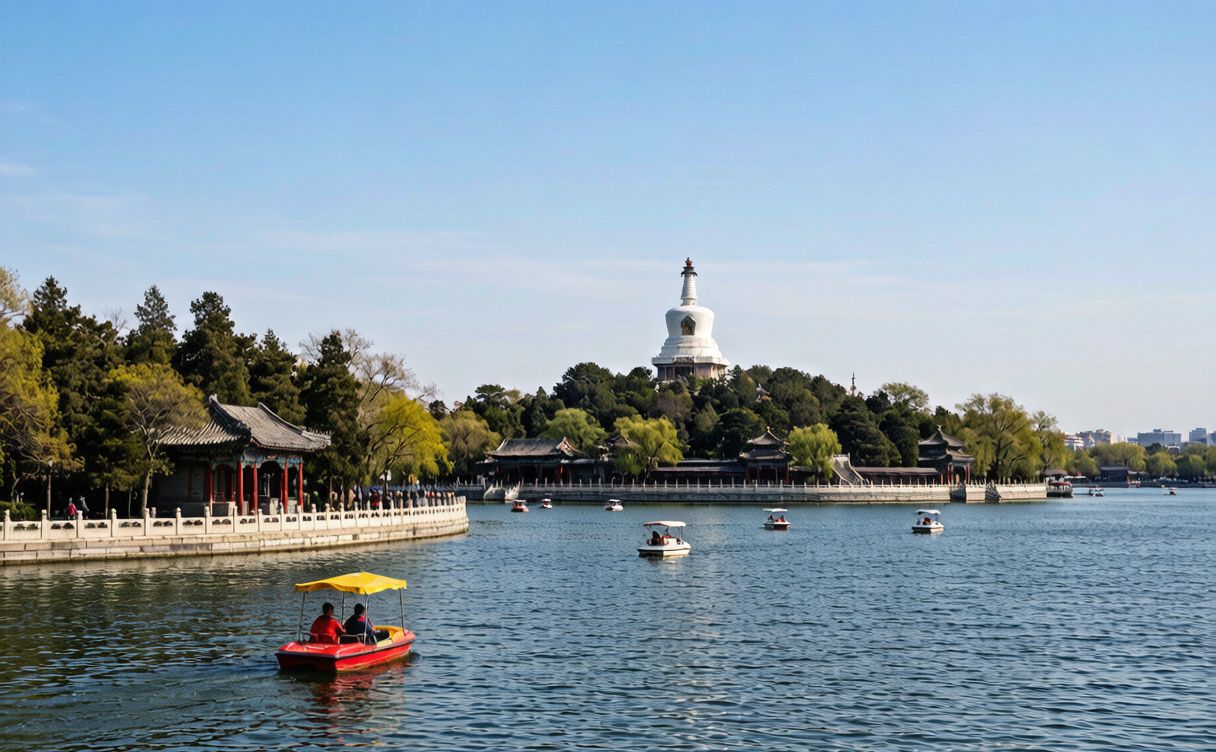
The White Dagoba (白塔)
You’ll see the dagoba long before you reach it — a 35-meter white stupa sitting on top of Jade Flower Island (Qionghua Dao), visible from the Forbidden City’s rooftops and from Jingshan Hill. It was built in 1651 by Emperor Shunzhi to honor visits by the Fifth Dalai Lama, and it remains the park’s defining silhouette.
To get there, you climb a steep, winding stone path lined with carved railings and small pavilions. Take your time. The path is the experience — glimpses of the lake open up between the trees, and near the top there’s a terrace where half of Beijing seems to be taking photos of the other half. At the summit, the dagoba is deceptively simple: a pure white dome with a gilded spire, flanked by two smaller white structures. You can’t go inside, but you don’t need to. The view back across the water toward the city is the payoff.
A practical note: the climb is short but steep, and the stone steps get slippery after rain or snow. Wear real shoes, not the fancy ones you saved for dinner.
Boating on the Lake — Don’t Skip This
Boating is, for me, the single best thing to do in Beihai, and the thing most first-time visitors underrate. The lake is enormous — about 39 hectares of water — and from a boat the park rearranges itself into something cinematic. You paddle under the bridge, circle the island, and look up at the dagoba from water level, where the emperors once floated in dragon-shaped barges.
Two options:
– Pedal boats — slow, silly, perfect for couples or families. About 60–80 RMB per hour.
– Electric boats — easier if you don’t want a workout, and they hold more people.
Boats operate roughly April through October, weather permitting, and they stop renting out an hour or two before the park closes. Go early or late in the day to avoid the midday scramble. I rented a swan boat at 4 p.m. in autumn and had the western half of the lake nearly to myself, with the sun dropping behind the willows. That hour alone justified the whole trip.
Must-See Corners Most Guides Miss
Beyond the dagoba and the boats, a few spots are worth your footsteps:
The Nine-Dragon Screen (九龙壁)
A 27-meter glazed-tile wall with nine coiling dragons, built in 1756. It’s smaller than the famous one in Datong but easier to reach, and the craftsmanship up close is stunning. Get there before 10 a.m. if you want a clean photo without a tour group in front of it.
Circular City (团城)
Tucked into the southwest corner near the main entrance, this tiny walled enclosure holds a 1.5-ton jade vase and an ancient canopy tree said to be over 800 years old. Most people walk straight past the gate. Don’t. It takes fifteen minutes and feels like a secret.
Five-Dragon Pavilions (五龙亭)
A row of five connected pavilions on the northwest shore where emperors fished and watched fireworks. At sunset the light turns them gold. I sat there for an hour doing nothing, which is exactly the point of this park.
Hao Pu Jian (濠濮间)
A quieter garden-within-the-garden in the northeast, built around a small pond and rockery. If the main loop feels crowded, escape here.
How to Pair Beihai With the Forbidden City and Jingshan
Beihai sits just northwest of the Forbidden City, and the three form a natural walking triangle. My recommended sequence:
- Morning: Enter the Forbidden City from Tiananmen Square, exit from the north (the Gate of Divine Prowess / 神武门).
- Cross the street to Jingshan Park, climb the hill (ten minutes) for the classic panorama over the Forbidden City’s golden roofs.
- Walk west along Jingshan Qianjie for five minutes, and you’re at Beihai’s east gate.
This is the single most efficient half-day in central Beijing, and it avoids backtracking. If you’re building a bigger plan, our Beijing 3-day itinerary strings this together with the Summer Palace and the Great Wall.
Tickets, Hours, and Getting There
- Opening hours: roughly 6:30 a.m. – 8:00 p.m. in summer, 6:30 a.m. – 7:00 p.m. in winter. The gardens open earlier than the enclosed sights (dagoba, Nine-Dragon Screen), so an early walk is free of the paid-attraction crowds.
- Tickets: around 10 RMB in low season, 20 RMB in peak season, plus small separate fees for the Circular City and a few pavilions. Buy at the gate or through official channels. Check the official Beihai Park site for current prices and any holiday closures.
- Getting there: Subway Line 6 to Beihai North (北海北), Exit B, is the easiest — a two-minute walk to the north gate. Lines 4 and 8 also get you close. Taxis and ride-hailing drop you at the south or north entrance.
A word on timing: Beihai is lovely in every season, but it’s at its most crowded on weekends and Chinese public holidays. If your dates are fixed, see our best time to visit Beijing guide for month-by-month crowd and weather notes.
When to Go (and What to Wear)
Spring brings willow catkins and blossoms; summer means lotus flowers on the lake and long evening light but real heat and crowds; autumn (late September–early November) is my favorite — crisp air, blue skies, and the dagoba glowing against red leaves; winter turns the lake still and the park hushed, occasionally with light snow that makes the white stupa disappear into the sky.
Dress for the season and for walking. The park is large, and you’ll cover 3–5 km comfortably if you do the full loop. Comfortable shoes, water in summer, and a windproof layer in winter when the lake wind bites.
What to Eat Nearby
You’re in the heart of Beijing’s hutong district, so food is easy. Just east, the Peking duck restaurants around the nearby Shichahai and Houhai lakes are a short ride away — Beihai itself isn’t the duck zone, but those lakes are lined with restaurants and bars. For a quick bite, the streets south of the park have noodle shops and baozi stalls where you can eat for under 30 RMB. I had a bowl of zhajiangmian (fried sauce noodles) at a hole-in-the-wall near the south gate that beat several “famous” restaurants I’d paid three times as much for.
How Beihai Compares to Other Beijing Gardens
Beijing has several imperial gardens, and they’re not interchangeable. The Forbidden City guide covers the palace itself — awe-inspiring but exhausting. The Summer Palace guide is Beihai’s bigger, grander cousin, with an even larger lake, best saved for a half-day of its own. The Temple of Heaven guide is more about ceremony and open courtyards than water. Beihai sits in the sweet spot: compact enough for two hours, watery and relaxed enough to actually enjoy, and right in the center.
If you only have time for one garden in Beijing, make it Beihai. If you have two, add the Summer Palace. The things to do in Beijing list has the rest ranked by how I’d prioritize them.
My Honest Tips After Three Visits
- Go early. The park at 7 a.m. belongs to locals; by 10 it belongs to everyone else. The difference is night and day.
- Rent the boat even if you’re alone. It’s the fastest way to feel the scale of the place, and the photos are unbeatable.
- Don’t drive the full loop on foot if it’s hot. Do the east shore, the island, and the north pavilions, then bail. Quality over quantity.
- Bring cash as backup. Most entrances take mobile pay, but small boat-rental kiosks can be finicky, so keep a little cash on hand.
- Pair it, don’t isolate it. Beihai is best as the relaxed finale to a Forbidden City + Jingshan morning.
Final Thought
Beijing can feel like a city of gates and queues and “must-sees.” Beihai Park is the place where that pressure lifts. You don’t conquer it; you drift through it. You sit on a rock, watch a paddle boat, and for a moment you’re sharing a habit with everyone from a Jin-dynasty emperor to the retired tai chi group that meets at the same bench every morning. That, more than any single sight, is why Beijing Beihai Park earned a permanent spot on my return list.