

I almost skipped the Big Wild Goose Pagoda on my first trip to Xi’an. I’d come for the Terracotta Army, the city wall, the noodles — and a 1,300-year-old brick tower sounded like one more thing to tick off. I was wrong, and I admit it now from the north plaza, where I ended up on three separate evenings because I couldn’t stop watching the water.
Here’s the thing about the Big Wild Goose Pagoda (Dayan Ta, 大雁塔): it’s not just a tower. It’s the place where one of the most important journeys in human history landed. A monk named Xuanzang walked out of here in the 7th century and came back years later with a cartload of Buddhist scriptures — the real-life inspiration for the “Journey to the West” legend you’ll see referenced all over China. The pagoda was built to store and translate those texts. Stand at its base and you’re standing at the endpoint of the Silk Road’s great intellectual exchange.
If you’re planning your China trip, the pagoda pairs naturally with the other Xi’an essentials — our Xi’an travel guide covers how to string it together with the warriors and the Muslim Quarter, and if this is your first time in the country our China travel guide for first-timers is the place to start.
A little history (the part worth knowing before you go)
The pagoda was commissioned in 652 CE by Emperor Gaozong, originally to hold the sacred sutras and relics that Xuanzang had brought back from India. Xuanzang himself supervised the early translation work here, and the site grew into the Da Ci’en Temple (大慈恩寺), one of the most important monasteries of the Tang dynasty.
A few details that make the visit richer:
- The tower was rebuilt in brick in 704 CE after an earlier version began to lean and crack — what you climb today is essentially that Tang-era rebuild, extraordinary for something 1,300 years old.
- It’s a square, seven-story pagoda about 64 meters tall, built in the Indian-style stupa tradition but executed with Chinese brickwork. No interior staircase spiral like a European tower — you climb a series of tight, steep flights between the stories.
- The famous “lean”? The pagoda does tilt slightly, though far less dramatically than its legend suggests. Locals will tell you it leans toward the west, toward the direction Xuanzang traveled. It’s a good story; the real cause was centuries of groundwater and foundation settling.
What I found most moving wasn’t the architecture — it was the sense of arrival. Xuanzang’s journey took him roughly 17 years and covered tens of thousands of kilometers on foot and horseback across some of the harshest terrain in Asia. The pagoda is where that whole odyssey came to rest.
Climbing the pagoda: is it worth the steps?
Short answer: yes, if you’re reasonably mobile and don’t mind tight stairs. The climb is the only way to get above the surrounding trees and plaza for a real view, and the upper-floor windows frame the city in a way the ground never does.
Practical notes from my climb:
- Ticket for the pagoda climb runs about ¥50 on top of the temple entry. The temple grounds themselves cost around ¥50 too, so budget roughly ¥100 all-in if you want both. Prices shift with season, so confirm at the gate.
- The stairs are narrow and steep — single-file, with low headroom on the upper levels. If you’re tall, duck. If you have knee or mobility issues, the climb is genuinely tough and the view from the base plaza is still rewarding.
- Go up in the late afternoon. You’ll catch the warm light on the brick, and if you time it right you’re at the top when the north plaza fountains switch on below — more on that in a second.
- There’s nothing much inside each floor except the structure and the windows. Manage expectations: this is about the ascent and the view, not exhibits.
I climbed once at midday (fine) and once about an hour before sunset (magical). The second time, I watched the whole plaza below transform from a quiet square into a choreographed wall of water and light. That’s the moment the pagoda earns its spot on your itinerary.
The north plaza music fountain: the real reason to stay for evening
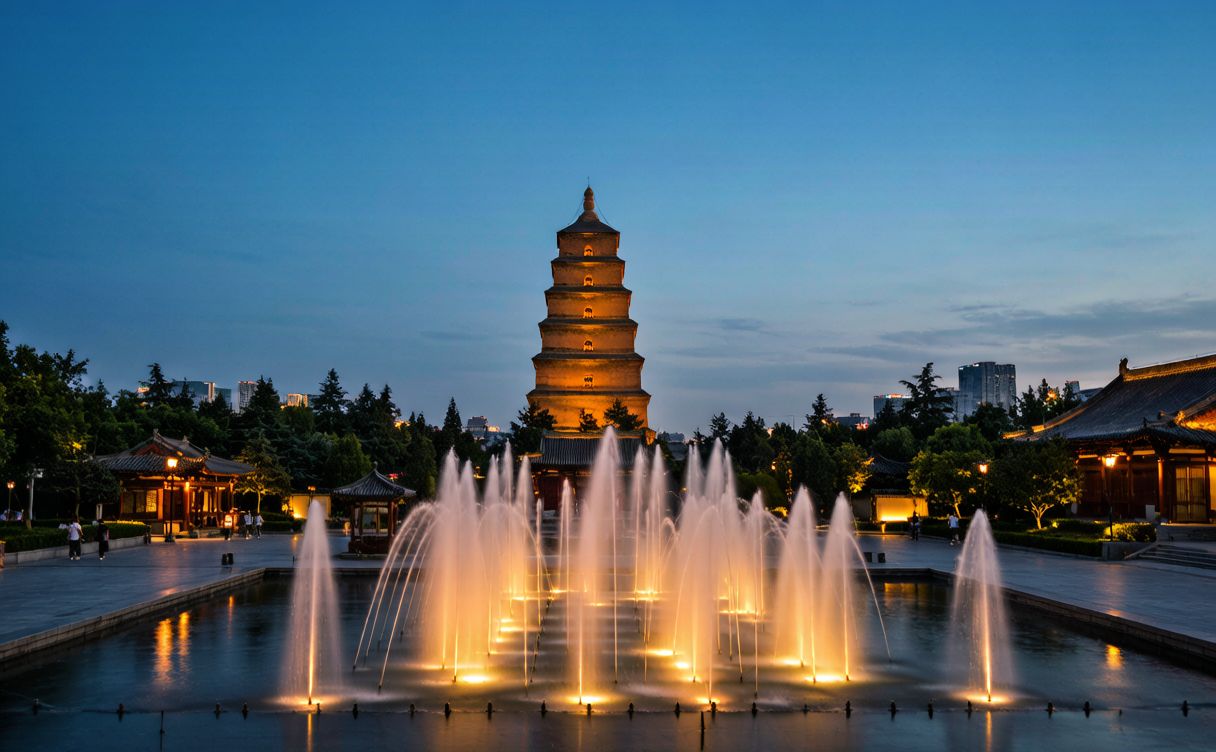
I’ll be blunt — the Big Wild Goose Pagoda North Plaza musical fountain is the largest of its kind in Asia, and it is gloriously, unironically fun. Rows of jets shoot synchronized water dozens of meters into the air while speakers pump out everything from “Ode to Joy” to Chinese folk tunes, and the pagoda glows behind it all. It sounds cheesy on paper. In person, surrounded by a few thousand smiling locals, it just works.
Show timing (roughly — verify on the day, as schedules shift seasonally):
- Daytime shows are shorter, often a single 20-minute performance around midday.
- Evening shows are the big ones, usually around 8:30–9 p.m. in summer, sometimes with two rounds. Get there 20–30 minutes early to find a spot with a clear view of the pagoda behind the water.
- Best vantage: the raised edges of the plaza, or simply stand back near the pagoda’s own viewing terrace after descending.
Bring nothing you mind getting lightly misted — the front rows get soaked, which is half the fun for the kids there. It’s free to watch from the plaza; you only pay if you enter the temple or climb the tower.
Da Ci’en Temple: the quiet half most visitors rush through
Most people treat the temple grounds as a corridor to the tower, which is a mistake. Da Ci’en Temple is a working monastery with several halls, peaceful courtyards, and fewer crowds than the plaza out front. Spend 20–30 minutes here and the pagoda means more.
What to look for:
- The main hall with its gilded Buddhas, usually busy with worshippers — incense smoke, chanting, the works. It’s a real place of practice, not a stage set.
- The scripture stele and Xuanzang relics areas, which tie the whole site back to the monk who made it matter.
- Quiet side courtyards where you can actually hear yourself think, a rarity in a city this loud.
Dress modestly (shoulders and knees covered) and keep your voice down near the halls. Photography is fine in the open courtyards but be discreet inside active worship spaces.
Getting there, and how it fits your Xi’an days
The pagoda sits in the southern part of the city, in the Yanta district, about 40–50 minutes from the Terracotta Army site and a short metro ride from the old city center. Take Metro Line 3 or 4 to Dayanta Station (大雁塔站) — the exits feed you right into the plaza area. A Didi or taxi will also drop you at the north or south gate.
A realistic half-day plan:
- Late afternoon: enter Da Ci’en Temple, climb the pagoda before closing.
- Walk the south gardens, then cross to the North Plaza.
- Grab dinner nearby (the area south of the plaza has solid Shaanxi noodle shops) and settle in for the evening fountain show.
If you’ve already done the Terracotta Army, this is the perfect low-effort evening — no overheating, no long drives, just a temple, a tower, and a water show. For the warrior visit itself, our Terracotta Warriors guide has the timing tricks that keep you ahead of the tour buses.
Getting to Xi’an in the first place is easy by rail — our high-speed train guide for foreigners walks through booking and riding China’s network, and it’s the most comfortable way to arrive from Beijing or Chengdu. For budgeting the whole stop, our China travel budget per day breakdown helps you estimate what the pagoda, temple, and a good bowl of biang biang noodles will actually cost.
When to visit (and when to avoid)
Xi’an’s climate is continental — hot, dry summers and cold winters. The pagoda is a year-round sight, but the experience changes:
- Spring (April–May) and autumn (September–October) are the sweet spots: comfortable temperatures, clear skies for the tower views, and pleasant plaza evenings. This lines up with the general advice in our best time to visit China overview.
- Summer evenings are sticky but the fountain show is at its most energetic, with the latest show times.
- Winter is cold and the plaza fountains may run on reduced schedules, but you’ll have the temple nearly to yourself — a fair trade if you dislike crowds.
- Avoid Chinese public holidays (National Day in early October, Spring Festival) if you can. The plaza becomes a solid mass of people and the climb queue stretches badly.
A few things I wish I’d known
- Toilets are decent inside the temple complex but sparse in the open plaza — use them before the show starts.
- The South Plaza (behind the pagoda) is calmer and has a small sculpture park and the “Xuanzang statue” — good for photos without the fountain crowds.
- Audio guides at the gate are hit or miss in English; a little pre-reading (like this) goes further than the rented device.
- Combine with nearby Tang Paradise (Datang Furong Yuan) if you want a second evening spectacle — a reconstructed Tang-dynasty theme park with its own light show, a short ride east.
The bottom line
The Big Wild Goose Pagoda won’t bowl you over the way the Terracotta Army does. What it gives you instead is context — the human story of a monk who walked half of Asia and came home, and a tower built to keep what he carried safe. Climb it for the view, wander the temple for the calm, and stay for the fountain show because you’ll be smiling whether you planned to or not.
It’s free to stand in the plaza and watch the water. The tower climb is the only real expense, and on a clear evening it’s worth every steep, duck-your-head step.
The Big Wild Goose Pagoda is part of the UNESCO-listed Silk Roads: the Routes Network of Chang’an-Tianshan Corridor, a World Heritage Site recognizing the routes that carried ideas, goods, and people between China and the wider world — the very exchange Xuanzang’s journey embodies. You can read the official listing from UNESCO.