

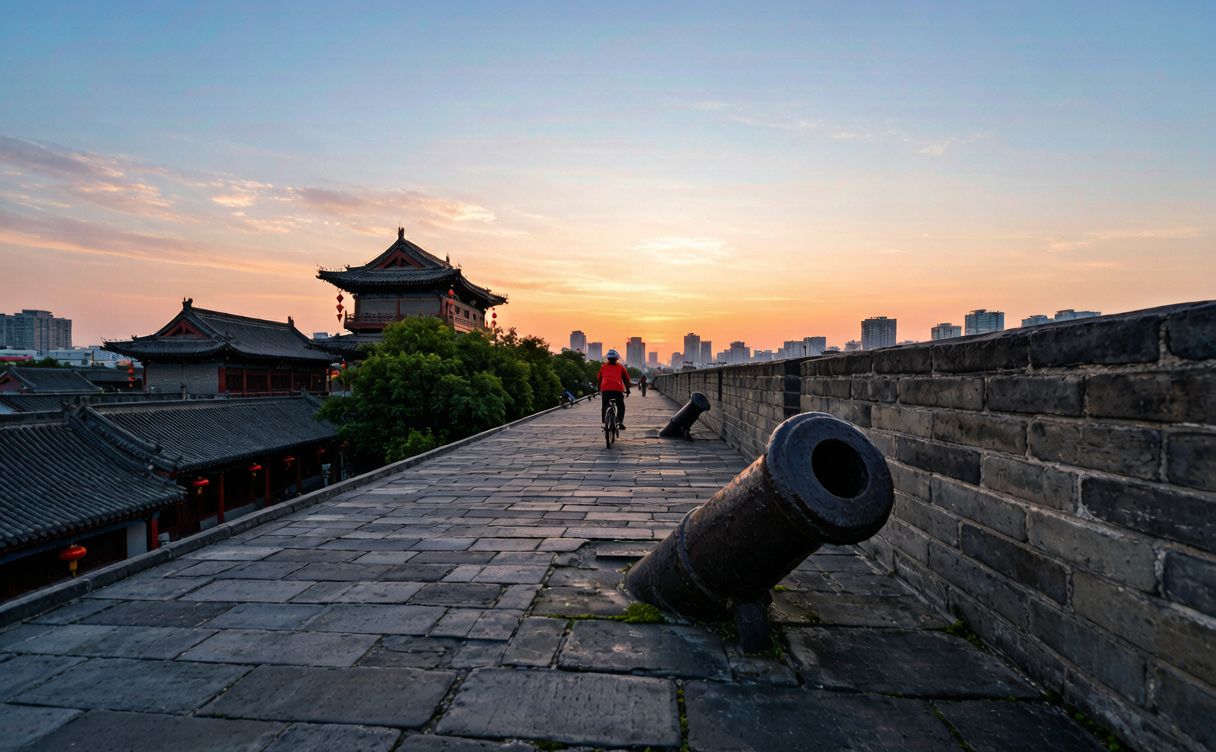
The first time I stood on top of the Xi’an City Wall, I had just come down from the Terracotta Army and expected another dusty tourist stop. Instead I found myself alone on a 12-meter-wide rampart, looking out over a moat so still it mirrored the rooftops, with the modern city humming just beyond the bricks. This isn’t a ruin behind a rope. Xi’an City Wall is a complete, rideable circuit — 13.7 kilometers of Ming-dynasty fortification wrapped around the old city center, wide enough on top to cycle, walk, or just lean on the parapet and watch the light change. It is, quite literally, the best-preserved ancient city wall left in China, and spending a couple of hours up there was the moment Xi’an stopped feeling like a list of sights and started feeling like a place.
A little history before you climb
The wall you ride today was built in the late 14th century, during the early Ming dynasty, on top of the foundations of the Tang-dynasty imperial capital that came before it. When Zhu Yuanzhang, the founding emperor of Ming, took the city then called Chang’an, he fortified it heavily — and the result is what survived. The rectangle he enclosed is almost perfectly aligned: about 3.4 km from east to west and 2.6 km from north to south, with a total perimeter of 13.7 km.
What makes it remarkable isn’t just age. It’s the completeness. Most Chinese city walls were torn down in the 20th century as cities modernized — Beijing’s were pulled down in the 1960s. Xi’an’s was spared, restored in patches over the last few decades, and is now a continuous loop you can traverse end to end. The structure is a sandwich of packed earth and grey bricks, 12 meters wide at the top (wide enough for two lanes of bikes), 15–18 meters wide at the base, and roughly 12 meters tall. A deep moat runs outside it, and four main gates punch through each side.
If you want the deeper context on the city this wall enclosed, our Xi’an travel guide lays out the whole itinerary — warriors, wall, and Muslim Quarter — in one read.
The four main gates (and why the South Gate is the star)
The wall has four great gates, one at the midpoint of each side, and each was serious military engineering — a tower, an archery tower, and a barbican courtyard between them where attackers could be trapped.
- South Gate — Yongning Gate (永宁门): This is the one everyone photographs and the one you should start from. “Yongning” means “eternal peace,” and it’s the oldest and most restored of the gates, with a proper barbican, a tower you can climb, and an evening light-and-fountain show in the square just outside. It’s also the most convenient entry if you’re staying in the old city.
- East Gate — Changle Gate (长乐门): “Everlasting joy.” Quieter than the south, good if you want to start a loop without the crowds.
- West Gate — Anding Gate (安定门): “Stability and peace.” A calmer entry on the less-touristed side.
- North Gate — Anyuan Gate (安远门): “Peace to the far reaches.” Handy if you’re coming from the train-station side of town.
There are also smaller arched gates at the corners and midpoints (like the Wumen and Hanguang gates), but the four main gates are where you’ll rent bikes and buy tickets.
Cycling the wall: the main event
Walking the full loop is possible but takes 3–4 hours. Cycling is the move, and it’s the experience the wall is famous for. Rentals are available at each main gate, and a standard bike runs about 45 RMB for the single and a bit more for a tandem or an electric cart pass. You get the bike, a helmet, and a time window — but here’s the catch beginners miss: you must return the bike to the same gate you rented it from, and the gates close (around 10 p.m. in summer, earlier in winter). Plan your loop so you’re back before closing, or you’ll be walking your bike down the nearest stair and finishing on the street.
The full 13.7 km loop takes about 1.5 to 2 hours if you keep pedaling, longer if you stop for photos every few minutes — which you will. The surface is smooth, flat, and lined with low lamp posts, with a constant gentle breeze you don’t feel at street level and almost no traffic except other cyclists.
A practical note from my own ride: I started at Yongning Gate around 5:30 p.m. in late April. The west and north stretches caught the last warm light, the moat turned gold, and by the time I rolled back to the south gate the city lights were on and the gate tower was lit like a postcard. That timing — late afternoon into dusk — is the single best decision I made in Xi’an.
If your legs aren’t up for it, electric carts run a circuit with hop-on hop-off stops at each gate, and they’re a perfectly good way to see the whole wall from above without the pedaling.
The best sections and the best times
Not all 13.7 km is equal, and you don’t have to do the whole thing to get the experience.
Best section for first-timers: The south and east stretches, starting from Yongning Gate. This is the most photogenic — the gate towers, the moat, and the Bell Tower poking up in the distance. If you only have an hour, rent at the South Gate, ride east to the corner, and come back.
Best section for quiet: The west and north sides are noticeably calmer, especially on weekday mornings. Fewer tourists, more locals out for a stroll, and better views back toward the city’s everyday life rather than its postcard angles.
Best time of day: Late afternoon to sunset, hands down. Midday in summer is hot and glary with no shade on the open ramparts; early morning is lovely and empty but the light is flat. Golden hour turns the grey bricks warm and gives you the lit-up gate towers as a finale.
Best time of year: Spring (April–May) and autumn (September–October) are ideal — mild, clear, and good for cycling. Our best time to visit China guide breaks the national crowd calendar down month by month. Winter is cold but nearly empty and atmospheric after a dusting of snow. Avoid the big holidays — National Day (early October) and Spring Festival — when the bike queues at the South Gate stretch out.
Getting up on the wall (tickets & access)
Entry to the wall is via stairs or ramps at the main gates, and your ticket covers walking the ramparts (cycling is a separate bike-rental fee on top). As of the 2025–2026 season, the standard adult ticket is around 54 RMB, with reduced rates for students and children; prices and hours shift a little by season, so confirm on the official Xi’an City Wall scenic area site before you go. Opening hours are typically around 8:00 a.m. to 10:00 p.m. in summer and a bit shorter in winter, and the last bike rentals stop an hour or two before closing.
You can enter and exit at different gates on foot — only the bikes need to come back to the start. That makes it easy to combine with the street-level sights: climb up at the South Gate, ride or walk a stretch, then come down near the Bell Tower or the Muslim Quarter for dinner.
If you’re pairing the wall with the warriors, our Terracotta Warriors visit guide has the timing that lets you do both in one well-paced day — army in the morning, wall at golden hour.
What to bring and how to survive it
A few things I wish someone had told me:
- Water. There’s almost no shade up top and only occasional vendors. Carry a bottle, especially May–September.
- A light layer. Even on warm days the wind on the ramparts drops the temperature a few degrees, and dusk gets cool fast.
- Your phone or a real camera. The photo opportunities are constant — the gate towers, the moat, the corner bastions, and the city beyond.
- Cash or Alipay/WeChat. Bike rental and tickets at the gate take cards and mobile pay, but keep a little cash for the street stalls below. If you haven’t set up mobile pay yet, our SIM and eSIM guide for tourists covers the data side so your maps work up on the wall.
- Your passport. Hotels and some ticket counters check it; keep it handy for the day.
Fitting the wall into your Xi’an trip
Most travelers reach Xi’an by high-speed train — Beijing to Xi’an North takes about 4.5 hours, and the G-trains are comfortable and frequent. Our high-speed train guide for foreigners explains the passport-ID booking rules so you’re not caught out at the gate. From Xi’an North, the metro or a DiDi ride drops you inside or just outside the wall in 20–30 minutes.
A realistic one-day Xi’an plan: Terracotta Army in the morning (arrive at opening), late lunch, then the City Wall from mid-afternoon into dusk, and the Muslim Quarter for dinner right after you come down. If you’re new to the country entirely, our China travel guide for first-timers builds the whole trip from the ground up.
Why it stuck with me
I’ve been on a lot of walls — sections of the Great Wall outside Beijing, the French Concession’s old boundaries in Shanghai. None of them feel like this. The Xi’an City Wall isn’t a monument you observe from a distance; it’s a surface you move across, 600 years of fortification under your wheels, with a living city on both sides. Ride it at the right hour and you get the whole story in one loop: the imperial past in the gate towers, the everyday present in the streets below, and the future glowing just beyond the moat.
Go early enough to beat the heat, late enough to catch the light, and bring a friend or a tandem if you can. It’s the cheapest great view in Xi’an, and the one I’d tell any first-time visitor not to skip.
This guide was written by Karl, based on personal rides around the Xi’an City Wall across multiple trips. Ticket prices and opening hours change by season — always confirm with the official Xi’an City Wall scenic area before you travel.