

Most visitors to Beijing tick the Great Wall and the Forbidden City off their list and head home thinking they’ve seen imperial China. I made that mistake on my first trip too. Then, on a second visit, I cycled past a procession of stone animals guarding an empty road that seemed to lead straight into the hills — and I finally understood the Beijing Ming Tombs. This is where thirteen of the Ming dynasty’s sixteen emperors were laid to rest, a sprawling necropolis of marble and silent valleys that feels nothing like the crowded palaces in town. If you want to see the dynasty at its most contemplative — and escape the tour buses for an hour — the Ming Tombs (明十三陵, Shisanling) deserve half a day. Here’s how I’d visit them and how to string them together with the Great Wall.
Key Takeaways
– Thirteen imperial tombs sit in a 40-square-kilometer valley about 50 km northwest of central Beijing, but only three are open to visitors: Changling, Dingling, and Zhaoling.
– The Sacred Way (神道) is the must-see for everyone — a 7 km approach lined with 18 pairs of stone statues and the Dragon and Phoenix Gate.
– Dingling is the only tomb you can actually enter, via a steep staircase down to the underground palace chambers where the Wanli Emperor and two empresses rest.
– Get there early or late. Most tour groups arrive around 10:30 a.m. and clear out by 2 p.m., so the edges of the day are gloriously quiet.
– Pair it with the Great Wall at Badaling, 8 km north — the two are an easy same-day loop, and I explain the route below.
What Are the Beijing Ming Tombs?
The Ming dynasty ruled China from 1368 to 1644. Its third emperor, Yongle — the same man who moved the capital to Beijing and built the Forbidden City — chose this valley as the royal burial ground in 1409. Over the next two centuries, thirteen emperors, twenty-three empresses, and a small army of concubines and princes were interred here. The other three Ming emperors rest elsewhere: one was overthrown and never given a tomb, and two were buried in Nanjing before the capital moved north.
What makes the valley special isn’t just the history — it’s the feng shui. Cradled by the Tianshou Mountains on three sides, it funnels a single ceremonial road through the middle, placing every stone animal and tomb mound to honor the emperors in death as the Forbidden City did in life. UNESCO lists the complex as part of the Imperial Tombs of the Ming and Qing Dynasties World Heritage property. You can read the official inscription on the UNESCO World Heritage Centre page.
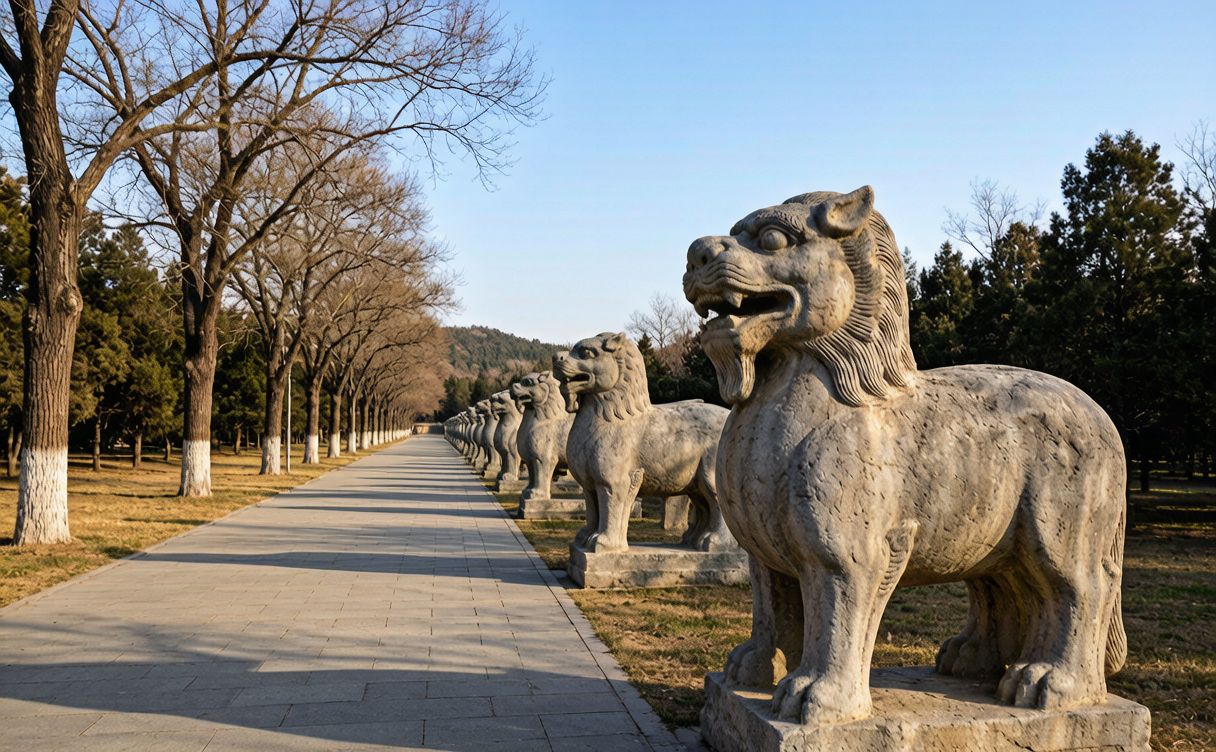
The Sacred Way (神道): The Best 30 Minutes of the Trip
If you do nothing else here, walk the Sacred Way. It’s the 7-kilometer ceremonial approach that all thirteen tombs share, and the first stretch — about 800 meters of it is open and paved — is the postcard part. I arrived at 8:45 a.m. on a weekday, and for twenty minutes I had the whole avenue to myself.
The road begins at the Great Red Gate (大红门) and runs past:
- The Stele Pavilion — a massive stone tortoise carrying an inscription commissioned by the Qing emperor Qianlong.
- The 18 pairs of stone statues — lions, camels, elephants, horses, and the mythical xiezhi (a unicorn-like judge of right and wrong), plus seated civil and military officials, all carved from single blocks of 15th-century white marble.
- The Dragon and Phoenix Gate — three ornate archways marking where the road splits toward the individual tombs.
A practical note: the full Sacred Way loop is long, and the open, walkable section is the part everyone photographs. Wear decent shoes — the paving stones are uneven, and there’s no shade for the first half.
The Three Tombs You Can Actually Visit
Only three of the thirteen tombs are open to the public, and they’re different enough that I’d pick based on your interests rather than trying to see all three.
Changling (长陵): The Grand One
Changling is the largest and best preserved, built for the Yongle Emperor who founded the site. The Hall of Eminent Favor (祾恩殿) is the highlight — a timber hall built entirely from nanmu, a fragrant hardwood so prized its beams were floated down rivers from southwestern China. It’s second in scale only to the Forbidden City’s Hall of Supreme Harmony. If you have time for one tomb, make it this one; its above-ground architecture beats Dingling’s underground chambers.
Dingling (定陵): The Only One You Enter
Dingling is the famous one because it’s the only tomb archaeologists have excavated and opened to visitors. In 1956, a team dug down to the underground palace — five chambers carved from stone, 27 meters below the surface, where the Wanli Emperor (r. 1573–1620) and two empresses were buried with a trove of silk, gold, and jade. You descend a steep flight of steps (and climb back up — there’s no elevator, so it’s tough on the knees) into the cool, dim chambers. The artifacts themselves are mostly in a small on-site museum rather than in situ, but standing inside the actual burial vault is genuinely eerie.
I’d be honest about Dingling: the underground rooms are atmospheric but modest, and the climb is real. If you have mobility concerns, Changling and the Sacred Way give you more bang for the effort.
Zhaoling (昭陵): The Quiet Alternative
Zhaoling, restored in the 1980s, is the third open tomb and the least visited of the three. It’s a calmer version of Changling with a pretty restored hall and fewer crowds. I stopped here on the way out and had the courtyards almost to myself. Good fallback if Dingling’s stairs put you off.
How to Get to the Beijing Ming Tombs
The tombs sit in Changping District, roughly 50 km from central Beijing. Your options:
- Public transit (cheapest): Subway Line 昌平线 to 昌平东关, then local bus 872 to the scenic area — about 90 minutes each way, a real local adventure.
- Tour bus from Qianmen (easiest): Several operators run day trips combining the tombs with Badaling. Our Beijing first-time travel guide covers which are legit and how to avoid shopping-stop traps.
- DiDi / taxi (most flexible): One-way from the city runs ¥150–220; handy if you want to linger.
- Private driver: If you’re doing the Wall-plus-tombs loop below, a driver for the day is the move.
There’s no single entrance — the Sacred Way has its own gate, and each open tomb has a separate one 2–4 km apart. Most do the Sacred Way first, then shuttle or taxi to Changling and Dingling.
Tickets, Hours & Practical Tips
As of the 2026 season, the site sells a combined ticket covering the Sacred Way plus Changling, Dingling, and Zhaoling, or individual tickets per tomb. Prices run roughly:
| Ticket | Peak (Apr–Oct) | Off-peak (Nov–Mar) |
|---|---|---|
| Combined (all open sites) | ¥130 | ¥100 |
| Sacred Way only | ¥35 | ¥30 |
| Changling | ¥45 | ¥35 |
| Dingling | ¥65 | ¥50 |
| Zhaoling | ¥35 | ¥30 |
Opening hours are generally 8:30 a.m. – 5:00 p.m. (Apr–Oct) and 8:30 a.m. – 4:30 p.m. (Nov–Mar), with last entry about an hour before closing. Buy at the gates or through the official WeChat mini-program; unlike the Forbidden City, you can usually get tickets on the spot except on major holiday weekends. For ticketing specifics and how the system compares to the palace in town, see our Forbidden City tickets guide.
A few things I wish I’d known:
– Almost no food or water inside the complex — bring a bottle and a snack.
– The tombs are spread out (10+ km walking all of them); use the shuttle or pick two.
– Go on a weekday. Tour groups flood in on weekends, and the Sacred Way loses its magic shoulder-to-shoulder.
How long do you need? Half a day is comfortable: two hours for the Sacred Way and Changling, plus an hour for Dingling if you’re doing the descent. Add the Great Wall and you’ve got a full, rewarding day.
Pairing the Ming Tombs with the Great Wall
Here’s the move that turned my second Beijing trip from “good” to “unforgettable”: do the Ming Tombs and the Badaling Great Wall on the same day. Badaling, the most famous and accessible Wall section, sits only about 8 km north of the tomb complex — both are Ming monuments in the same northwestern corridor, so linking them avoids a separate cross-city haul.
My suggested loop:
1. Leave central Beijing by 7:30 a.m. — do the Sacred Way and Changling before the crowds.
2. Late morning: drive 20 minutes north to Badaling, climb the Wall, have lunch at the base.
3. Afternoon: return to the city, or add Dingling on the way back if your legs still have it.
For Wall logistics, the best section to combine, and how to dodge the worst crowds, our Great Wall Beijing day trip guide is the companion read. If you’re torn between Badaling and the quieter Mutianyu section, the Mutianyu vs Badaling comparison breaks it down.
When to Visit the Ming Tombs
Timing matters less here than at the Forbidden City, but it still shapes the experience. The valley has four distinct moods:
- Spring (Apr–May): apricot and peach blossoms along the Sacred Way, mild walking weather — my favorite window.
- Summer (Jun–Aug): green and lush, but hot by midday; go early.
- Autumn (Sep–Oct): clear skies, golden light, hills turning red and amber — and coincidentally the best time to visit Beijing overall.
- Winter (Nov–Mar): bare trees, few visitors, a stark quiet — but cold enough that the underground Dingling chambers feel like a fridge.
For a fuller month-by-month and crowd-by-crowd breakdown of the capital, our Beijing attractions guide maps out the whole city, tombs included.
Is the Beijing Ming Tombs Worth It?
I’ll give you the straight answer I’d give a friend. If your Beijing trip is three days and packed with the Forbidden City, the Summer Palace, and the Great Wall, the Ming Tombs are easy to skip — they’re a half-day commitment and the architecture echoes what you’ll see elsewhere. But if you have four or more days, or you like a place’s quiet, contemplative side, the Sacred Way alone is worth the trip. I’ve now been three times, and the morning I spent alone among the stone elephants remains one of my favorite Beijing memories.
The Ming Tombs won’t wow you like the Wall. They’re slower, older, stranger — a 600-year conversation between a dynasty and its own mortality, in marble and guarded by mythical beasts. Give them a morning, and Beijing feels a little deeper when you leave.