

Most visitors to Hubei never leave the Yangtze corridor between Wuhan and the Three Gorges, which is exactly why Xuan’en (宣恩) stays so genuinely itself. Tucked into the hills of the Enshi Tujia and Miao Autonomous Prefecture in southwest Hubei, Xuan’en is a riverside county town built around stilt houses (吊脚楼, diaojiaolou) and a slow, misty river life that feels a world away from the provincial capital. This Xuan’en travel guide covers what’s worth your time, when to go, and how to work it into an Enshi-region trip.
The stilt-house heart of Xuan’en
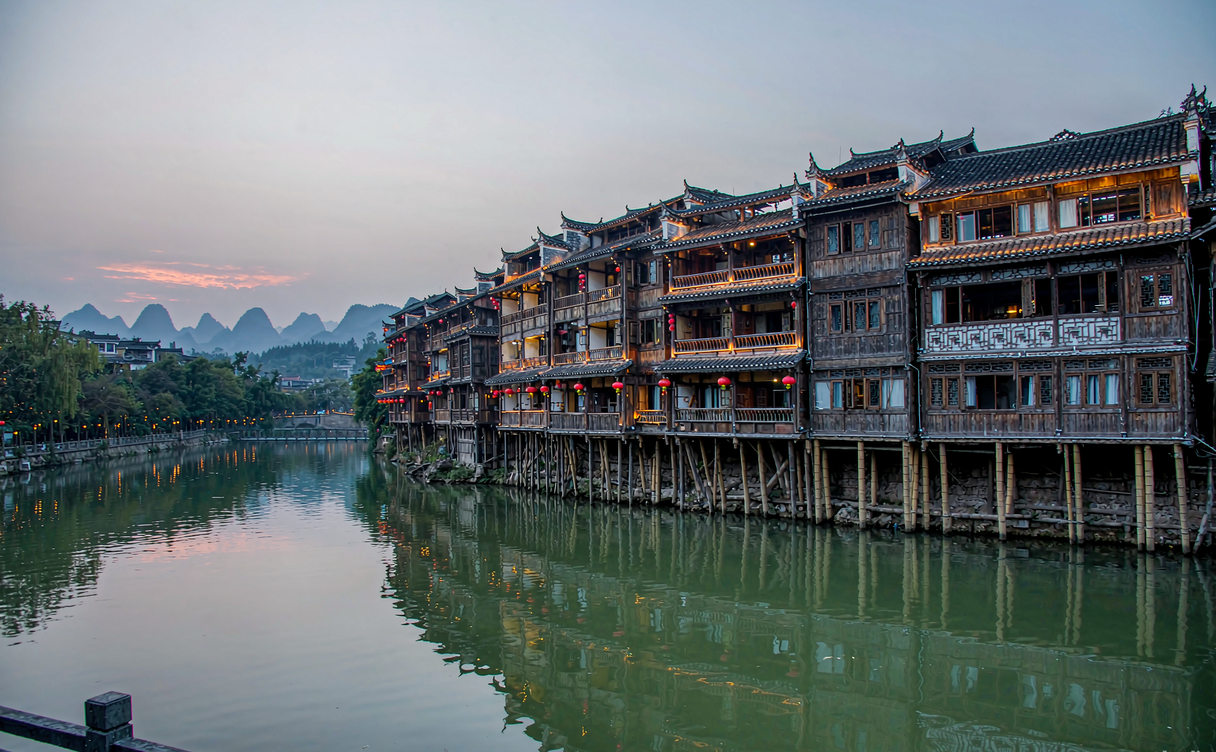
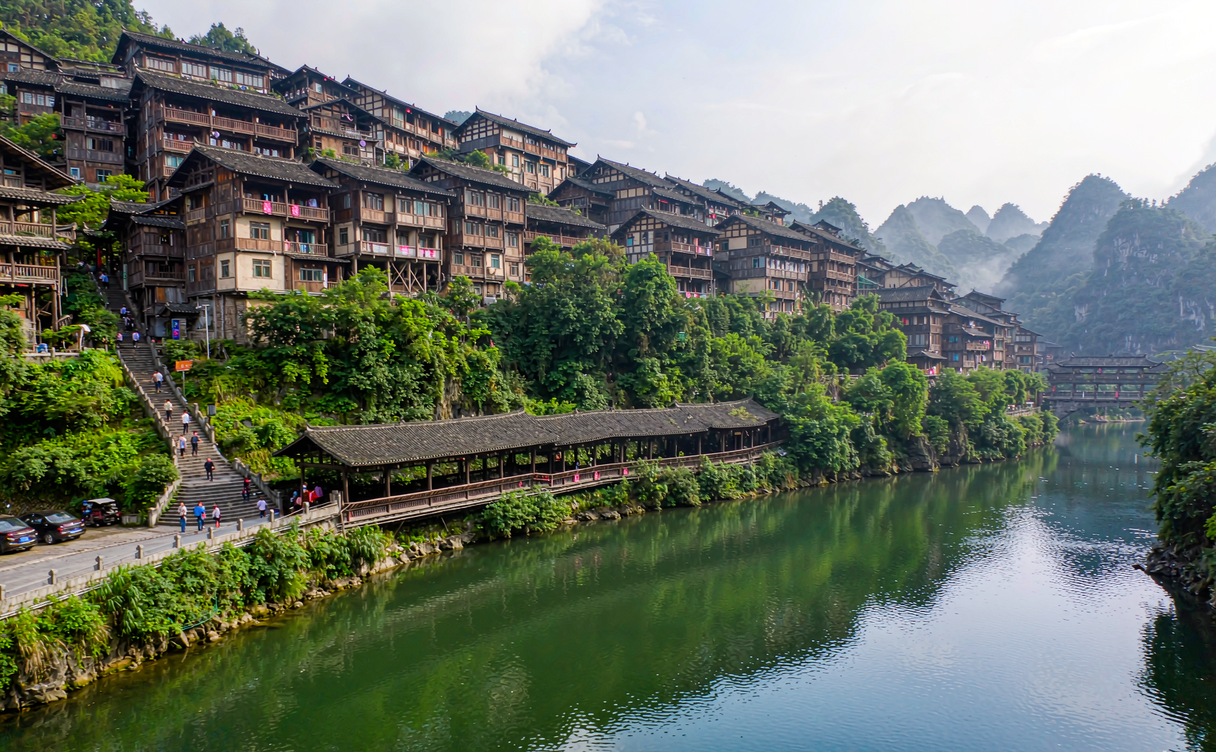
The headline sight is Pengjiabao (彭家寨), a Tujia stilt-house village that is, frankly, the reason Xuan’en is worth the detour. Unlike the commercialized ancient towns you’ll find elsewhere, Pengjiabao is a working settlement of dozens of timber diaojiaolou — houses raised on stilts over the slope, with curved roofs, open under-stories where tools and livestock once lived, and a rhythm of daily Tujia life that hasn’t been staged for cameras. In our experience, arriving late afternoon lets you watch the light go long across the timber, and staying until the cooking smoke rises is the real reward.
Closer to the county seat itself, the Gongshui River (贡水河) waterfront has been gently restored into a riverside promenade with stilt-house styling, fountains, and a lit-up bridge at night. It’s not “ancient,” but it’s a pleasant, local evening stroll and a good place to see how Xuan’en Hubei attractions blend the old form with modern small-town life.
Things to do in Xuan’en
Things to do in Xuan’en split between the villages and the river town:
- Pengjiabao stilt-house village. The must-see. Allow 2–3 hours; there’s a small folk museum and short trails between the houses. A local guide (¥50–100) turns timber into a story about Tujia clan life.
- The Gongshui River night walk. Free, easy, and genuinely pretty when the bridge lights reflect on the water. Families gather, kids play in the fountains in summer.
- Wulongshan hot springs (乌龙山温泉). A few kilometers out, these sulfur-light springs are a calm afternoon, especially in cooler months; entry runs roughly ¥80–150 depending on the pool.
- Surrounding Tujia villages. With a car you can reach half a dozen unrestored stilt-house hamlets where nobody expects tourists. Our travelers who hired a driver for a day rated this the best ¥200 they spent.
- Local markets. The county seat’s morning market is where Tujia cured meats, wild vegetables, and woven goods change hands; go before 9 a.m.
Best time to visit Xuan’en
The best time to visit Xuan’en is April to May and September to November. Spring brings green terraces and comfortable 16–24°C days; autumn is dry and clear, the best light for Pengjiabao’s timber. Summer (June–August) is hot and humid but popular as an escape from Wuhan’s furnace — expect 28–33°C with afternoon storms, and bring mosquito repellent for the river at dusk. Winter is cold and damp, occasionally near freezing, but nearly empty and cheap.
Because Xuan’en sits in the same cool, karst-riddled corner of Hubei as Enshi, the whole region shares a climate; our best time to visit China overview lines up the seasons province by province so you can plan a wider loop.
How to get to Xuan’en
How to get to Xuan’en starts in Enshi city, the regional hub. Fly into Enshi Xujiaping Airport (ENH) from Wuhan, Chongqing, or a handful of major cities, or take the high-speed train to Enshi from Wuhan (roughly 4–5 hours) or Chongqing (roughly 2–3 hours). From Enshi, Xuan’en is about 40–50 km away; a direct bus from Enshi bus station takes 1 to 1.5 hours and costs ¥20–30, while a taxi or arranged car runs ¥120–180 and saves the wait. There is no convenient high-speed station at Xuan’en itself, so the Enshi connection is the standard approach — our China high-speed train guide for foreigners explains the ticketing if you’re coming in by rail.
If you’re already building a Hubei trip from the east, start with our Wuhan travel guide and work west; Xuan’en is best as the quiet final stop after the big karst sights.
Where to eat and stay
Xuan’en eats are Tujia through and through. Larou (腊肉, cured pork) smoked over pine is the anchor of most meals, served with tubery (蕨粑, fern cake), youcha tang (油茶汤, savory oil-tea soup), and glutinous rice cakes. A hearty bowl of cured-meat noodles is ¥12–20; a shared Tujia dinner with several dishes runs ¥40–70 per person. The oil-tea soup is an acquired, delicious taste — salty, nutty, and nothing like the sweet tea you expect.
Stay in the county seat at ¥150–300 a night in functional hotels; for atmosphere, a handful of stilt-house guesthouses near Pengjiabao run ¥200–400 but book out on weekends. We usually keep travelers in the town for the night walk and send them to the village by day. For broader ideas, Xuan’en belongs on any list of best ancient towns in China precisely because it hasn’t been fully discovered.
A half-day and a full-day plan
With half a day, do the Gongshui River promenade in the evening and the morning market if you’re up early. With a full day, spend the morning at Pengjiabao, lunch on Tujia fare back in town, and take the afternoon hot springs or a village drive, then the lit bridge at night.
The whole southwest-Hubei karst region is best taken together, and our Enshi travel guide lays out the bigger loop — Xuan’en is the gentle, low-effort entry into it.
Getting around Xuan’en
Xuan’en town is small enough to cross on foot, and the riverside promenade is a flat, easy walk. For the village sights you’ll want wheels: shared e-bikes (¥3–5 for a short hop) are everywhere in the county seat, and metered taxis start around ¥6. The 40–50 km run to Pengjiabao is best done by the county bus from the seat’s main station (¥10–15, roughly hourly) or a hired car. In our experience, a driver who waits while you explore the village costs only a little more than two round bus fares and saves the awkward timing of the last departure.
Practical notes before you go
English is minimal outside the airport, so a translation app earns its keep. Carry cash for village stalls and small guesthouses. The riverfront is safe and walkable after dark. Trails at Pengjiabao are uneven timber and stone — wear closed shoes, not sandals. Mosquitoes own the river at dusk in summer; repellent is non-negotiable.
For first-timers to the country figuring out payments and transport, our China travel guide for first-timers covers the ground-level basics.
For neutral background on the ethnic landscape here, the Xuan’en County page on Wikipedia is a useful primer before you go.