

Ninety minutes west of Chengdu, in the dripping green hills above Ya’an city, the Bifengxia panda base pairs two things most travelers book separately: a serious giant panda research center and a limestone gorge you can hike with waterfalls on both walls. Since the 2008 Wenchuan earthquake pushed the breeding program’s animals out of Wolong, Bifengxia has been one of the China Conservation and Research Center for the Giant Panda’s busiest campuses — which means you get close pandas and, on the same ticket, a cool canyon walk that suits non-panda companions. For visitors based in Chengdu who want pandas without the longer Wolong drive, Bifengxia is the easy, scenic default.
The base sits up in the mountains inside the Bifengxia scenic area, in Yucheng District of Ya’an. It holds several dozen pandas across planted hillside enclosures, plus a cub nursery that is usually open from August to October. What sets it apart from the Chengdu city center is the setting: the enclosures are wrapped in real forest, the air is misty, and the whole place feels like a mountain retreat rather than an urban zoo. Our China panda tour guide ranks Bifengxia against the other Sichuan panda centers if you are deciding where to spend your keeper day.
How to get to Bifengxia from Chengdu
The fastest route is the Chengdu–Ya’an intercity railway, which reaches Ya’an station in about 1 hour (second class ¥52 to ¥65). From Ya’an station a taxi or the scenic-area shuttle takes 30 to 45 minutes up to the Bifengxia gate (¥50 to ¥90 by taxi). Driving yourself is also simple: the G5 Beijing–Kunming Expressway and the Chengdu–Ya’an highway put you at the gorge gate in 1.5 to 2 hours, and a private car runs ¥500 to ¥700 round trip from Chengdu. Long-distance buses still leave Chengdu’s Xinnanmen station for Ya’an (¥40 to ¥55), but the train is quicker and drops you closer. If you are still arranging your Sichuan arrival, our high-speed train guide for foreigners explains buying the Chengdu–Ya’an service and what ID you need at the gate.
Best time to visit Bifengxia
Ya’an carries the nickname “Rain City,” and Bifengxia is the wettest, greenest corner of it — which is exactly why the gorge is so lush. Spring (April to May) and autumn (September to November) are the best windows, with comfortable 16 to 24°C days and the waterfall flow at its photogenic peak after spring rains. Summer is warm and very humid, with daily downpours that turn the trails slick but the foliage vivid; bring a shell and skip it if you hate rain. Winter is quiet and cool, occasionally with valley frost. The best time to visit China’s southwest follows the same spring-and-autumn rule, and Bifengxia is no exception. Avoid the May and October holiday weeks, when the gorge path gets congested.
Things to do in Bifengxia
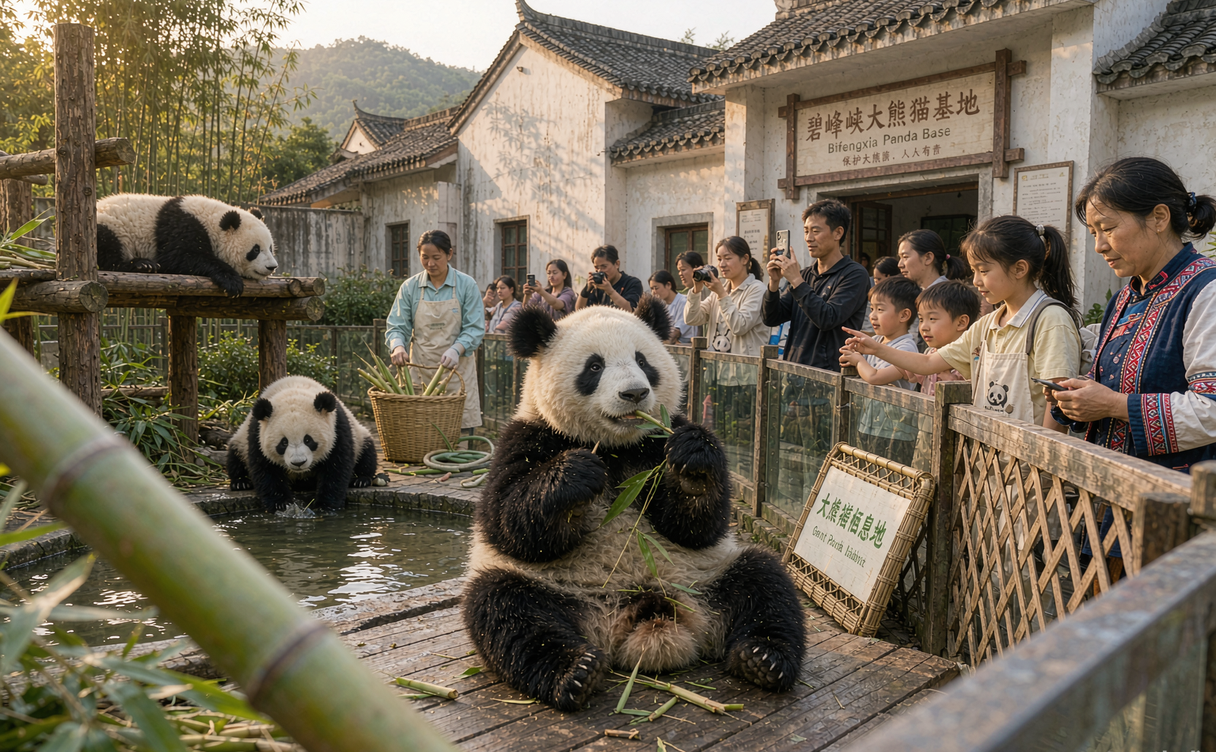
Plan on half a day for the panda base and another two to three hours for the gorge. The base loop passes the breeding enclosures, the nursery, and a small museum; the keeper-for-a-day program (about ¥800 to ¥1,000, book ahead) lets you clean an enclosure and help with feeding. The gorge is the surprise: a 1.3 km canyon walk on catwalk platforms fixed to the cliff, with the Baizhang waterfall dropping more than 100 m and the “Lover’s Pass” squeeze where the walls nearly meet. A cable car (¥50 to ¥80 round trip) lifts you from the base area to the upper gorge if you would rather not climb, and there is a short “ecological” loop past a tea plantation where local Mengding ganlu tea is grown. The nearby Ya’an travel guide adds the city’s tea-horse road museums and the local Qiang and highland-ethnic cultural show if you stay the night.
The gorge is also a working tea landscape. The slopes above Bifengxia sit inside the Mengding mountain tea zone, and small family plots line the access road; in March and April you can watch the first flush being picked and buy loose-leaf Mengding ganlu directly from the growers for ¥80 to ¥200 per 100 g, far cheaper than the city. In the evening the scenic area runs a Qiang and highland-ethnic cultural show (¥120 to ¥180 with dinner) down in the gorge theater — dancing, throat singing, and a Qiang flute recital — which is a soft introduction to the herding cultures of the Sichuan highlands if you are not heading deeper into the mountains. It is touristy, but the costumes are real and the energy genuine, and it rounds out a panda day with something human rather than purely scenic.
The pandas and why Bifengxia matters
Bifengxia’s panda story is tied to disaster and recovery. When the 2008 earthquake wrecked Wolong’s original base, the breeding center evacuated its animals here, and Bifengxia became a temporary then permanent home for a large share of the captive population. The enclosures were built to higher, safer standards, and the camp now does both research and public viewing. The animals you meet are part of the same national breeding effort that has returned cubs to wild-release sites across Sichuan — the conservation arc told at Chengdu’s panda and city guide and at Wolong. For the species background, the Wikipedia giant panda article is a solid pre-trip primer on why this bamboo-dependent bear is so hard to breed and protect.
Food, stays and pairing with Chengdu
Base yourself in Chengdu and do Bifengxia as a day trip, or overnight in Ya’an to slow down. Chengdu has the airport and the trains and is the natural hub for the pandas and the city. In Ya’an, riverside hotels run ¥250 to ¥500, and the Sichuan cuisine guide pays off at the table — Ya’an cooking is peppery and rustic, heavy on river fish, smoked pork, and the local “Ya fish” (Ya yu) steamed with pickled vegetables. At the gorge gate, stalls sell corn cakes, roasted sweet potato, and the region’s famous green tea by the cup. Pack a dry change of clothes in summer; the lower gorge sprays you with mist whether it is “raining” or not.
Want pandas and a waterfall gorge on one ticket? Book the Bifengxia keeper program now and take the Chengdu–Ya’an train straight to the gate.
Practical tips and what to book in advance
The keeper program is the only thing that truly sells out, so reserve it two to three weeks ahead through the base or a licensed agency. General entry (base plus gorge, about ¥100 to ¥150 in 2025) can be bought at the gate, but buying online saves the queue on weekends. Wear grippy shoes — the gorge catwalks are wet year-round — and bring a light rain jacket even in “dry” months. Payment is easiest by Chinese app or cash; foreign cards are unreliable at the window, so keep ¥300 to ¥500 on hand. The cable car saves legs but misses the best waterfall viewpoints, so walk down at least one way. Photography is best before 11:00, when mist softens the enclosures and the gorge light is flat and even. Leave by mid-afternoon and you reach Chengdu in time for dinner; the train runs until late evening.
Build your Ya’an day trip today — train to Ya’an, taxi to the gorge, and lock the keeper slot before the cap fills.
A note on the experience
Bifengxia suits travelers who like their wildlife with a side of landscape. The pandas are the headline, but the gorge is what makes people stay an extra hour, and the mist means even a grey day photographs well. Give the base the morning, eat at the gate, then walk the canyon in the cooler afternoon. If you are choosing between Bifengxia and Wolong, the rule is simple: less driving and more scenery, choose Bifengxia; more wilderness and fewer crowds, choose Wolong. Both feed the same conservation story, and both are an easy half-day from Chengdu if you start early. Bring binoculars for the gorge birds, and don’t rush the nursery — cub season is brief and the line to see it can be long.
Make Bifengxia your panda-and-gorge day out of Chengdu — book the train, grab the keeper slot, and let the waterfalls finish the trip.