

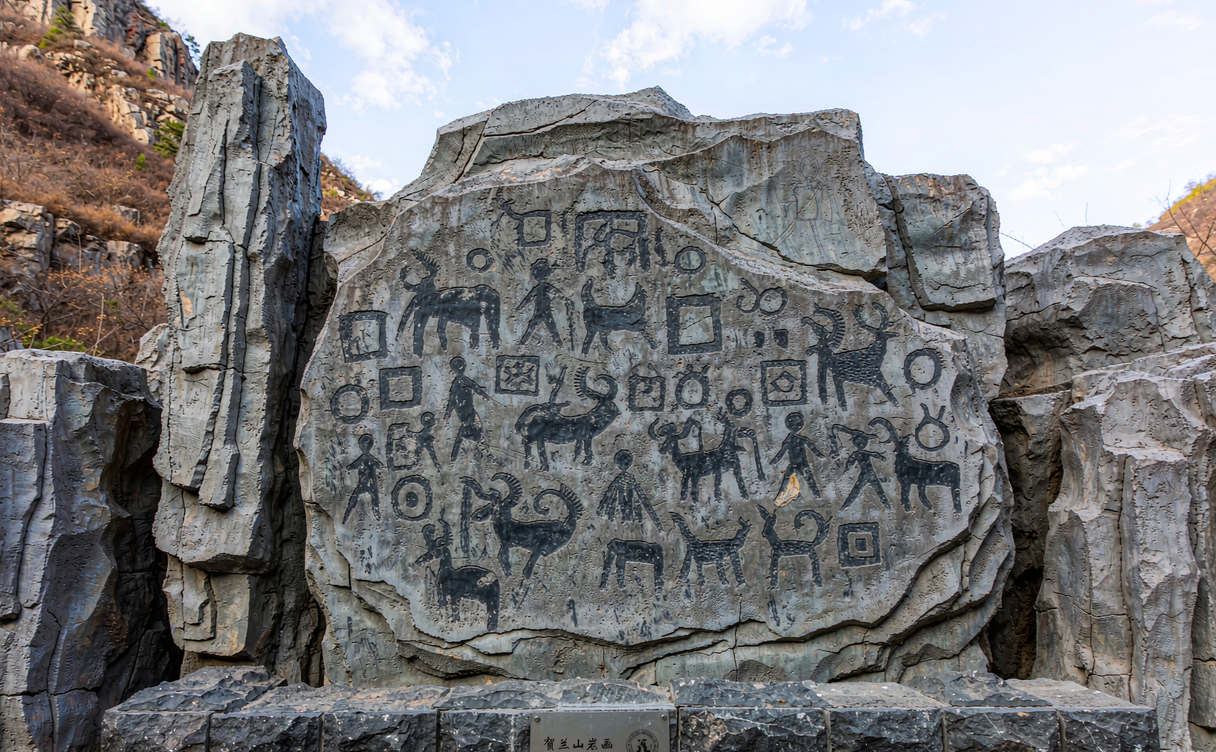
West of Yinchuan, where the Ningxia plain ends and the Helan Mountains rise like a wall against the Mongolian steppe, a story cut in stone has been waiting for three thousand years. The Helan Mountain petroglyphs are one of China’s largest and most haunting rock-art sites: thousands of carvings scattered across the dark volcanic outcrops at Helankou, the main gateway gorge. Faces with radiating rays (the famous “Sun God”), herds of running sheep and deer, hunters with bows, and later Buddhist and Mongolian inscriptions — all pecked into the rock by the nomads who once moved through this frontier. For travelers who think Chinese sightseeing means temples and walls, the Helan carvings are a bracing change: open sky, bare mountain, and human marks older than the Great Wall.
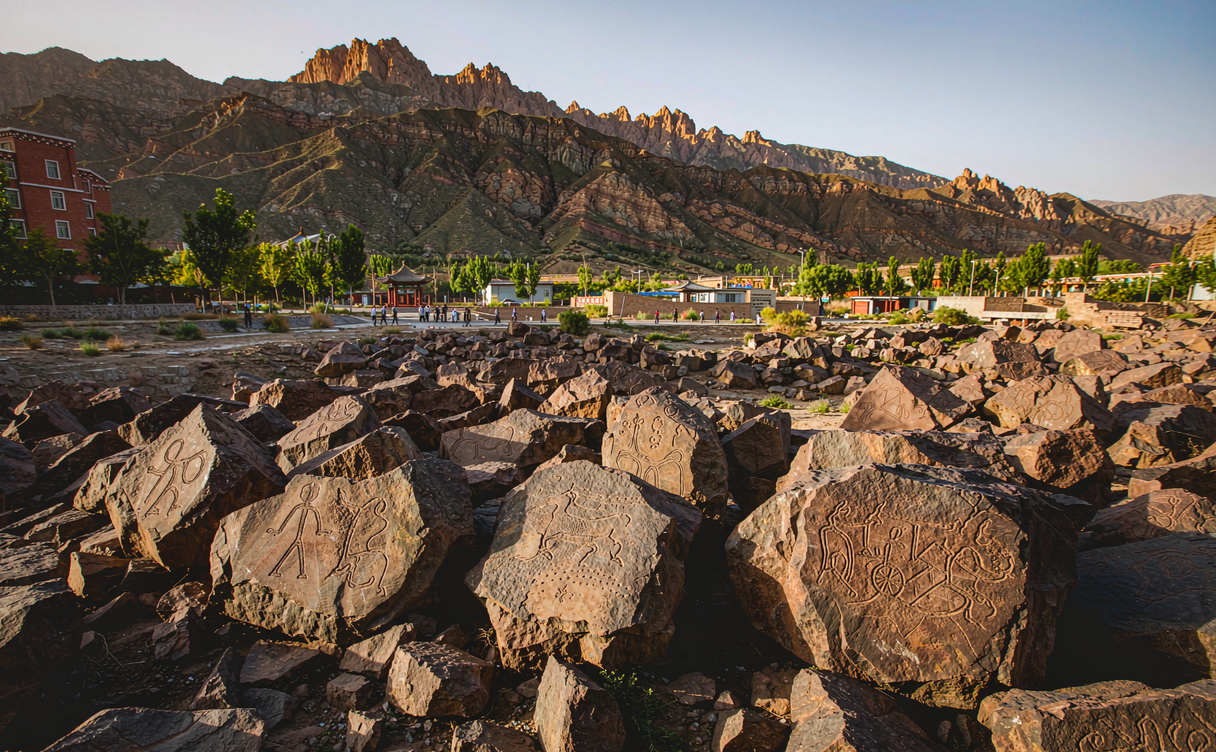
The site sits about 50 km from Yinchuan in the Helan Mountains, at an opening where a seasonal stream cuts through the ridge. Archaeologists count more than 6,000 individual images in the Helankou cluster alone, made over a very long span — the earliest probably Neolithic, the bulk by the northern nomadic peoples (Xiongnu, Xianbei and others) through the Western Xia period (1038 to 1227), and a later layer of Buddhist and Mongolian script. The Ningxia Western Xia tombs down the road are the other great Helan Mountain monument, and the two together tell the story of who lived at this frontier and what they believed.
How to get to Helan Mountain from Yinchuan
There is no train to the petroglyphs; you go by road from Yinchuan. The drive heads west out of the city on Beijing Road, then climbs into the foothills — about 50 km and 50 to 70 minutes. A chartered car or taxi for the day runs roughly ¥250 to ¥400 round trip including waiting, and is the standard choice; some Yinchuan hotels and the Gulou travel agencies sell seats on a half-day shuttle in peak season for ¥60 to ¥100 per person. Driving yourself is easy on the paved approach, but the final mountain lot has no fuel or repair, so arrive with a full tank. If you are still planning your rail approach, our high-speed train guide for foreigners covers reaching Yinchuan from Lanzhou or Xi’an; from the city you still need a car for the final 50 km. First-time visitors to the region should also skim our China travel guide for first-timers before booking.
Best time to visit Helan Mountain
The Helan foothills are high, dry and exposed. Summer (July to August) is hot on the plain but tolerable up at the carvings, with daytime highs around 28 to 32°C and almost no shade — bring a hat and 2 liters of water. Spring (April to May) and autumn (September to October) are clearly best: 15 to 24°C, clear light, and the rock faces photograph beautifully. Winter is cold (daytime often below freezing) but empty and crisp. The best time to visit China’s north favors those same shoulder seasons, and the Helan site follows the rule. Strong afternoon winds can whip off the steppe in spring, so mornings are calmer for both walking and photography. Avoid the October holiday week, when Yinchuan buses the site with domestic tour groups.
Things to do at Helan Mountain
The ticketed scenic area (¥60 to ¥70 in 2025, with the on-site museum included) is compact and walkable in two to three hours. Start at the Helan Mountain Rock Art Museum, which displays rubbings, maps and a clear timeline of who carved what and when — essential context before you read the real rocks. Then follow the boardwalk up the Helankou gorge to the main carved panels. The headline image is the “Sun God,” a round face with radiating rays and elongated eyes, pecked high on a boulder where the light catches it best in the morning. Elsewhere you will find whole herds of sheep and deer, a line of dancers, and a wolf among goats — the everyday world of the people who made this a frontier. A short climb above the panels gives a view back across the Ningxia plain toward Yinchuan, which explains why this pass mattered: anyone moving between the steppe and the farmland had to come through here.
Helan Mountain rock art and the frontier it记录了
A little background turns scattered scratches into a record. The Helan range is the watershed between the ordos loop of the Yellow River and the Alashan steppe, and for millennia it marked the edge of settled China. The carvings are the only voice left by the nomads who lived on that edge — no written histories, just these images of the animals they hunted and the spirits they feared. The later Western Xia and Buddhist carvings show the frontier changing hands and faiths. The mountains themselves are geologically distinct: a north-south wall of Ordovician granite and slate that traps rain on the eastern (Ningxia) side and creates the oasis farming below. For the wider geography, the Wikipedia Helan Mountains article is a useful pre-trip reference on the range and its role as a climate and cultural divide.
Pairing the petroglyphs with wine and the Western Xia tombs
Helan Mountain is the spine of a tidy Ningxia day. The Yinchuan travel guide is your base — the city is 50 minutes away and has the hotels and the airport. From there, a logical loop is the petroglyphs in the morning, the Ningxia wine region at lunch (the eastern foothills grow some of China’s best cabernet sauvignon and ice wine, with tastings at ¥50 to ¥150), and the Western Xia tombs in the late afternoon light. The tombs — the “pyramids of the North” — sit 30 km southeast of the city and close the historical loop the petroglyphs open: one site shows who crossed the frontier, the other shows who ruled it. A driver can cover all three in a long day for ¥600 to ¥900, far cheaper than three separate hires and with no wasted backtracking.
Want the real Ningxia in one day? Book a Yinchuan driver and chain the petroglyphs, the wine foothills and the Western Xia tombs together.
Practical tips and what to book in advance
No advance booking is needed for the petroglyphs themselves — buy at the gate or online and go — but arrange your driver the day before, since foothill taxis are scarce after morning. Wear closed, grippy shoes; the gorge boardwalk is fine but the side paths are loose rock. Carry water and sun protection year-round; the altitude (around 1,500 m at the carvings) makes the sun deceptive. Payment is easiest by Chinese app or cash, as foreign cards are unreliable at the window — keep ¥200 to ¥300 on hand. The site is exposed, so a windbreaker earns its place even in spring. Photography: the Sun God panel faces east, so morning light is right and afternoon is backlit — plan the gorge for before noon. Give the museum 30 minutes first; without it the carvings read as decoration rather than history.
Plan the Helan loop now — reserve a Yinchuan driver, schedule the petroglyphs for the morning light, and add a wine tasting before the tombs.
A note on the experience
The Helan petroglyphs will not wow you the way a palace does. They are quiet, weathered, and ask for a little imagination. But stand at the Sun God panel with the wind off the steppe in your ears and the plain spread behind you, and the frontier suddenly makes sense — this was the line between two worlds, and the people who lived on it left their faces in the stone. Pair the site with the wine country and the tombs and you get a full, untouristy day that most Ningxia visitors miss. Bring binoculars for the ridge raptors, a zoom lens for the high carvings, and patience; the best images are the ones you almost walk past. Go early, stay cool, and let the mountain do the explaining.
Make the Helan Mountain petroglyphs the untouristy heart of your Ningxia trip — book the driver, catch the morning light, and read the frontier in its own stone.