

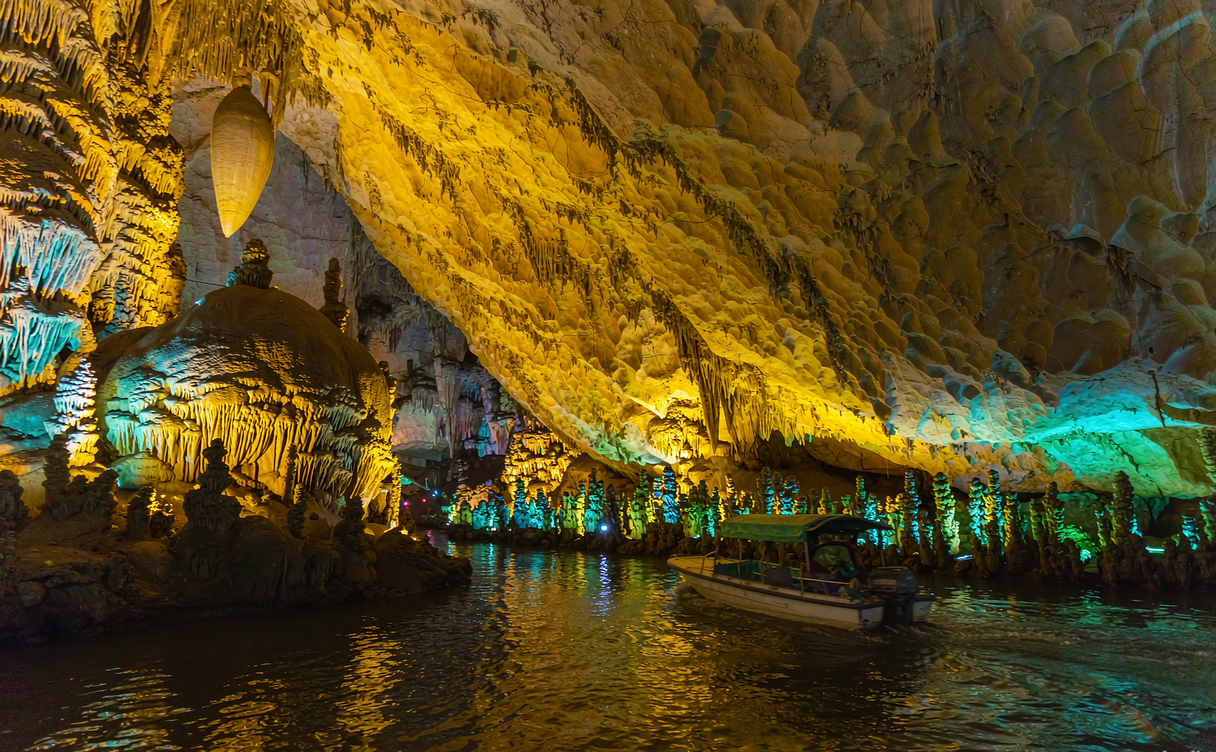
I have toured many caves, but few prepared me for the moment a small boat rounded a corner inside Yellow Dragon Cave and revealed a floodlit cavern the size of a cathedral. Yellow Dragon Cave (黄龙洞) near Zhangjiajie, Hunan, China is one of the region’s great underground show caves, a vast karst system of stalactites, stone pillars, and an underground river that you explore partly on foot and partly by boat. It is a perfect half-day complement to the famous quartz-sandstone peaks above ground, and a reliable rain-or-shine option when the mountains are wrapped in mist.
A Dragon-Shaped Labyrinth Beneath the Peaks
Yellow Dragon Cave sits about 8 kilometers (5 miles) from the center of Wulingyuan, the scenic district that contains Zhangjiajie National Forest Park. Local legend says the cave was named for a yellow dragon said to dwell within, but the geology tells the real story: this is a mature karst system developed in limestone, with more than 13 kilometers (8 miles) of surveyed passages spread across multiple levels. Only a portion is open to visitors, but even that takes about two hours to walk at a relaxed pace, with bridges and walkways built to keep you dry and oriented.
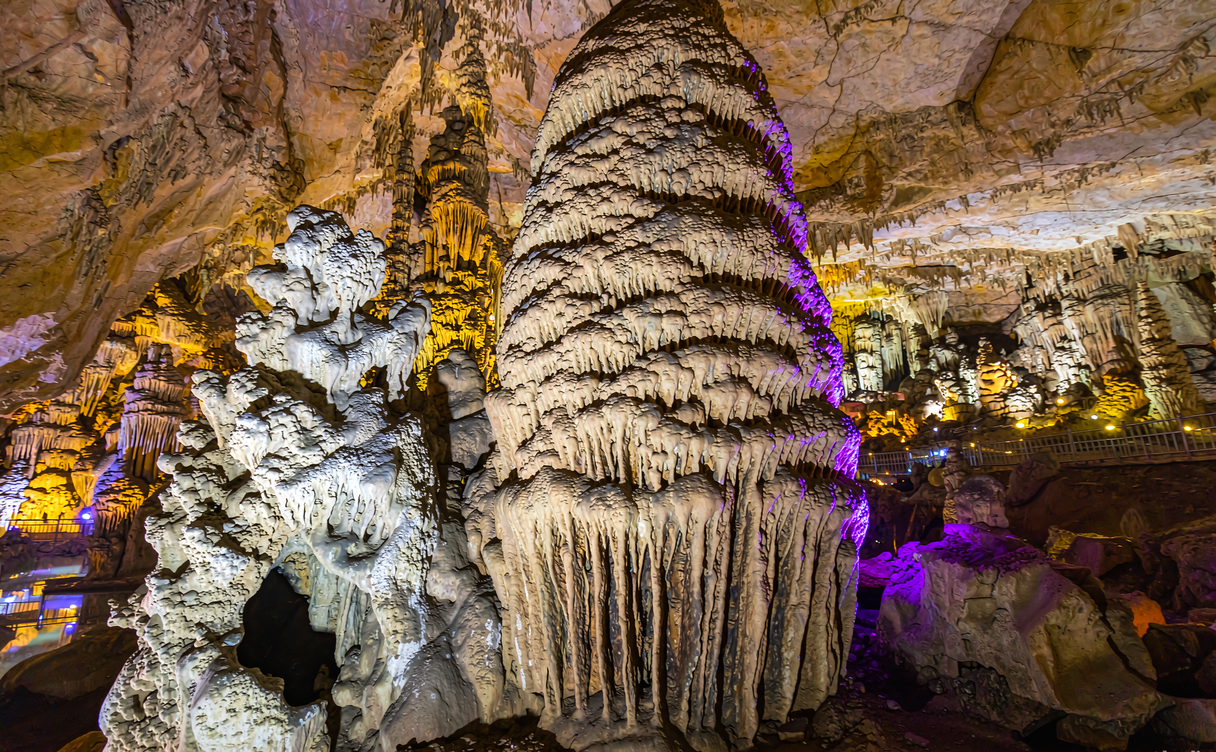
What sets it apart from smaller show caves is its scale and variety. The system includes a great hall, a string of connected caverns, an underground river, and a lake, all threaded with rail-lined paths and lit in changing colors that show the formations to best effect. The centerpiece is a 19-meter (62-foot) stalagmite known as the “Hairpin Pillar” (定海神针), which is insured for a symbolic sum and spotlit like a sculpture. I found the boat ride across the underground lake the highlight — drifting under a ceiling of glowing formations while the guide’s spotlight picked out dragons, towers, and Buddhist shapes in the rock, a show that is part geology and part theater.
Note that this is the Zhangjiajie Yellow Dragon Cave in Hunan, distinct from the Sichuan Huanglong scenic area (the terraced travertine pools) farther west. Both are stunning, but they are different destinations; this guide focuses on the cave, and you can plan the peaks separately with our Zhangjiajie National Forest Park guide, which covers the Avatar mountains and the park’s elevator and cable-car network above ground.
What to See Inside the Cave
The standard route moves through several named chambers. The entrance hall opens into a cool, humid world kept at a steady 15–18°C (59–64°F) year-round, a relief in summer and a light jacket territory in winter. You then descend through caverns filled with straw stalactites, curtain formations, and the tall pillars that give the cave its drama, before reaching the underground river section where you board an electric boat for a ten-minute glide past illuminated walls. The internal elevator (included or separately ticketed depending on the season) lifts you to the higher gallery for the best overview of the Hairpin Pillar and the main hall.
I recommend taking the boat early in your visit, before the tour groups bunch up at the dock, and then walking the upper loop slowly so the scale of the great hall sinks in. Photography is allowed without flash, and the colored lighting makes even a phone camera produce striking images, though a camera with a steady hand does better in the low light. Families with children do well here because the paths are flat, rail-lined, and sheltered, and there is none of the exposure you get on the mountain walks. For a complete regional plan, our Zhangjiajie travel guide shows how to sequence the cave with the Avatar mountains and Tianmen Mountain, while the Tianmen Mountain guide covers the glass walkway and the cliff-hanging cable car on the opposite side of the city.
Add the underground half of Zhangjiajie to your trip — get our cave route map, boat-timing tips, and how to pair it with a Tianmen Mountain day so the whole region reads as peaks above and dragons below.
Tickets, Hours, and How to Get There
As of the 2025 season, Yellow Dragon Cave admission is about 100–121 RMB per adult, with the internal elevator and boat generally included or available for a small add-on of 20–40 RMB. Opening hours run roughly 08:00 to 17:30 in peak season (April–October) and 08:30 to 17:00 in winter, with the last entry about an hour before closing so the boats can be brought in before dark. The cave is in the Wulingyuan area, about 35 kilometers (22 miles) from Zhangjiajie city center and 8 kilometers from the Wulingyuan ticket station, which makes it an easy morning or afternoon once you are based near the park.
Getting there is easy and cheap. A taxi or Didi ride from Wulingyuan town costs around 20–40 RMB and takes 15 minutes, while a private car from Zhangjiajie city runs about 120–180 RMB and takes 50–70 minutes. Many visitors combine the cave with a stop at the nearby Baofeng Lake on the same half-day loop. If you are arriving from far away, our China high-speed train guide for foreigners explains how to reach Zhangjiajie station by rail from Changsha or Wuhan, and how to book the right class without a Chinese ID app in advance.
Unsure whether to pair the cave with Tianmen Mountain or the forest park? Our 3-day sequencing shows the least-transfer way to see dragons below and quartz peaks above in one relaxed trip without doubling back.
Best Time to Visit and Where to Stay
Because the cave temperature is constant, it is a good rainy-day or hot-afternoon alternative any time of year, and I often send travelers here when the peaks are closed in cloud. The surrounding Zhangjiajie mountains are best in spring (April–May) and autumn (September–November), when skies are clearer and crowds thinner than the July–August summer rush and the October National Day holiday. Our best time to visit Zhangjiajie guide breaks down the monthly weather and crowd patterns so you can plan both the cave and the mountains together, and the Zhangjiajie 3-day itinerary slots the cave into day two or three alongside Tianmen Mountain without wasting a transfer.
Most visitors stay in Wulingyuan town, where mid-range hotels and guesthouses run 250–500 RMB per night and put you within minutes of the forest park gate and the cave. Staying in Wulingyuan rather than the city center saves a daily commute and lets you enter the park at opening, which matters more than it sounds when the bus queues build after nine. For the karst processes that built this cave, the Wikipedia article on karst explains how limestone dissolution creates such underground landscapes across the world, including here in Hunan, China.
A sample half-day itinerary inside Yellow Dragon Cave
To make the most of the underground half of Zhangjiajie, we suggest this relaxed half-day rhythm built around the cave’s steady 15–18°C air and its boat tour. Start from Wulingyuan town and take a DiDi or taxi at around 09:00 — the 8-kilometer, 15-minute ride costs just 20–40 RMB and drops you at the cave entrance before the bus groups gather. Buy your ticket at the gate (about 100–121 RMB, with the internal elevator and boat usually included or a 20–40 RMB add-on), and head straight for the underground river boat ride first, while the dock is quiet; the ten-minute electric glide past floodlit walls and the glowing Hairpin Pillar is the cave’s signature Yellow Dragon Cave Zhangjiajie boat tour moment, and the best photos come before 11:00.
After the boat, walk the upper loop slowly: the great hall, the connected caverns, and the elevator gallery for the overview of the 19-meter stalagmite. Allow about two hours total at a relaxed pace, then exit by 12:30 and taxi the short hop to Baofeng Lake for a late lunch and a second boat ride on the surface water. Total per-person spend for the cave alone runs roughly 120–160 RMB including the add-ons, and the whole morning fits before the afternoon peak-season heat or the mountain mist rolls in. Bring a light jacket even in summer, because the constant cave temperature feels cool after the Hunan humidity, and wear flat shoes — the paths are rail-lined and dry but long. Photography without flash is allowed, so a steady hand or a phone on a short timer captures the colored lighting well. We have run this exact loop with families and rainy-day travelers alike, and it always delivers the region’s most unexpected photos while the quartz peaks stay wrapped in cloud above.
Build your Zhangjiajie cave day with confidence — get our combo-ticket advice, Wulingyuan hotel picks, and a 3-day plan that balances peaks and underground wonders so nothing gets cut for lack of time.
Yellow Dragon Cave is the hidden half of Zhangjiajie: while the world photographs the pillars above, the real dragons sleep below. Give it a morning and you will leave with the region’s most unexpected photos, taken in a cavern that stays cool and bright no matter what the weather does outside.