

An hour and a half southwest of Shijiazhuang, the land around Zanhuang County splits open into walls of red rock hundreds of meters high. We’ve taken travelers there who expected a minor hill park and instead stood under a cliff face the color of rust and sunset, curved into one of the largest natural echo chambers on Earth. This Zhangshiyan Hebei guide explains why this quiet corner of the Taihang Mountains deserves a place on any northern-China itinerary.
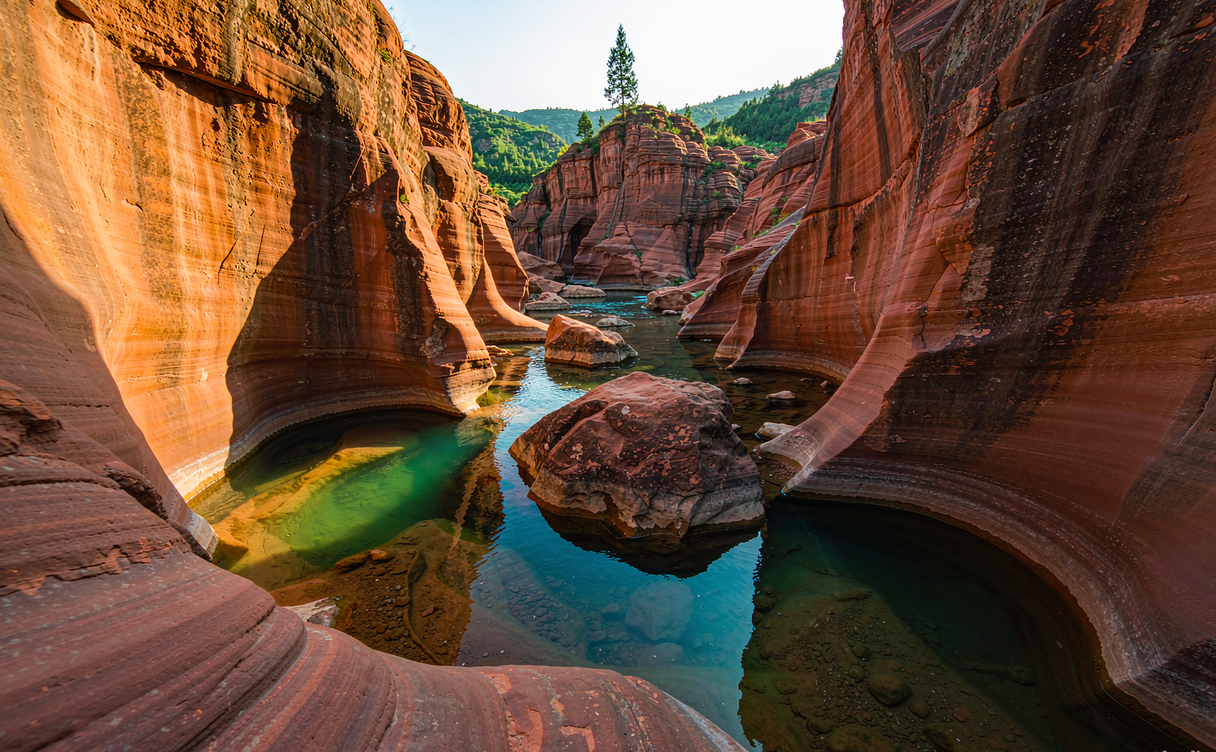
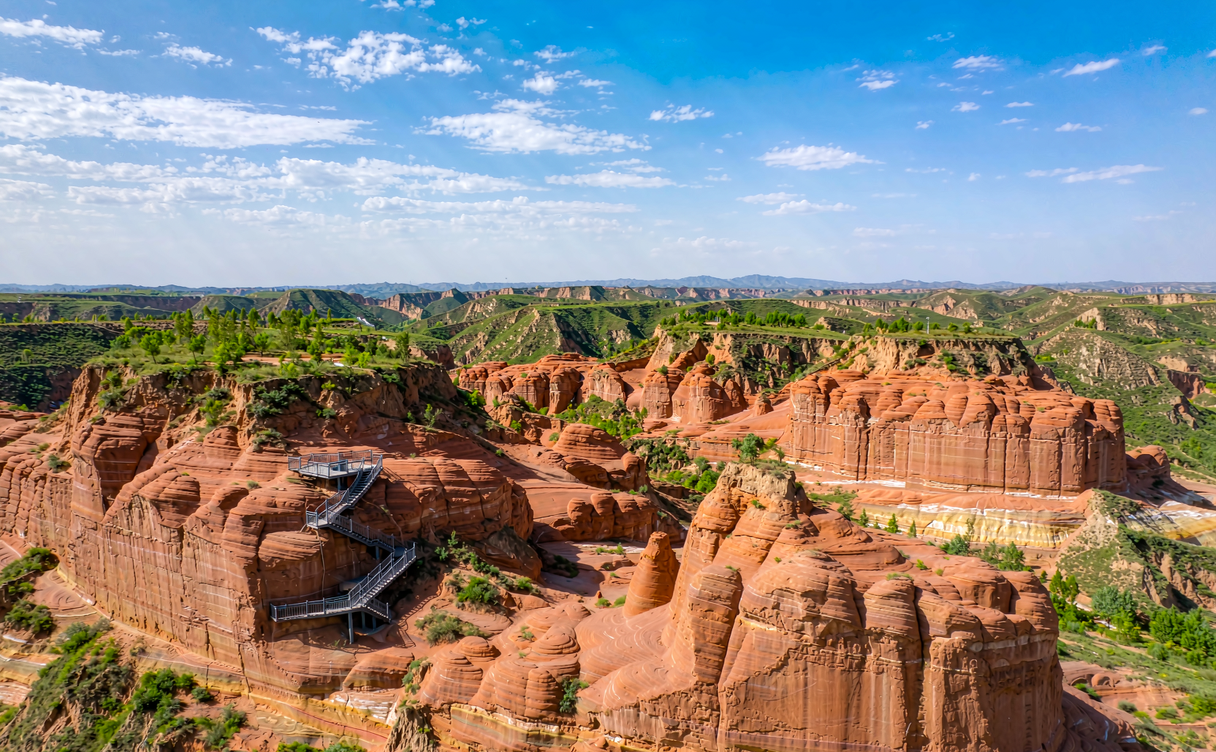
Zhangshiyan (嶂石岩) is named after the very landform it exemplifies. Chinese geographers rank the “Zhangshiyan landform” alongside Danxia and the quartz-sandstone peaks of Zhangjiajie as one of the three great sandstone landscapes of the country. The rock here is red quartzite laid down horizontally, then lifted and cut by erosion into sheer, layered cliffs — the local term is 赤壁 (red wall). Unlike the rounded humps of classic Danxia, Zhangshiyan’s walls are flat-topped and massively tall, like a series of giant crimson staircases climbing into the sky.
How to get there
A Zhangshiyan to Shijiazhuang trip is the standard approach. By car, take the Jinggang’ao Expressway (G4) south past Gaoyi, then follow the Pingshe Highway (S202) west into the mountains; the drive is about 100 kilometers and two hours. By public transport, high-speed trains from Beijing or Shijiazhuang stop at Gaoyi West Station, from where a bus or taxi reaches Zanhuang town in about thirty minutes, and a local minibus continues to the Zhangshiyan gate (roughly another forty minutes, ¥10–15). Shijiazhuang’s coach station also runs direct buses to Zanhuang a few times a day for around ¥25. We usually recommend driving or hiring a car for the day, because once you are at the gate the scenic area is large and the internal shuttle is the only way between trailheads. The Shijiazhuang travel guide has the wider rail picture, and the Baoding travel guide works if you approach from the north.
Things to do at Zhangshiyan
The signature sight is the Echo Wall (回音壁), a vast concave cliff more than a hundred meters tall and several hundred meters long, curved so perfectly that a shout thrown at the rock returns after a delay you can count. We time it with groups — clap once and you hear it come back two or three times. It is listed among the largest natural echo walls in the world, and standing in its hollow on a still morning is genuinely theatrical.
Beyond the Echo Wall, things to do at Zhangshiyan include the Thread of Sky (一线天), a narrow vertical cleft you climb on iron stairs between two cliff faces, and the Nine Girls Peaks (九女峰), a cluster of freestanding red towers best viewed from the opposite ridge at sunset. There is also the Donglingbei Waterfall (冻凌背), which freezes into ice curtains in deep winter, and the small Huaiquan Temple tucked into a side valley. The main summit, Huang’an Nao (黄庵垴), tops out at 1,774 meters and on clear days you can see across the Taihang range into Shanxi.
The red-cliffs hike
The Zhangshiyan red cliffs hike is the reason serious walkers come. The classic route runs a loop from the gate up past the Echo Wall, along the mid-cliff boardwalk, and across to the Nine Girls viewpoint, a round trip of about eight kilometers taking four to five hours. The paths are stone and wood, with fixed chains at the exposed steps, but nothing technical. What surprises people is the scale: you are walking along a ledge cut into a wall that rises another two hundred meters above you and drops a similar distance below. We tell photographers to save energy for the final ridge, because that is where the full arc of the cliff reveals itself.
Zhangshiyan photography
For Zhangshiyan photography, light is everything. The red rock reads flat and brown under harsh midday sun, but in the low, raking light of early morning and late afternoon it glows. The Echo Wall faces east, so it catches the first sun; the Nine Girls Peaks face west and are best in the last hour before dusk. After rain the cliffs darken to a deep wine color and the air clears, which is why we often schedule trips for the day after a storm passes. A wide-angle lens is essential for the walls, and a polarizer helps kill the glare on the quartz surfaces.
Best time to visit
The best time to visit Zhangshiyan is April to May and again September to October. Spring lays wildflowers across the valley floor and the cliffs stay cool; autumn gives the cleanest light and the most comfortable hiking temperatures, around 15–22°C. Summer is green and full of runoff for the waterfall, but it is also the busy season and afternoon heat builds in the canyon. Winter is cold and sometimes snowed in, yet the frozen waterfall and the empty red walls make it a favorite of landscape photographers willing to brave the chill. Weekdays beat weekends almost any month.
Tickets and budget
Entry runs about ¥65 per person, with a scenic shuttle inside the area costing a further ¥30–40 if you want to skip the walk between gates. A round-trip cable car to the Nine Girls ridge is around ¥60. Budget ¥150–250 per person for the day including transport from Shijiazhuang if you share a car. For an overnight, the best hotels in Beijing are too far for a dawn start, so we suggest a night in Shijiazhuang or Zanhuang (¥150–250), or you can fold the trip into a longer Beijing first-time travel guide loop by driving down the G4. Travelers heading west across the mountains can continue to the Taiyuan travel guide and the Pingyao ancient town guide in Shanxi, which pair naturally with a Zhangshiyan stop.
Insider tips
Carry water and snacks — there are few vendors once you leave the gate, and the canyon has no shade at midday. Wear proper trail shoes; the chained steps are slick after rain. And if the Echo Wall is your priority, go early: by late morning the tour buses arrive and the hollow fills with competing shouts. The scenic area posts seasonal opening hours and trail status on its official site, which we check before every group departure, because rockfall after heavy rain occasionally closes the upper ledges.
The landform and a local legend
What makes Zhangshiyan different from the rounded Danxia hills of southern China is its structure: here the red quartzite lies in nearly horizontal beds, so erosion carves sheer, flat-topped walls rather than soft towers. Chinese geographers list it beside the quartz-sandstone peaks of Zhangjiajie as one of the country’s three great sandstone landscapes. The Nine Girls Peaks carry a local story of nine sisters who turned to stone rather than marry against their will — a folktale you will hear from any guide at the viewpoint. Zanhuang County is also famous for its jujube dates (赞皇大枣), sold dried by the roadside for ¥10–15 a bag and worth grabbing for the trail. The Huaiquan Temple, a quiet monastery tucked into a side valley, has a cold spring the monks have used for centuries; we stop there on hot afternoons for the shade and the silence.
Practical timing for the ridge
If you only have half a day, take the shuttle to the Echo Wall, walk the mid-cliff boardwalk to the Nine Girls viewpoint, and ride back — about three hours in total. A full day lets you add the summit ridge and the frozen or flowing waterfall. Either way, start at the gate before 9 a.m.; the canyon funnels sound, and the later the hour the louder the crowds become.
Visit the Echo Wall before 10 a.m. to beat the tour buses and hear the cleanest echo.
Bring trail shoes and water; the canyon has little shade and few vendors past the gate.
Shoot the red cliffs at sunrise or sunset, never under the flat midday sun.