

Every autumn, roughly from the middle of September, something close to a national obsession takes hold across the lower Yangtze. Restaurant windows fill with tanks of dark, furry-clawed crabs tied up in reed string. Office workers send each other gift vouchers instead of flowers. Prices in Shanghai double overnight, and a small freshwater crustacean becomes the most talked-about food in the country. This hairy crab China guide explains what the fuss is about, when the season actually runs, where to eat the crabs, how much you should expect to pay, and how to get the meat out without embarrassing yourself at the table.
What a Hairy Crab Is and Why It Matters
The Chinese mitten crab (大闸蟹, dàzháxiè) is a freshwater crab that lives in lakes and rivers and migrates to brackish water to spawn, and it takes its English name from the dense brown fur on its claws. It is not a big animal — a good one weighs 150 to 250 grams — and there is not much white meat in it. That is not the point.
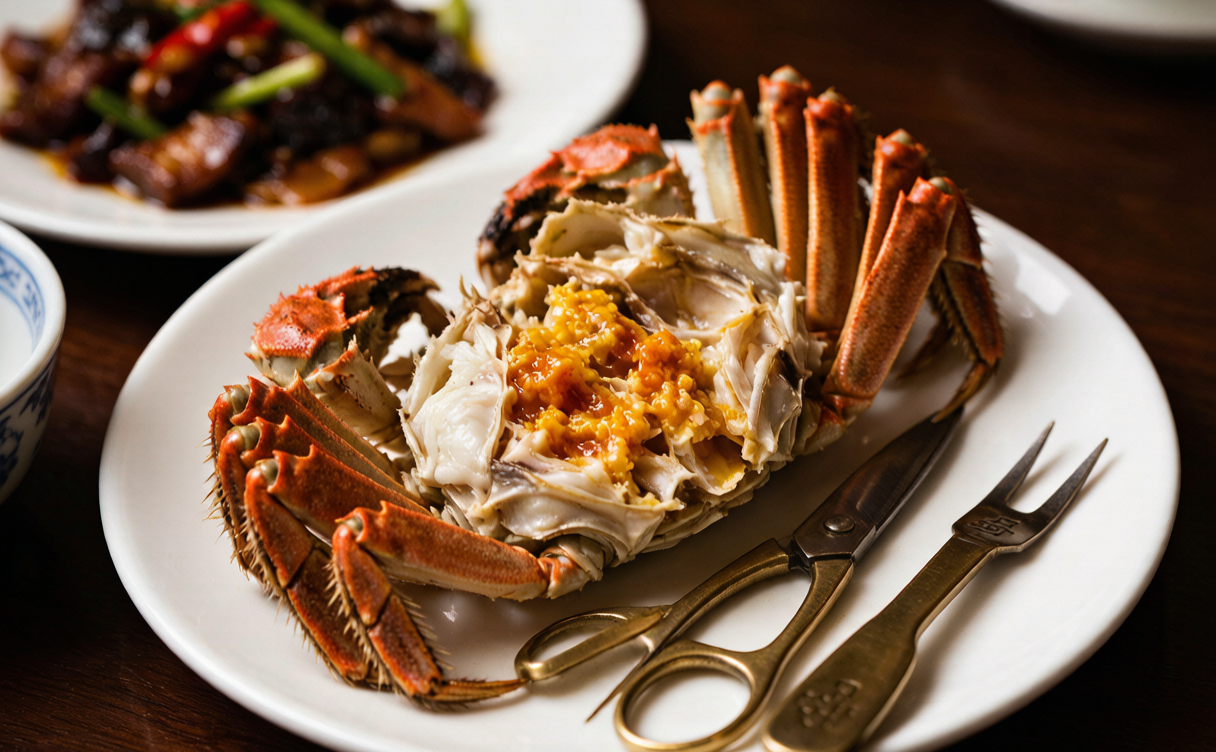
The point is what is inside the shell. In females, the orange roe (蟹黄, xiè huáng) sets into a dense, rich paste with the texture of a firm custard and a flavour somewhere between sea urchin and salted egg yolk. In males, the milt (蟹膏, xiè gāo) turns translucent, sticky and faintly sweet. Both are eaten straight from the shell with a dab of vinegar, and both are why people pay extraordinary sums for what is essentially a pond crab.
The cooking is deliberately minimal: steamed whole, bound in string so the legs stay attached, with a few slices of ginger and a perilla leaf. Everything depends on the raw material, which is why provenance drives the price so hard.
Season Dates: Getting the Timing Right
The season runs from roughly mid-September to late December, peaking in October and November. Within that window there is a rule every Chinese diner knows: 九雌十雄 (jiǔ cí shí xióng) — “ninth month females, tenth month males”, referring to lunar months. In practice:
- Late September to early November: females are at their best, roe fully set. This is the premium period.
- November into December: males come into their own, milt thick and glossy.
- Before mid-September: the crabs are undersized and underdeveloped. Anything sold as hairy crab in July is either frozen from last year or not worth eating.
If you are planning a trip around it, the crab season overlaps perfectly with the best weather and colour in the Yangtze delta — see our roundup of autumn destinations across China for how to build the rest of the itinerary.
Where They Come From: Yangcheng Lake and the Rest
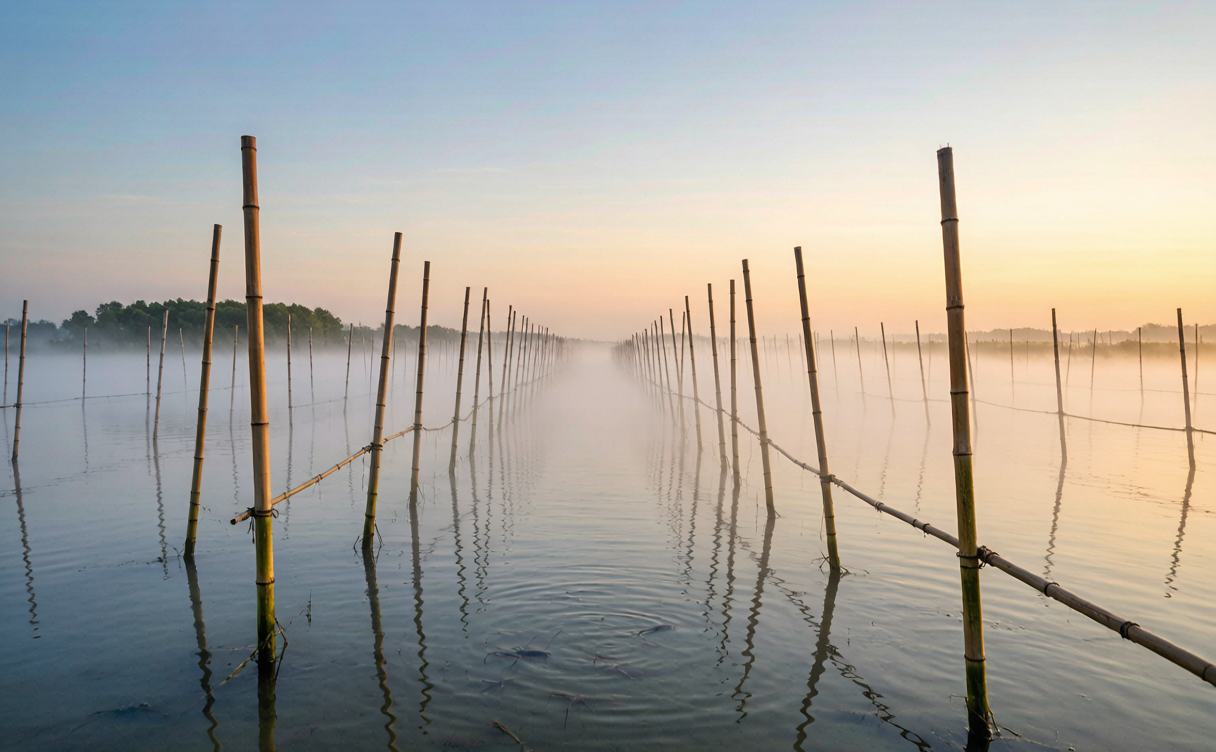
Yangcheng Lake (阳澄湖, Yángchéng Hú), just east of Suzhou in Jiangsu, is the name everybody chases. Its shallow, clear, hard-bottomed water is said to produce crabs with paler shells, cleaner bellies and firmer meat. The lake’s crabs carry a numbered anti-counterfeit ring, and even so, the widely repeated joke is that far more “Yangcheng Lake” crabs are sold each year than the lake could possibly produce.
The honest position: Yangcheng crabs are excellent, and heavily marked up. Several other waters produce crabs that are nearly as good for a fraction of the price — Taihu Lake near Wuxi, Gucheng Lake in Nanjing, Hongze Lake in northern Jiangsu, and the Chongming Island farms in Shanghai. Blind tastings rarely separate them cleanly. If your budget is limited, eat Taihu crabs and spend the difference on more of them. The Wuxi travel guide covers the lakeside restaurants there.
What It Costs
Crabs are priced by weight, expressed in liǎng (两), a unit of 50 grams. A “four-liang” female is 200 grams. Bigger crabs cost disproportionately more, because roe volume rises faster than body weight.
| Size and type | Typical restaurant price each | US$ approx. |
|—|—|—|
| 3 liang female (150g), lake unspecified | ¥60–100 | US$8–14 |
| 3.5–4 liang female, Taihu | ¥100–160 | US$14–22 |
| 4 liang female, certified Yangcheng | ¥200–380 | US$28–53 |
| 4.5–5 liang male, Yangcheng | ¥260–450 | US$36–63 |
| Peak-season premium, top restaurants | ¥500+ | US$70+ |
Market prices are considerably lower than restaurant prices — often half — and the wholesale markets around Yangcheng Lake and in Shanghai sell by the pair or the box. Expect to pay ¥400–900 (US$56–125) for a boxed gift set of eight, which is how most Chinese buyers acquire them.
A realistic budget for two people eating properly in a mid-range Suzhou restaurant: ¥400–700 (US$56–98) including two crabs each, a couple of vegetable dishes, rice wine and rice.
Where to Eat It
Suzhou is the spiritual home. The restaurants on the Yangcheng lakeshore, particularly around Bacheng and Lianhua Island, do the classic version, and the city’s old-town restaurants serve it alongside the rest of the local repertoire. Suzhou’s food culture goes far beyond crab — squirrel fish, mooncakes with pork, white sauce noodles — and our Suzhou food guide covers the full picture, while the Suzhou travel guide handles gardens and logistics. The city’s classical gardens are themselves a UNESCO World Heritage site, and pairing a morning garden visit with an afternoon crab lunch is close to the perfect Jiangnan day.
Shanghai offers the widest range, from old-school Benbang restaurants in the former French Concession to hotel dining rooms doing crab tasting menus. Prices are the highest in the country and the crabs are trucked in, but the cooking is often the most polished. First-time visitors should read the Shanghai orientation guide for districts and transport. While you are in the city, the other autumn obsession worth chasing is crab-roe soup dumplings, covered in our Shanghai soup dumpling guide — a xiaolongbao filled with crab roe and pork is arguably an easier introduction than a whole crab.
Nanjing, Wuxi and Hangzhou all have strong local scenes with better value than Shanghai. In any of these cities, the crab restaurants worth eating in are the ones with live tanks by the door and a queue of local families on a Saturday.
How to Eat a Hairy Crab
Traditionally there is a set of eight small bronze tools for this — the 蟹八件 (xiè bā jiàn) — but a spoon, a pair of chopsticks and patience will do. The sequence:
1. Detach the legs and claws first and set them aside. They keep the meat warm and you eat them last.
2. Turn the crab belly-up and pull off the triangular flap on the underside. Discard it.
3. Lever the top shell off with your thumbs. Inside the shell is a pool of roe or milt — this is the prize. Add a drop of vinegar and eat it straight from the shell with the spoon.
4. Remove and discard four things: the feathery grey gills along both sides, the hexagonal stomach sac behind the eyes, the black intestinal thread running down the middle, and the small white hexagonal heart in the centre of the body. These are inedible and unpleasant.
5. Break the body in half and pick the white meat out of the chambers with chopsticks.
6. Crack the claws last, using the flat of a spoon or the shell edge, and suck the legs.
Eat slowly. A crab takes a good fifteen minutes if you do it properly, and rushing is regarded as a waste of an expensive animal.
What to Drink and Eat Alongside
The classic accompaniment is a saucer of Zhenjiang black vinegar with finely shredded ginger (姜丝香醋), warmed slightly. It cuts the richness and is not optional as far as locals are concerned.
To drink, warmed Shaoxing yellow rice wine (黄酒, huáng jiǔ) is the traditional pairing — amber, nutty, gently sweet, served in a small ceramic cup sometimes with dried plums or ginger. It is about 15% alcohol, so a small pot goes further than it looks. Warm ginger tea is the non-alcoholic standard.
Order a couple of hot vegetable dishes as well. Crab is cold food in local reckoning and the meal feels unbalanced without something warm — stir-fried water shield soup, garlic pea shoots, or a bowl of rice.
Practical Warnings and Common Mistakes
Only eat crabs that were alive before cooking. A hairy crab that died before steaming spoils fast and is a genuine food-safety risk. In a restaurant, they should come from a live tank; if you buy from a market, the legs should still be moving.
Never eat them raw or drunken-style unless you know the source. Raw marinated crab exists in some regional cuisines and carries a real parasite risk from freshwater species. Steamed and thoroughly hot is the safe standard.
Watch the portion. Crab roe is extremely rich and high in cholesterol. Two crabs is a normal serving; four will defeat most people. Anyone with a shellfish allergy should avoid the restaurant entirely, since the steamers and sauces are shared.
Beware the online bargain. Gift vouchers and cut-price mail-order crabs are a well-documented scam market, with undersized crabs, dead-on-arrival deliveries and vouchers that cannot be redeemed at peak season. Buy from a physical shop or eat in a restaurant.
Check the bill. Crabs are priced by weight, and a menu quoting per-liang rates can produce a much larger total than expected. Ask for the price per crab, confirmed on a calculator, before the order goes to the kitchen.
Is it worth the money? For a first-time visitor in the Yangtze delta in October, yes — once. The flavour is unlike anything else, the ritual of eating it is half the experience, and a lakeside lunch in Suzhou with a pot of warm rice wine is one of the great set-pieces of autumn travel in China. Just start with a mid-priced crab from Taihu rather than a trophy from Yangcheng Lake, and spend the savings on a second one.