

Sooner or later, usually at a round table with a lazy Susan and far too many dishes on it, someone will fill a thimble-sized cup with a clear liquid and raise it in your direction. This baijiu guide for foreigners exists for that moment. Baijiu is the world’s most-consumed spirit by volume and almost the least understood outside China — powerfully aromatic, high in alcohol, tied up in a century of table ritual, and capable of producing either a very good evening or a very bad morning depending entirely on how you handle the first twenty minutes.
What Baijiu Actually Is
Baijiu (白酒, báijiǔ, literally “white spirit”) is a distilled grain liquor, typically 38% to 53% alcohol by volume, most often made from sorghum and sometimes blended with rice, wheat, corn or barley.
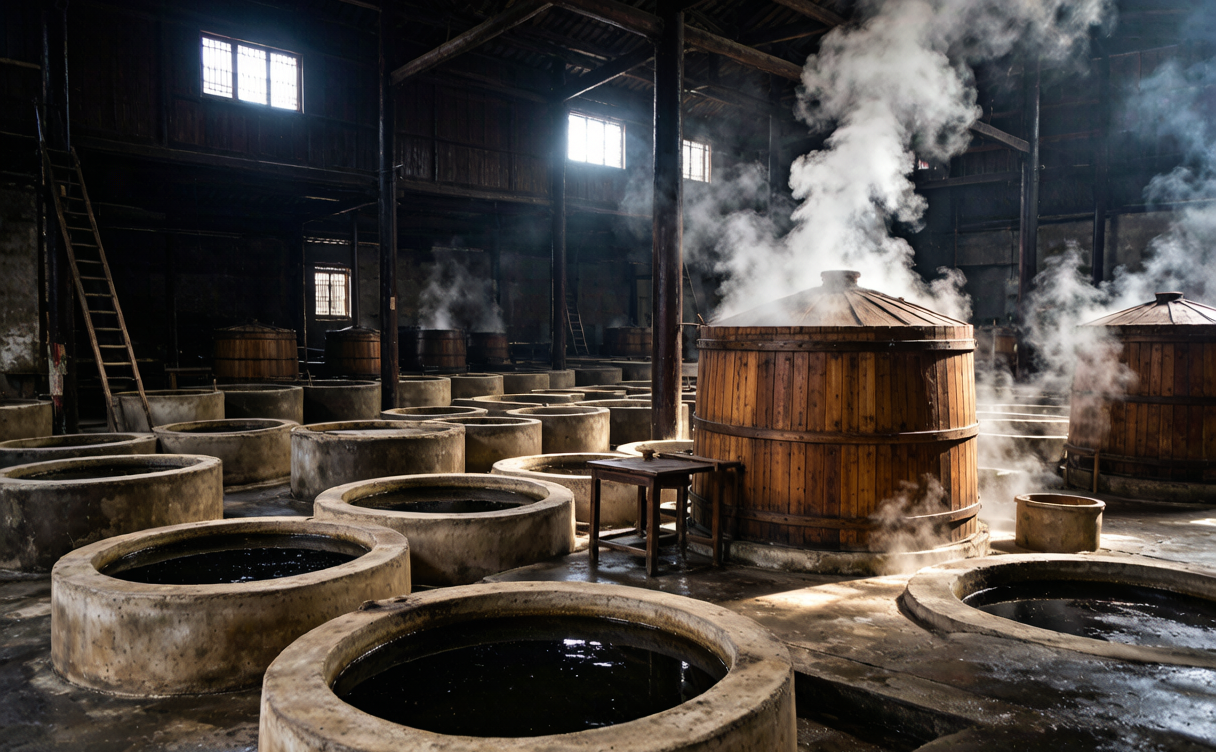
What makes it unlike vodka, whisky or shochu is the fermentation agent. Chinese distillers use qū (曲), usually translated as “jiuqu” or fermentation starter — bricks of crushed grain colonised by wild moulds, yeasts and bacteria, left to mature in warm rooms for weeks. That microbial cocktail is then buried with cooked grain in earthen pits, stone vessels or clay jars for anywhere from a month to a year before distillation.
The result is a spirit with an enormous congener load — hundreds of aromatic compounds that give baijiu its characteristic intensity. First-time drinkers often describe it as tasting of pineapple, soy sauce, blue cheese, overripe fruit or wet stone, sometimes all at once. It is not a subtle drink and it does not try to be.
The Aroma Categories: The Single Most Useful Thing to Know
Baijiu is classified by aroma type (香型, xiāng xíng), and knowing which one you are being poured tells you almost everything about what to expect. There are more than a dozen recognised categories; four account for most of what you will encounter.
| Aroma type | Chinese | Character | Famous examples | Beginner-friendly? |
|—|—|—|—|—|
| Strong / thick | 浓香型 | Fruity, sweet, pineapple and banana, oily body | Wuliangye, Luzhou Laojiao | Moderate |
| Sauce / soy | 酱香型 | Deep, savoury, umami, soy sauce and mushroom | Moutai, Xijiu | Difficult but rewarding |
| Light / rice | 清香型 | Clean, dry, floral, closest to vodka | Fenjiu, Erguotou | Yes — start here |
| Rice aroma | 米香型 | Soft, mild, faintly honeyed | Guilin Sanhua | Yes |
If someone hands you your first ever cup and it is a sauce-aroma Moutai at 53%, you are being thrown in at the deep end. The gentler entry point is a light-aroma Fenjiu from Shanxi, or a rice-aroma spirit from Guangxi — both are clean, comparatively restrained, and give you a reference point.
The Big Names and What They Cost
Moutai (茅台, Máotái) is the national prestige bottle, made in a small town in Guizhou, sauce-aroma, 53%. Official retail for the flagship Feitian is around ¥1,499 (US$210) but market prices routinely run ¥2,200–2,800 (US$310–390) and higher for aged expressions. It is a status object as much as a drink.
Wuliangye (五粮液) from Sichuan is the great strong-aroma rival, made from five grains, typically ¥900–1,200 (US$125–170).
Luzhou Laojiao (泸州老窖) uses fermentation pits in continuous use for centuries; mid-range bottles sit at ¥200–500 (US$28–70). Fenjiu (汾酒) from Shanxi is the classic light-aroma spirit, clean and dry, from around ¥100–300 (US$14–42). Erguotou (二锅头), the Beijing workhorse in a small green bottle, costs ¥6–15 (US$1–2) and is what taxi drivers drink with a plate of peanuts — at 56% it is not gentle, but it is a very cheap education.
The spread between ¥10 and ¥2,500 is real, and much of the top end reflects scarcity and gifting culture rather than better flavour. For a visitor, the interesting zone is ¥150–400 (US$21–56).
Toasting Etiquette: The Rules That Actually Matter
Baijiu toasting etiquette in China is where most visitors feel out of their depth, but the system is more forgiving than it looks. A few principles cover almost every situation.
The host leads. The first toast belongs to the host, and it is offered to the whole table. Wait for it. Drinking before the first collective toast is the one genuine misstep.
Gānbēi means empty the cup. 干杯 (gānbēi) literally means “dry the cup”, and when someone says it while looking at you, they intend to finish theirs. 随意 (suíyì) means “as you like” — sip as much as you want. If you say suíyì when you toast someone, you are releasing them from the obligation, which is a courtesy.
Lower your glass. When clinking with someone senior to you in age or position, hold your cup so its rim meets below theirs. It is a small gesture and it is noticed.
Two hands. Hold the cup with your right hand and steady the base with your left, particularly when receiving a pour.
Reciprocate. If someone toasts you individually, you owe them one back at some point in the meal — go round the table, say something short and specific, and drink.
Never toast with an empty cup, and never pour for yourself alone while leaving neighbours’ cups empty. Watching the cups around you and refilling them is the mark of a good guest.
Our broader China etiquette guide for tourists covers seating order, chopstick rules and the business-card ritual that often precedes all this.
How to Drink It Without Suffering
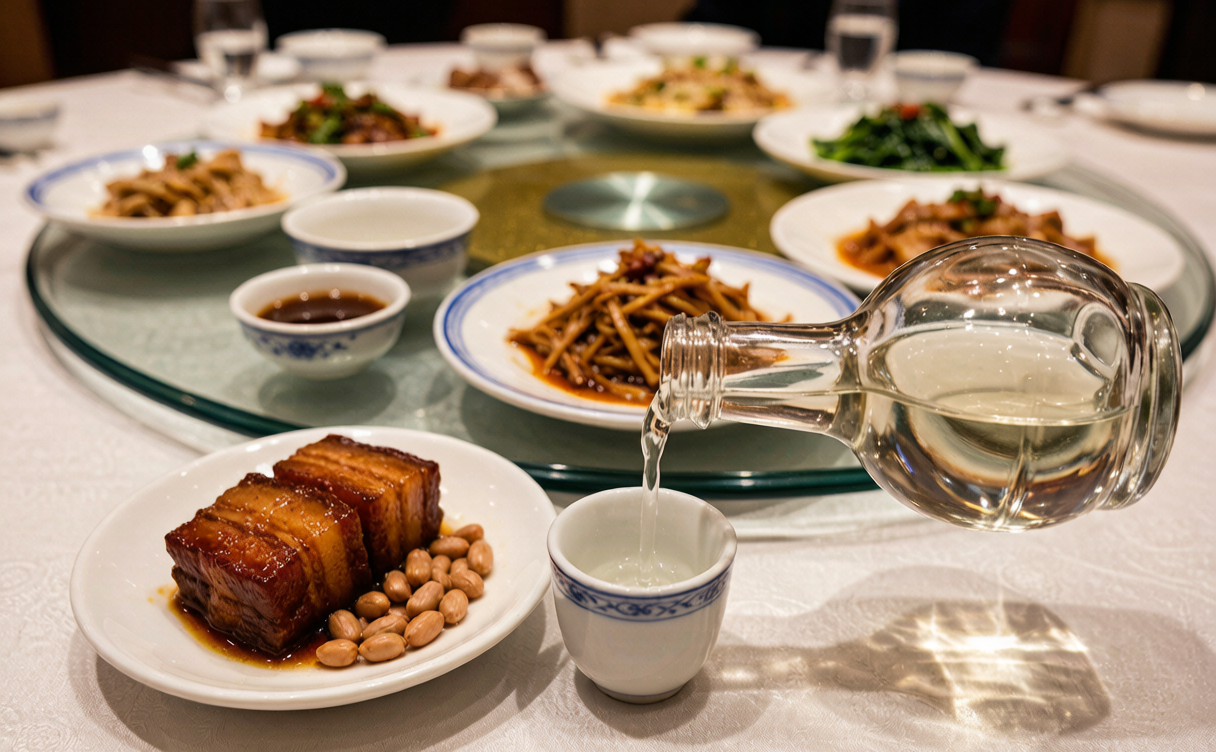
The single most effective strategy is to eat continuously. Baijiu is designed to be drunk with food, never on its own, and a table loaded with braised pork, peanuts, cold dishes and rice is your primary defence. The regional pairings genuinely work — a strong-aroma Sichuan baijiu against numbing mala food, a clean Fenjiu with northern lamb; our eight great cuisines guide is a useful map of what goes with what.
Practical tactics, all of them locally accepted:
- Declare early, not late. Saying at the start that you drink only a little is completely normal and respected. Reversing course after three rounds is harder.
- Sip and announce it. Raise your cup, say suíyì, take a small sip. Nobody objects.
- Use tea or water as your reciprocal drink if you are not drinking alcohol at all. Toasting with tea is an accepted substitution — the gesture matters more than the liquid.
- Exhale after, not during. Breathe out through your nose after swallowing rather than inhaling over the cup. The burn is largely aromatic.
- Pace with the group. Cups hold only 15 to 25ml, but at 53% six of them equal roughly three shots of spirits.
- Medical or driving reasons are absolute. “I’m driving” or “I’m on medication” ends the pressure instantly and honourably.
Nobody at a Chinese table wants a guest to be ill. The pressure is a form of hospitality, and a polite, cheerful, consistent limit is understood by everybody.
Where to Drink and Taste It
At the table is the default and the best introduction — any decent restaurant will have several bottles behind the counter, and ordering a small 100ml bottle for the table is inexpensive and low-commitment.
Dedicated baijiu bars now exist in Beijing, Shanghai, Chengdu and Guangzhou, several serving tasting flights of three or four aroma types with food pairings. This is by far the most useful way to work out what you like, and prices for a flight typically run ¥80–200 (US$11–28). Our nightlife and bar guide covers the cities where these are easiest to find.
Distillery towns are the deep dive. Zunyi in Guizhou is the gateway to Maotai Town, where the valley air genuinely smells of fermenting sorghum and several distilleries run visitor halls; see the Zunyi travel guide. Yibin in Sichuan does the same for Wuliangye, and Luzhou’s old fermentation pits are open to visitors. If you enjoy this kind of thing, China’s brewing heritage is also well presented at the Tsingtao Beer Museum in Qingdao.
Buying a Bottle to Take Home
Counterfeiting is a genuine problem at the premium end, so buy from supermarkets, airport duty free, official brand stores or large chain liquor retailers — never from a street stall or an unsolicited “wholesale” contact. Genuine bottles have anti-counterfeit codes, sealed caps and clean, sharply printed labels.
Check the alcohol strength before you commit: many bottles are 52% or 53%, which exceeds the limits some airlines set for spirits in checked baggage, and anything above 70% cannot be carried at all. Duty-free allowances and the rules on taking goods out of China are published by the General Administration of Customs of China, and your home country will have its own import allowance — usually one to two litres per adult.
Practical packing advice: baijiu bottles are heavy glass, frequently in ceramic, and boxed. Buy at the airport if you can. If you buy in the city, wrap the bottle in clothing inside a hard-sided case and put it in the centre of the bag. For gift ideas beyond spirits, our shopping and souvenirs guide has alternatives that survive a long-haul flight more reliably.
A Reasonable First Encounter
If you want to approach baijiu deliberately rather than by ambush, do it in this order. Start with a light-aroma Fenjiu at a restaurant, with food, in small sips. Move to a strong-aroma Sichuan bottle with something spicy. Only then try a sauce-aroma spirit, which is the most demanding and the one most likely to convert you if you get to it in the right sequence. Keep the cups small, keep eating, and stop when you have had enough.
Plenty of visitors never come round to it. But a surprising number find that somewhere around the third encounter the spirit stops tasting like an assault and starts tasting like a place — sorghum, damp earth, old clay jars, a valley in Guizhou. That is when a bottle stops being a dare and becomes a souvenir worth carrying home.