

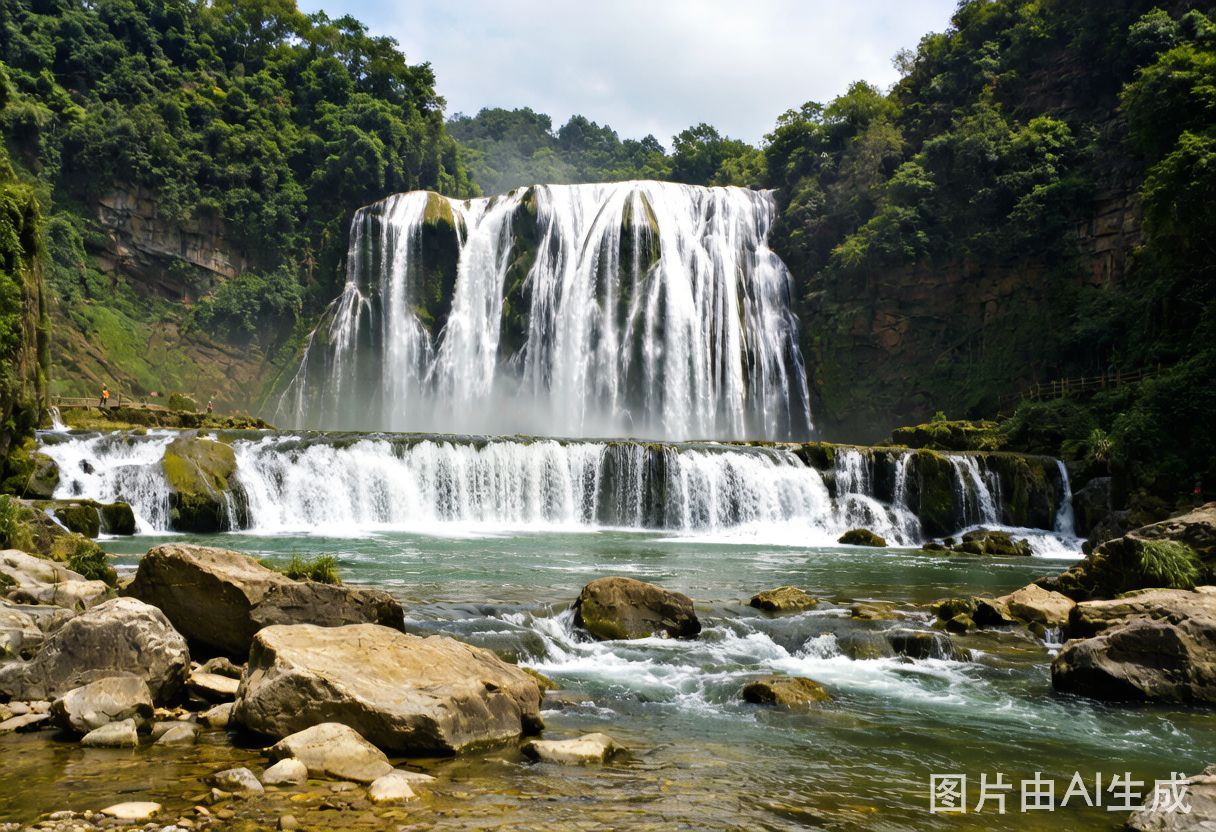
Standing on the viewing platform at Huangguoshu, I felt the ground actually tremble. A wall of water 81 meters (266 ft) high and 101 meters (331 ft) wide was hurling itself into the White Water River below, and the spray drifting back up toward me carried the cold, mineral scent of the Guizhou mountains. This is not a single pretty cascade you photograph and leave. Huangguoshu is the centerpiece of a cluster of more than 18 waterfalls scattered through a 12-kilometer limestone gorge in Anshun, Guizhou, China — and it is the largest waterfall by volume in all of Asia.
Most foreign travelers have never heard of it. They fly to Guilin for the karst hills or queue for the pandas in Chengdu. But if you are the kind of traveler who wants to feel nature rather than just tick a box, Huangguoshu deserves a firm place on your China list. In this guide I will walk you through what makes it unique, how to walk behind the falls, when to go for the biggest flow, exactly how to reach it from Guiyang or Kunming, and how to fold it into a wider southwest-China trip.
Why Huangguoshu Is Different From Any Other Waterfall
The first thing to understand is that “Huangguoshu Waterfall” is marketing shorthand for an entire waterfall system. The main drop — the one everyone photographs — measures about 77.8 meters (255 ft) of free fall and a face of over 100 meters wide at peak flow. But it sits inside the Huangguoshu National Park, where the Baishui River (白水河) tumbles down a series of steps through porous karst. Upstream and downstream you will find the Doupotang Waterfall, the Tianxingqiao (Star Bridge) caves and cascade system, and a dozen smaller falls threaded through bamboo and limestone.
What earns it the title “largest in Asia” is water volume and width rather than height. During the summer flood season the river can discharge over 700 cubic meters per second, a thunderous sheet you feel in your chest. I have stood at Niagara and at Victoria Falls, and Huangguoshu is a different experience: it is intimate and vertical, wrapped in green mountains, and you can get behind it.
The entire region sits within the South China Karst, a UNESCO World Heritage landscape recognized for its tower karst, Fengcong (peak clusters) and Fenglin (peak forests). When you look at the smooth limestone walls the water carves through, you are looking at geology that took hundreds of millions of years to shape. For background on the protected landscape, see the UNESCO listing for the South China Karst: https://whc.unesco.org/en/list/1248/
Walking Behind the Falls: The Water-Curtain Cave
This is the single feature that sets Huangguoshu apart from almost every major waterfall on Earth. Cut into the cliff behind the curtain of water is the Water-Curtain Cave (水帘洞, Shuilian Dong) — a natural tunnel about 134 meters long that lets you stand inside the waterfall. There are six viewing windows and five openings where you can press your face to the rock and watch the river explode past, inches from your nose, while you stay (mostly) dry.
I will be honest: it is misty, slippery, and crowded at midday. Bring a rain jacket even in August — the spray soaks the walkway. The path winds between viewing windows to a ledge where rainbows form whenever the sun breaks through — and you can enjoy the novelty of hearing the roar from inside the rock without knowing any mythology.
A practical note from my visit: the cave one-way system is enforced, and it closes in heavy rain for safety. Go early. The park opens around 7:00–7:30 a.m. in summer, and the first hour is magic — fewer tour groups, better light, and the morning mist still hanging in the gorge.
Best Time to Visit: Catch the Summer Torrent
If you want the waterfall at its most spectacular, plan for June through August, the heart of Guizhou’s rainy season. The Baishui River swells with monsoon runoff from the Yunnan-Guizhou plateau, and the falls hit maximum width and volume. Yes, it is hot and humid, and yes, it rains — but that is precisely when Huangguoshu earns its reputation. I visited in late July and the flow was so heavy the viewing platform vibrated.
Shoulder seasons work too. May and September offer strong flow with smaller crowds and more comfortable temperatures. October to April is the dry season: the falls are thinner, sometimes reduced to a few silver ribbons, and the water-curtain cave experience is less dramatic. If your trip only allows winter, lower your expectations and enjoy the quieter trails and karst scenery instead.
For a wider seasonal picture of the country, our guide to the best time to visit China breaks down weather and crowds month by month.
Getting There: Anshun as Your Base
Huangguoshu sits about 45 km (28 mi) southwest of Anshun city and roughly 130 km (80 mi) from Guiyang, the capital of Guizhou, China. The gateway hub is Anshun, which has its own high-speed rail station.
From Guiyang (the easiest and most common route): high-speed trains from Guiyang North to Anshun West take about 30–40 minutes. From Anshun West, shuttle buses and taxis cover the remaining 45 minutes to the park entrance. Some travelers also take a direct tourist bus from Guiyang. If you are coming from further afield, fly into Guiyang Longdongbao International Airport and connect by train.
From Kunming (Yunnan, China): the high-speed line between Kunming and Guiyang makes this very doable. Kunming to Guiyang is roughly 2–2.5 hours by train, then follow the Guiyang–Anshun route above. Kunming is a wonderful starting point if you are building a Yunnan-and-Guizhou loop. Our Kunming travel guide has the airport and station details to plan that leg.
From other cities: Guilin, Chengdu, and Chongqing all have rail links into Guiyang, so Huangguoshu slots neatly into a southwest itinerary. Train booking is simpler than it used to be; our high-speed train guide for foreigners explains the 12306 app and required documents.
Miao and Buyi Culture Around the Falls
Guizhou is one of China’s most ethnically diverse provinces, and the Huangguoshu area is home to Miao (Hmong) and Buyi (Bouyei) communities whose villages dot the hills between the karst peaks. This is a big part of why I recommend staying overnight rather than rushing in and out.
Around the park and in nearby Anshun you can find Miao batik (wax-resist dyeing), Buyi stone villages built from the same limestone as the cliffs, and seasonal festivals with lusheng reed-pipe music and embroidered costumes. The food is its own reward: sour fish hotpot, sticky rice wrapped in leaves, pickled vegetables, and the region’s famous griddled tofu. None of it is tourist-theater if you wander a little off the main path and into a village market.
I spent an afternoon in a Buyi stone village near Tianxingqiao with cured pork and wild greens that cost less than a coffee back home — the kind of unplanned encounter that makes Guizhou special.
A Practical One-Day vs Two-Day Plan
One day is enough if you are tight on time: arrive at opening, walk the main falls and water-curtain cave, loop through Doupotang, and catch an afternoon train out. You will be tired and mist-soaked, but you will have seen the icon.
Two days is what I recommend. Day one covers the main waterfall and cave; day two explores Tianxingqiao’s cave-and-cascade system and a nearby Miao or Buyi village, with a relaxed evening in Anshun. The park ticket is typically valid for a set window (often one or two days depending on the season), so confirm when you buy.
Tickets and hours change, but as a rule: buy online or at the gate, arrive at opening, wear grippy shoes, and pack a light rain jacket and a dry bag for your phone. Drones are restricted near the falls — check current rules before you fly one.
Combine Huangguoshu With the Rest of Guizhou and Yunnan
Huangguoshu is rarely a standalone trip — and it shouldn’t be. Guizhou, China pairs beautifully with neighboring Yunnan, China, and the rail network makes multi-stop loops easy.
A natural route is Guiyang → Huangguoshu (Anshun) → Kunming → Dali → Lijiang. From Kunming you can roll south to the rice terraces and north to the old towns. Our Dali, Yunnan travel guide covers the Erhai Lake loop, and the Lijiang Old Town guide handles the Naxi heritage streets. If you would rather chase karst rivers than mountain towns, the Guilin and Yangshuo guide shows how to pair Guizhou’s waterfalls with Guangxi’s limestone scenery on a single sweep through southern China.
Practical Tips Before You Go
- Cash vs card: Alipay and WeChat Pay dominate, but carry some cash for village stalls. See our cash in China guide for the 2025 reality.
- Get there early: Opening hour is your friend — the mist, light, and empty platforms are worth a 6:30 a.m. start.
- Dress for water: Non-slip shoes, a packable rain jacket, and a phone dry bag. The water-curtain cave will find a way to wet you.
- Stay in Anshun: Hotels are cheaper and the commute to the park is short. Guiyang works too if you want a bigger city base.
- Mind the holidays: Chinese public holidays turn the park into a human river. Check the crowd calendar before locking dates.
Why It’s Worth the Detour
I have sent friends to Huangguoshu who expected a quick photo stop and left calling it the highlight of their China trip. There is something humbling about a waterfall you can walk inside, fed by a river older than the mountains around it, in a province where minority cultures still shape daily life. It is not as famous as the Li River or the Great Wall, and that is exactly its advantage — you get the wow without the wall-to-wall crowds, at least if you time it right.
If your China plan has room for one more wonder off the standard track, put Guizhou, China on the map and let Huangguoshu be the reason. Bring a rain jacket, arrive at dawn, and stand behind the curtain. You will hear it long after you leave.