

I still remember the moment my knees started to shake on the Plank Walk. There is no “path” in the ordinary sense — just a two-foot-wide wooden board bolted to a vertical cliff face, a thin harness clipped to a rusted chain, and a 2,000-meter drop opening beneath my boots. This is Huashan, or Mount Hua, the mountain the Chinese have called “the most precipitous under heaven” (奇险天下第一山) for over a thousand years, and it sits barely two hours east of Xi’an by high-speed train. If you came to China expecting gentle temple hills, Huashan will recalibrate your definition of a hike.
I’ve now climbed it twice — once in a sleepless rush to catch sunrise on the East Peak, once at a slower pace to actually enjoy the weird, thrilling ridges. Below is everything I wish someone had handed me before that first cable car ride up into the clouds.
Why Huashan Earns Its Terrifying Reputation
Huashan is one of China’s Five Great Mountains, but unlike the others it doesn’t whisper “sacred.” It screams “don’t look down.” The mountain rises in five distinct peaks — East (Chaoyang), South (Luoyan), West (Lianhua), North (Yuntai), and Center (Yunv) — each a granite blade separated by knife-edge ridges. The Taoist temples and cable-car stations soften the edges, but the core experience is the same one pilgrims and generals knew centuries ago: you are walking up a stairway carved into living rock.
What surprised me most wasn’t the height. It was the exposure. On the popular routes the stone steps are wide and railed, perfectly manageable. Then you turn a corner onto something like the Plank Walk or “Yaozi Fanshen” (the name means “the falcon turns its body”) and the rails simply stop. That contrast — safe one second, vertiginous the next — is the whole personality of the mountain.
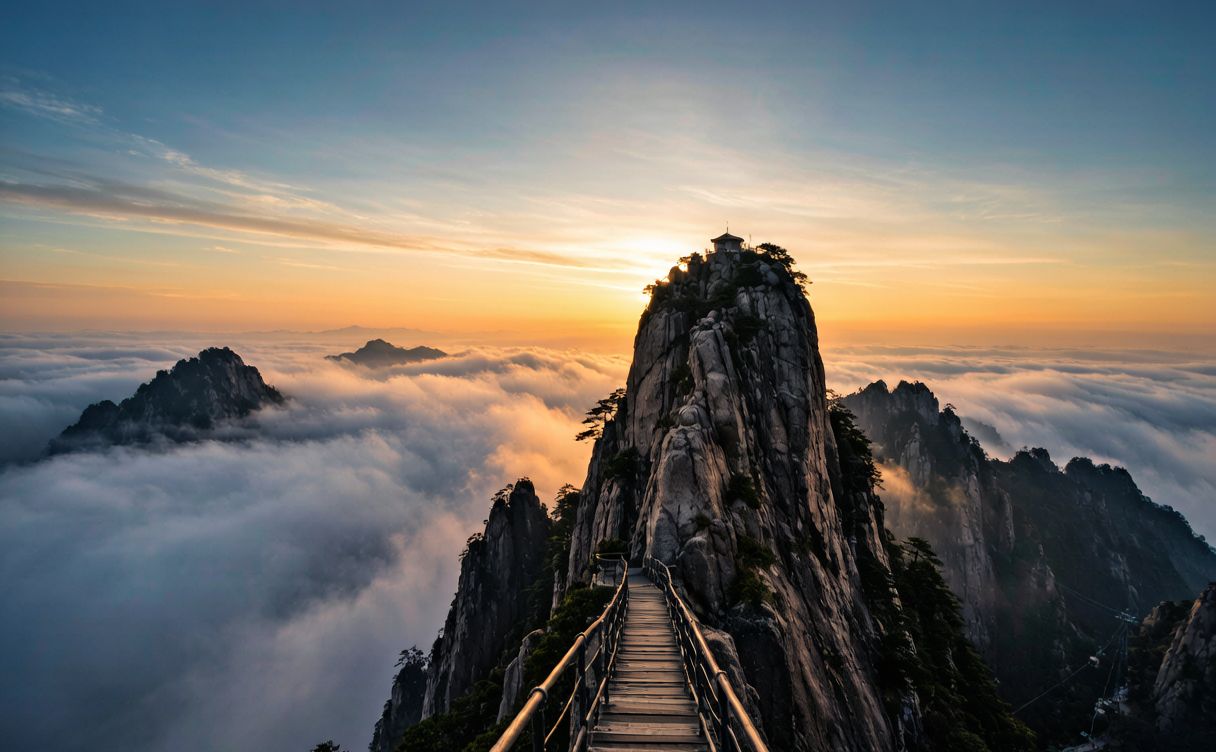
Getting There From Xi’an
Huashan sits in Huayin City, Shaanxi Province, about 120 km east of Xi’an. The easiest and most reliable way is the high-speed train from Xi’an North Railway Station to Huashan North (华山北). Trains run roughly every 30–60 minutes and the ride is 30–50 minutes depending on the service. From Huashan North station, a local bus or taxi covers the last 10–15 minutes to the scenic area entrance.
If you’re building a Shaanxi itinerary, pair this with the city itself. Most visitors fly or train into Xi’an for the Terracotta Army and then realize the country’s most adrenaline-charging hike is a half-day trip away. Our Xi’an travel guide breaks down where to stay and how to route your days, and the Terracotta Warriors visit guide covers the must-see that everyone pairs with a Huashan climb. If you’re arriving from another city, our high-speed train guide for foreigners explains ticketing through 12306 and what to expect at the station.
Cable Car vs. Hiking: My Honest Take
This is the first decision you’ll face, and there’s no single right answer.
The cable cars. Huashan has three main cable lines. The West Peak (Taiping) cable car is the headline act — a 20-minute ride in a large gondola that climbs more than 1,500 vertical meters, the longest single-drop cable car in Asia. It dumps you near the West Peak, shaving hours off the ascent. The North Peak (Huangfu) cable car is shorter and cheaper, landing you at the lowest of the five peaks, so you still hike up to the others. A smaller West Peak express option also exists.
The full hike. If you start from the foot, the classic route to the North Peak alone is around 4–6 hours of steep stone steps, then more to reach the higher peaks. Hardcore hikers do the whole mountain on foot in a long day.
My recommendation: take the West Peak cable car up and hike down via the North Peak, or vice versa. Going up by cable saves your legs for the scary, fun sections near the top; descending the steps is far kinder on the knees than descending by cable (and you actually see the mountain). On my second visit I took the cable up to West Peak at first light, walked the ridgeline to East Peak for sunrise, then descended all the way to North Peak and caught the second cable car down. That loop gave me every peak without a death march.
One practical note: in peak season and on weekends the cable car queues can be brutal — an hour or more. Arrive early or, better, start your climb the night before (more on that below).
The Three “Death” Sections (And How Scary They Really Are)
Huashan’s fame rests on three engineered thrill sections. All three require a separate small fee and a harness rental at the site.
1. Changkong Zhandao — The Plank Walk (长空栈道)
This is the one that shows up in every “world’s most dangerous hikes” list, and it earns it. A wooden plank path is pinned directly to a sheer cliff on the East Peak’s southeast side. You wear a safety harness clipped to a fixed chain, but the planks are narrow, the cliff drops straight down, and there is nothing between your chest and the sky. The route is one-way — you go out and come back. It’s not actually that long (maybe 100 meters round trip), but those minutes stretch. I went through in a lull between crowds and it was genuinely meditative, in a heart-pounding sort of way.
It is not for anyone with a real fear of heights, and it’s closed in high wind or rain. Don’t argue with the staff if they wave you off.
2. Yaozi Fanshen — The Falcon Turns (鹞子翻身)
Near the East Peak, this is a short down-climbing pitch where you descend a near-vertical rock face using iron rings hammered into the stone, then “turn your body like a falcon” at the bottom onto a ledge. It’s over in a few minutes but demands focus and decent upper-body control. Less exposed than the Plank Walk but more physically awkward.
3. The General’s Ridge and Sky Ladder (苍龙岭 / 天梯)
These are the natural vertigo zones, not gated attractions. Canglong Ling is a narrow ridge with alarmingly steep drops on both sides and fixed chains to hold — spectacular and a little unnerving even without a harness. The “Sky Ladder” is a near-vertical staircase section that you climb on all fours. None of these cost extra, but they’re where most first-timers quietly reconsider their life choices.
If Huashan leaves you wanting more vertical drama, our Huangshan (Yellow Mountain) guide covers a different but equally jaw-dropping granite range in Anhui, with its own famous sea of clouds.
Sunrise on the East Peak (And the Overnight Hack)
The East Peak (Chaoyang Feng, “Peak of the Rising Sun”) is the classic sunrise spot, and on a clear morning the view of the first light hitting the granite spines is the payoff for the whole trip. The smart move: hike up the night before, sleep in one of the basic hotels on the mountain (North or East Peak), and walk to the viewing terrace before dawn. I did this on visit one and it was unforgettable — headlamps tracing the ridges like a constellation, then sudden gold across the valleys.
If you can’t face the overnight, the alternative is the “midnight start”: take the first cable car (or hike through the night) so you reach East Peak around 5 a.m. In summer that means a very late evening departure from Xi’an. Either way, bring a headlamp, layers, and patience — the viewing platforms get crowded.
For timing your trip around weather and crowds, our best time to visit China guide has a season-by-season breakdown that applies well to Shaanxi.
Survival Tips I Learned the Hard Way
Go light, but not too light. Bring water (buy it low — prices climb with altitude), a few snacks, a rain shell, and a headlamp. The weather swings fast; I started in a t-shirt and ended in every layer I owned.
Wear real shoes. Smooth-soled sneakers are a mistake on wet stone. A grippy trail shoe makes the difference between confidence and terror on the descent.
Start early, always. Crowds compound the danger on the narrow sections and the cable queue is worst mid-morning.
Don’t trust “closed” Google info. Schedules, cable car maintenance, and section closures change. Check the official source before you go — the Mount Hua scenic area official site posts operating hours and alerts in Chinese, and your hotel in Xi’an can help translate.
Respect your fear. The Plank Walk and Falcon sections are optional. Plenty of people ride the cable, walk the safe ridgelines, catch the views, and call it a perfect day. There is no medal for white-knuckling something that genuinely terrifies you.
Carry cash and a working map offline. Signal is patchy up high. Our China travel safety tips roundup covers the basics of staying connected and solvent on remote hikes.
A Note on Difficulty and Who Should Skip It
Huashan is rated strenuous. If you have knee problems, serious vertigo, heart conditions, or are traveling with very small children, the cable-car-and-ridgeline version is the realistic ceiling — skip the Plank Walk and Falcon entirely. Fit travelers in their 20s–50s will find it challenging but doable in a day; out-of-shape travelers should budget two days with an overnight on the mountain. I’m reasonably fit and my legs were jelly by the North Peak descent. Humility helps.
Sample One-Day Game Plan (Cable Up, Hike Down)
- 06:30 — High-speed train Xi’an North → Huashan North
- 08:00 — Enter scenic area, West Peak cable car up
- 09:30 — West Peak temples and viewpoints
- 11:00 — Walk ridge to South Peak (highest, 2,154 m), do the Plank Walk if open
- 13:00 — East Peak, Falcon section, lunch at a peak café
- 15:00 — Descend via Canglong Ling ridge to North Peak
- 17:30 — North Peak cable car down, train back to Xi’an
That’s a full, triumphant day and you’ll still sleep in your own bed.
Huashan isn’t the tallest mountain I’ve climbed, but it’s the one that made my hands sweat just remembering it. The mix of ancient Taoist paths, brutal granite, and infamous plank boards is unlike anything else in China — and it’s close enough to Xi’an that you have no excuse not to try. Take the cable if you must, hike the ridges if you can, and don’t look down until you’re ready.