

Most people land in Beijing or Shanghai and never make it to the city that once ruled them both. This Nanjing travel guide is for the traveler who wants the layers most itineraries skip. Six dynasties and two republican governments called this place home, and you can still walk the original Ming city wall, climb the hill where Sun Yat-sen rests, and eat noodles that predate every guidebook. If you’re tired of the same three China photos, Nanjing is the reset button.
At a glance
- Best for: history lovers, walkers, food-focused travelers, anyone combining Shanghai + Beijing by rail
- Don’t miss: Ming city wall, Sun Yat-sen Mausoleum, Purple Mountain, Confucius Temple (Fuzimiao) night scene
- Getting there: 1h10m high-speed train from Shanghai, ~3h30m from Beijing
- Time needed: 2–3 full days
- Walkability: excellent inside the old city; metro covers the rest
- Vibe: calmer and greener than Shanghai, more relaxed than Beijing
Getting to Nanjing by high-speed rail
Nanjing sits right on the Beijing–Shanghai line, which is the busiest bullet-train corridor in the country. From Shanghai Hongqiao you’ll be in Nanjing South in about 70 minutes on a G-train. From Beijing South it’s closer to 3.5 hours. Trains run from early morning until late evening, and you rarely need to book more than a day ahead outside holidays.
Buy your ticket through the official 12306 system or a reseller app — the process is smoother than most first-timers expect. If you’re building a longer route, our China high-speed train guide for foreigners walks through seat classes, ID requirements, and how to read a Chinese train ticket.
Walking the Ming city wall
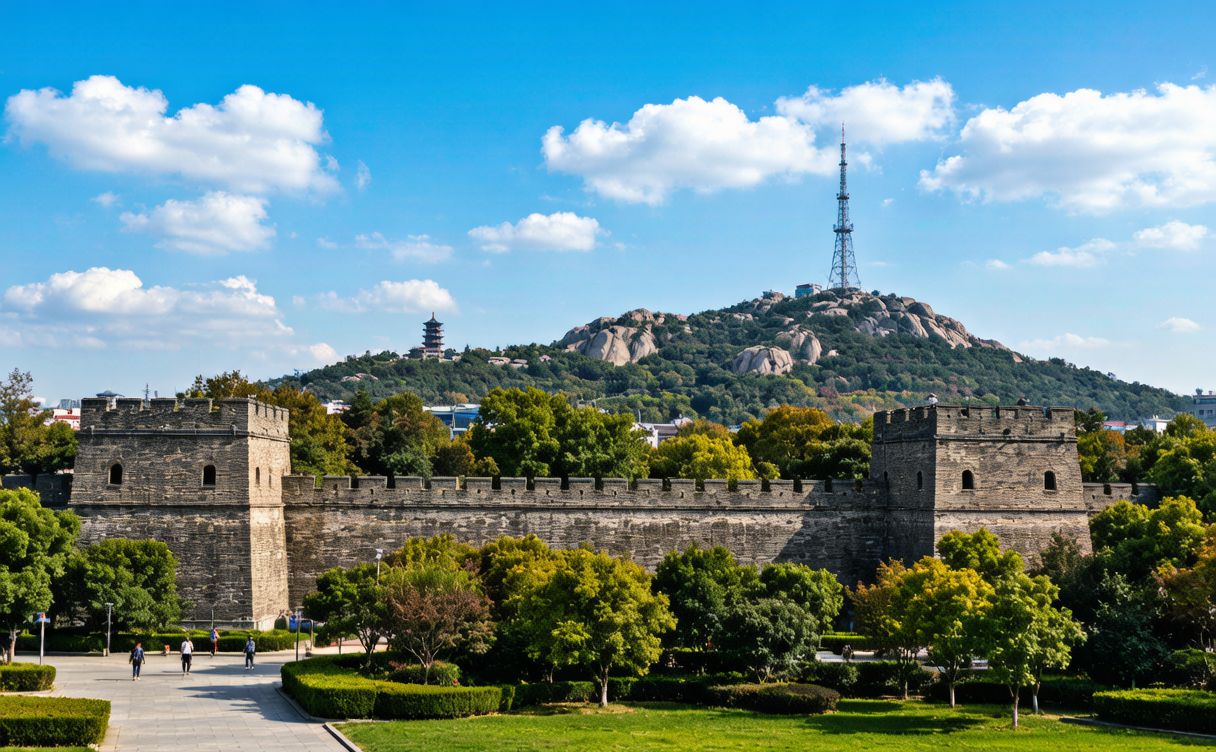
Nanjing’s wall is the real thing — not a replica. Built in the late 1300s under the first Ming emperor, it used to ring the city for 35 kilometers, and large stretches still stand. The bricks were individually stamped with the names of the villages and officials who made them, a 600-year-old quality-control system you can read with your own eyes.
The easiest place to get on top is the Zhonghua Gate (Gate of China) complex in the south. You can climb the ramparts, walk between the massive stone courtyards, and look down on where the old moat meets the new city. For a quieter experience, head to the section near Xuanwu Lake on the north side, where the wall doubles as a riverside path.
Bring good shoes. The wall is uneven in spots, and the stairs are steep. Go early or late in the day if you want photos without tour groups.
Purple Mountain and the Sun Yat-sen Mausoleum
Purple Mountain (Zijin Shan) rises on the city’s east edge and packs more than you can see in one visit. The headline stop is the Sun Yat-sen Mausoleum — a wide staircase climbing to a white marble hall where the founder of modern China is entombed. The climb is about 390 steps, but there’s a slow ramp feel to it and the view back over the city is worth the effort.
Just downhill is the Ming Xiaoling Mausoleum, the tomb of the Hongwu Emperor, surrounded by a sacred path lined with stone animals. It’s less crowded than the Sun Yat-sen site and arguably prettier in autumn, when the ginkgo trees turn gold. A third option, if your legs hold up, is the Purple Cloud Lake and the cable car that swings you over the canopy.
The Nanjing Massacre Memorial
This is the hardest stop in the city, and the most important. The Memorial Hall of the Victims in the Nanjing Massacre by Japanese Invaders documents the 1937 atrocities with survivor testimony, photographs, and a quiet courtyard of names. It is not a sightseeing photo opportunity — treat it like a place of remembrance.
Entry is free. Photography is restricted inside the exhibition halls, and visitors are asked to keep voices low. Most people spend 1.5 to 2 hours. It sits on the western side of the city near Yunjin Road, reachable by metro line 2. Go in the morning; the weight of it is easier to carry before a long day of other plans.
Confucius Temple and the Qinhuai River
Fuzimiao — the Confucius Temple area — is Nanjing’s social heart after dark. The Qinhuai River runs past restored pavilions, and the narrow lanes fill with tea houses, lantern shops, and snack stalls. It’s touristy, yes, but it’s the kind of touristy that’s been going on for a thousand years. Take a short boat ride on the river at night when the lanterns are lit; it’s the single most postcard-able moment in the city.
Step off the main strip and you’ll find quieter hutongs and small museums, including the former residences of scholars. If you want a break from crowds, the nearby Laomendong district keeps the old-town feel with fewer selfie sticks.
What to eat
Nanjing food is its own thing — salty, savory, and duck-forward. The city eats more duck per person than anywhere else in China, and they mean the whole bird: salted duck, braised duck, duck blood vermicelli soup.
- Duck blood vermicelli soup (鸭血粉丝汤): a breakfast-lunch staple, light broth with silky noodles
- Salted duck (盐水鸭): the signature, best from a neighborhood butcher, not a chain
- Tangbao soup dumplings: larger and soupier than Shanghai’s xiaolongbao
- Plum blossom cake (梅花糕): a sweet street snack shaped like the city flower
For a broader sense of regional cooking, our guide to China’s eight great cuisines puts Nanjing’s Jiangsu style in context with the rest of the country.
Planning your days
Two days covers the essentials; three lets it breathe. A simple split:
- Day 1: Ming city wall (Zhonghua Gate) → Confucius Temple and Qinhuai River at night
- Day 2: Purple Mountain — Sun Yat-sen Mausoleum and Ming Xiaoling
- Day 3 (optional): Massacre Memorial in the morning, then Xuanwu Lake or a slow afternoon in Laomendong
Nanjing works as a natural pause between Shanghai and Beijing, or as a base if you’re exploring the lower Yangtze. If you’re starting from scratch on a China plan, our first-timers travel guide covers visas, payments, and timing across the whole country. For the two bigger cities on either side, see the Shanghai first-time guide and the Forbidden City ticket guide for Beijing.
When to go
Spring (March–May) and autumn (September–November) are best — mild, less smog, and the ginkgo and plum blossoms put on shows. Summer is hot and sticky; winter is cold but uncrowded. For the wider picture across regions, our best time to visit China overview helps you stack Nanjing against places like Zhangjiajie or Xinjiang, China.
One practical note for any China trip: download offline maps and a translation app before you fly, since some platforms don’t work the way they do at home. The official tourism portal at Travel China Guide is a solid, frequently updated source for opening hours and ticket prices if you want to double-check details closer to your dates.
Nanjing won’t shout at you like Shanghai or Beijing. It lets the wall, the mountain, and the river do the talking — and if you slow down, they tell a fuller story of China than any single headline city.