

This Xi’an street food guide walks you through the noisy, delicious heart of Shaanxi cuisine, where the former capital of thirteen dynasties still eats like a frontier garrison town: big wheat noodles, roasted lamb, and flatbread stuffed with braised pork. The Xi’an street food guide below covers biangbiang noodles Xi’an locals queue for, the roujiamo Chinese burger that fuels a day of sightseeing, and the Xi’an food streets beyond Muslim Quarter that most tourists miss. Xi’an sits at the eastern end of the Silk Road, and its food carries the weight of that history — cumin from the west, wheat from the loess, and a love of chili oil that defines the north. Come hungry, because the city rewards grazing.
The DNA of Xi’an Street Food
Xi’an cooking is wheat-and-mutton country. Unlike the rice south, the north builds meals around noodles, steamed buns, and flatbreads, with chili oil (lazhi) and black rice vinegar doing the seasoning. The result is hearty, chewy, and deeply savory. For the regional frame, our Chinese food guide to the 8 great cuisines places Shaanxi within the broader northwest and shows how it differs from Sichuan heat or Cantonese lightness. The city’s signature noodle is explained on Wikipedia’s biangbiang noodles page, which also shows the famously complex character used to write its name — a symbol so long it barely fits on a signboard.
Must-Eat Dishes
Biangbiang Noodles Xi’an
The biangbiang noodles Xi’an is famous for are belt-wide ribbons of hand-pulled wheat dough, boiled, then topped with a smear of chili oil, garlic, scallion, and often a few pieces of cured pork or tomato-egg. The name imitates the “biang biang” sound the dough makes slapping against the counter. Order “youpo che mian” (oil-splashed noodles) and watch the cook pour hot oil over the toppings to bloom the chili. One bowl is a meal; the chew is unlike any pasta you know, and the chili oil is fragrant rather than fiery.
Roujiamo Chinese Burger
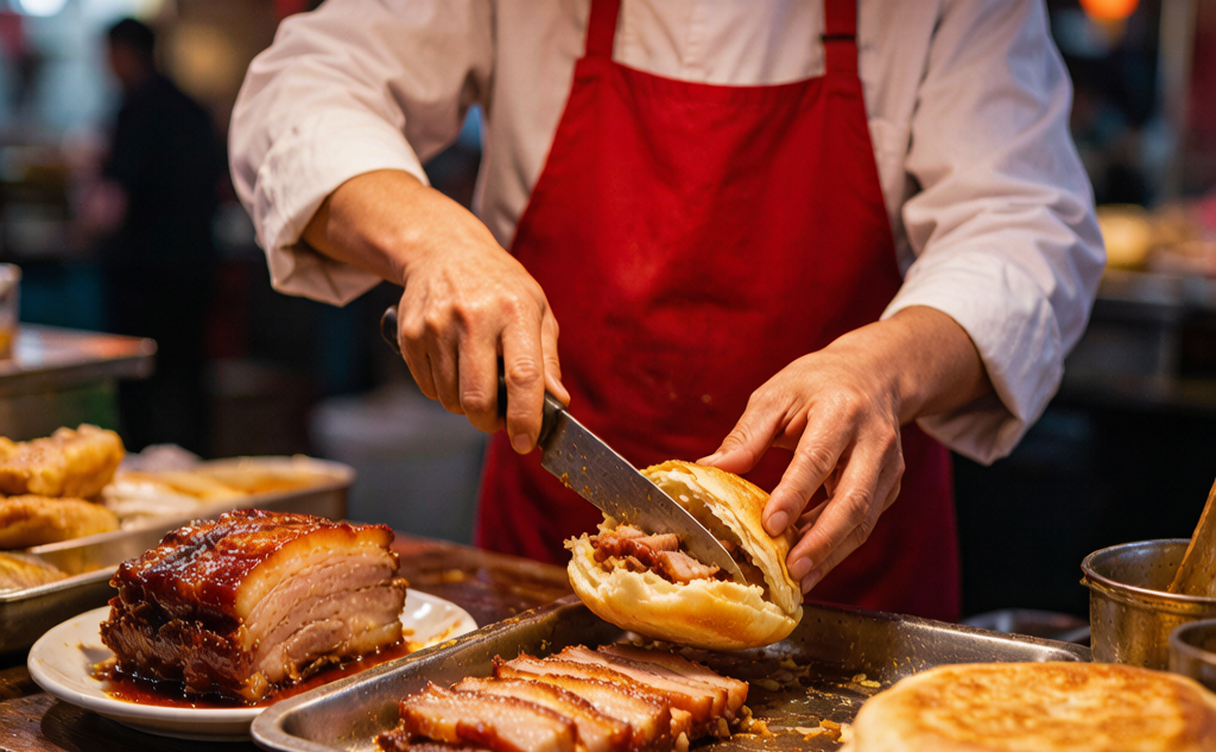
The roujiamo Chinese burger is Xi’an’s answer to fast food: a round, slightly chewy mo bread, split and stuffed with slow-braised pork (or beef and lamb in the Muslim Quarter) that has been stewed with spices for hours. The meat is chopped fine with a little of its jelly, so each bite is rich and unctuous. It costs around 10 to 15 yuan and is the perfect handheld bite between the city wall and the Bell Tower. Vegetarians can find tofu versions near the temples.
Liangpi Cold Noodles
On hot days, liangpi cold noodles are the relief: sheets of steamed wheat or mung-bean starch, cut into ribbons, dressed with vinegar, garlic water, chili oil, and cucumber. Chewy, cooling, and a little sour, they balance the heavy noodles and are sold at nearly every street corner. A “liangpi jia ruan mianpi” mix gives you both the firm and the tender versions in one bowl.
Other Street Stars
- Yangrou paomo: Crumbled flatbread soaked in lamb broth, a meal in a bowl near the mosques.
- Zenggao: A steamed rice cake with red dates, sweet and filling.
- Grilled lamb skewers (chuan): Cumin-heavy and charred, the Silk Road’s gift to the night.
- Guantang baozi: Soup dumplings, smaller and lighter than Shanghai’s.
Xi’an Food Streets Beyond Muslim Quarter
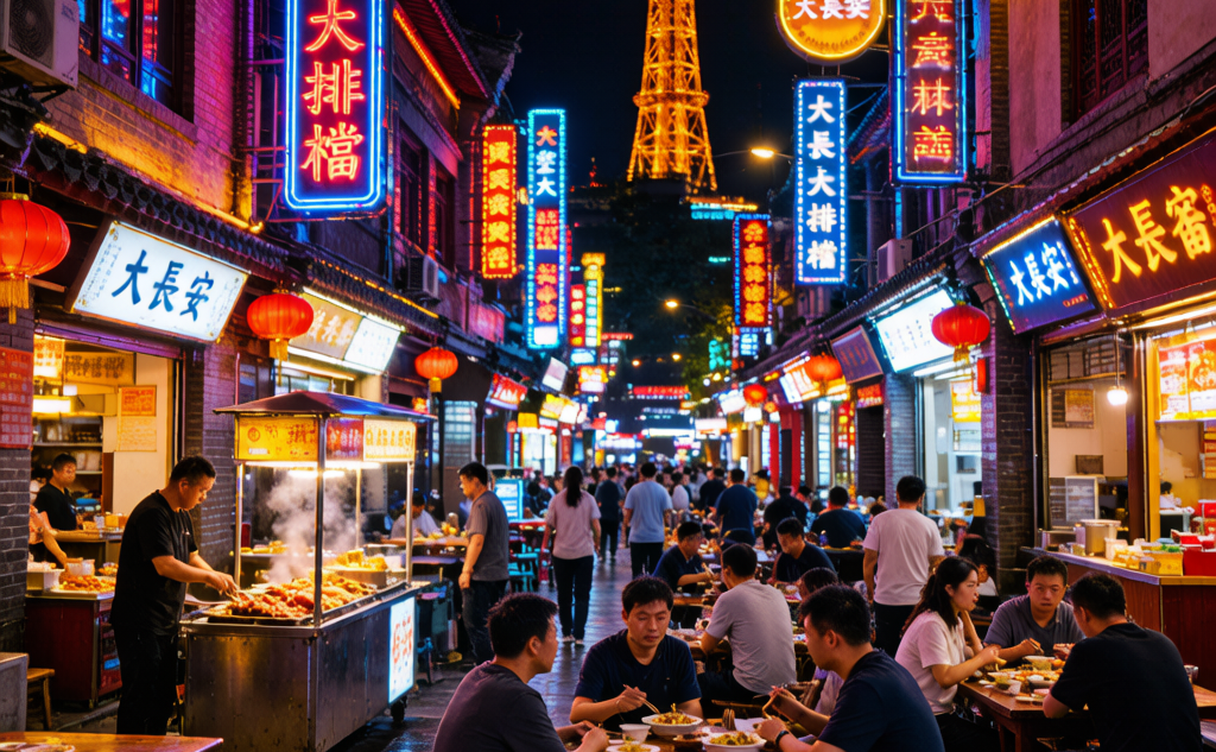
Everyone goes to the Muslim Quarter, but the best Xi’an street food guide pushes past it. The Xi’an food streets beyond Muslim Quarter include:
- Yongxing Fang: A rebuilt Tang-style lane east of the wall where each Shaanxi county has a stall; great for one-stop sampling and cleaner surroundings than the busy Quarter.
- Wenyi Bei Lu and the university belts: Student-area night stalls with cheap biangbiang and roujiamo and a local crowd.
- Sajin Qiao: A residential street near the wall with beloved old noodle shops and breakfast haunts.
- Defu Lane: A bar-and-snack alley for an evening graze with a drink.
For the classic tourist experience itself, our Xi’an Muslim Quarter food guide goes deep on the halal lanes, the kebabs, and the desserts you will only find there.
A Day of Eating in Xi’an
- Breakfast: Roujiamo and a bowl of hu la tang (peppery soup) at a corner shop.
- Late morning: Biangbiang noodles Xi’an style before the lunch rush, with a side of liangpi cold noodles.
- Afternoon: Walk the city wall, then a steamed zenggao for sweetness.
- Evening: Muslim Quarter or Yongxing Fang for lamb skewers and paomo.
- Late snack: A second roujiamo because one is never enough.
Pairing Food With Sights
The eating and the history sit side by side. Our Xi’an travel guide maps the wall, the Bell and Drum Towers, and the old city’s food lanes so you can eat between sights. No first trip is complete without the army itself, and the Xi’an Terracotta Warriors visit guide helps you time the trip and come back hungry to the city. A common plan: see the warriors in the morning, then spend the afternoon and night grazing the lanes — the contrast of imperial silence and street sizzle is pure Xi’an.
Street Food Safety in Xi’an
A good Xi’an street food guide respects the gut. Our street food safety in China guide has the full rules, but the local version is simple: pick stalls with long lines of locals, watch the oil look fresh, and prefer cooked-hot food over raw. Tap water is not for drinking, so buy bottled or bottled tea, and carry a translation app for menus that rarely show Latin text. If your stomach is sensitive, ease in with the plainly cooked noodles before the spicier skewers.
What to Eat in Xi’an on a Budget
What to eat in Xi’an is wonderfully cheap: a full noodle bowl is 15 to 25 yuan, a roujiamo 10 to 15, and skewers 3 to 6 each. Two people can eat superbly for under 100 yuan a meal by grazing rather than sitting down for banquet dishes. The city’s Shaanxi cuisine is built for the street, so you lose nothing by skipping fancy restaurants except air-conditioning.
Practical Tips
- Go early or late: Noodle shops are calm before 11:30 and after 13:30; the Quarter peaks after 18:00.
- Share plates: Order one of everything and pass them around to taste more.
- Carry small cash and mobile pay: Stalls vary; Alipay and WeChat rule, but cash helps.
- Learn “bu la” (not spicy): Handy if the oil is too much, though some dishes are inherently hot.
- Save room: The city rewards a second dinner, so do not fill up at the first stop.
FAQ
Is Xi’an street food safe for foreigners?
Yes, at busy stalls with high turnover and hot cooking; follow basic street-food hygiene and you will be fine.
What is the one dish I cannot miss?
Biangbiang noodles, for the texture and the spectacle of the oil splash — it is the city’s signature.
Is the Muslim Quarter the only place to eat?
No. Yongxing Fang, Sajin Qiao, and the university streets offer great food with fewer crowds.
How spicy is Shaanxi food?
Moderately; the chili oil is fragrant more than burning, but you can ask for less.
Final Thoughts
This Xi’an street food guide shows a city that eats with both hands and a lot of history. From the biangbiang noodles Xi’an slaps out by the handful to the roujiamo Chinese burger and the cooling liangpi cold noodles, what to eat in Xi’an is a tour of the Silk Road on a plate. Wander the Xi’an food streets beyond Muslim Quarter to find the local favorites, pair the grazing with the warriors and the wall, and let Shaanxi cuisine surprise you with its wheaty, cumin-scented warmth. Bring an appetite and comfortable shoes.