

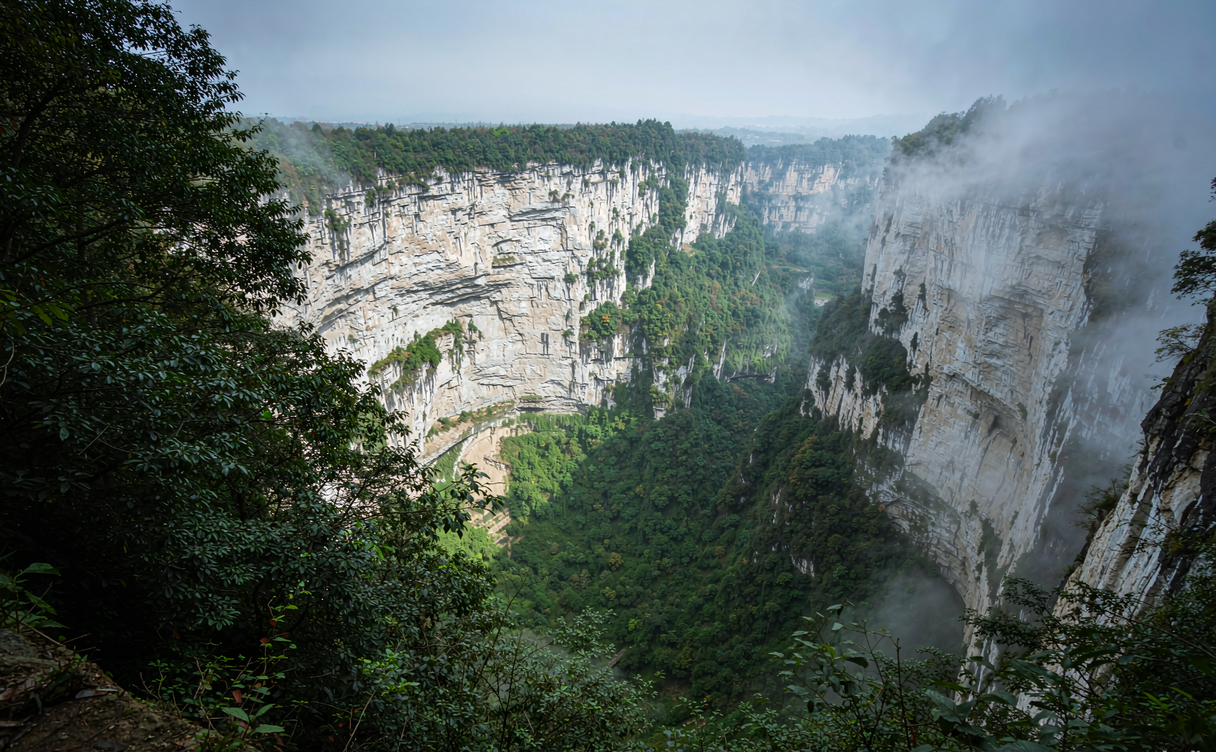
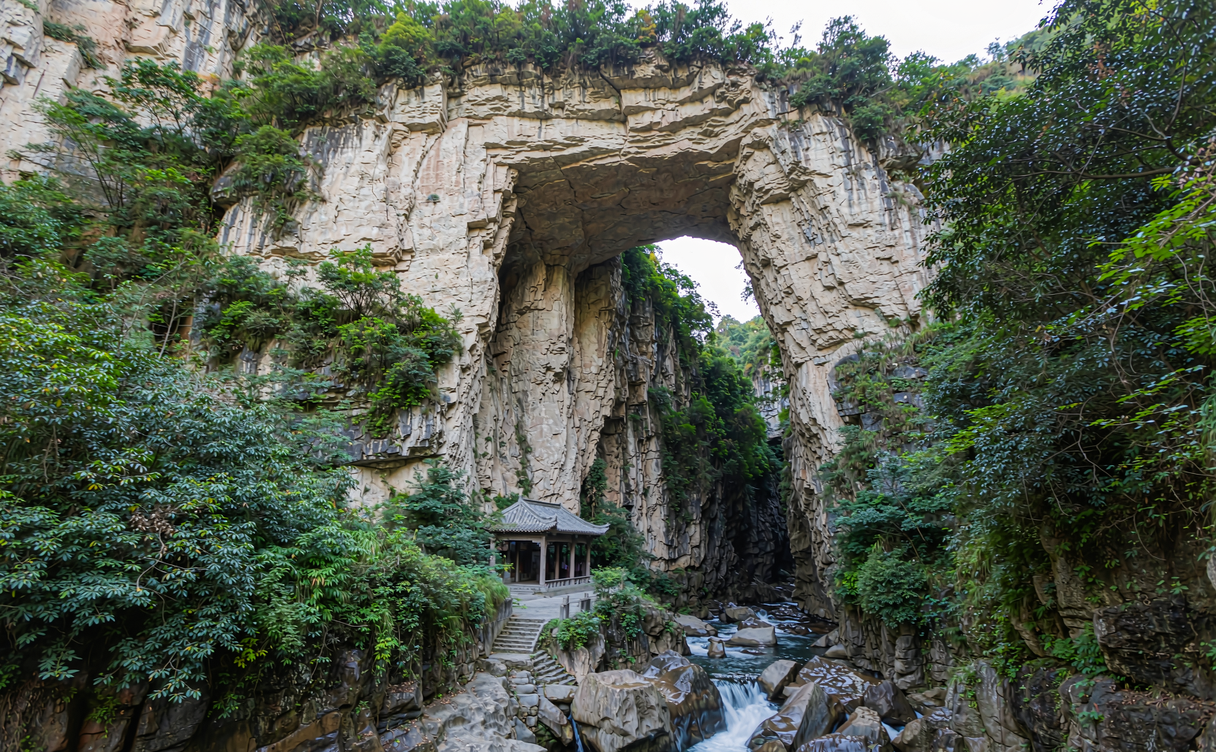
Wulong sits in the mountainous southeast of Chongqing municipality, China, and its claim to fame is a cluster of natural bridges and sinkholes so large they feel engineered. The headline site, the Three Natural Bridges (Sanqiao), drops you into a green-walled gorge where three stone arches — each the size of a city block — span a hidden river, and the floor beneath is a collapsed doline the locals call a tiankeng, or “sky pit.” This Wulong Tiankeng guide lays out what we tell our own travelers: the 2026 prices, the real walking effort, and the easiest way to reach the gorges from downtown Chongqing without a headache.
The Wulong Karst is part of the South China Karst, inscribed as a UNESCO World Heritage Site in 2007. The Three Natural Bridges are the star: Tianlong (Heavenly Dragon), Qinglong (Azure Dragon), and Heilong (Black Dragon) bridges, formed as an underground river carved the rock away and the ceilings of adjacent caves collapsed, leaving freestanding spans of limestone. Between them sits the Tianlong Tiankeng, a circular sinkhole several hundred meters across with vertical walls and a small temple at the bottom. The setting is so otherworldly that two big international films shot here, which is why some travelers recognize the gorge before they ever read its name.
Beyond the bridges, the wider Wulong area includes Furong Cave, a vast lit cavern, and the Houping Tiankeng group, a chain of dolines used for adventure caving. In our experience most day-trippers focus on the Three Natural Bridges plus Furong Cave, which is plenty for one long day out of Chongqing. The city itself is worth a night too: the Chongqing Hongyadong guide covers the riverside stilt-house district that lights up after dark, and the Chongqing Ciqikou old town guide describes the riverside lane-and-teahouse warren worth an afternoon.
Tickets, shuttles, and 2026 prices
For the 2026 season the Three Natural Bridges ticket is 95 RMB, with a mandatory sightseeing shuttle of 15 RMB each way from the visitor center to the gorge entrance. Furong Cave is priced separately at about 120 RMB, and combination tickets covering several Wulong sites are sold at a small discount if you plan to see more than two. Children under 1.2 meters enter free, and students with a physical ID get a modest gate discount.
Plan your time honestly. The Three Natural Bridges route is a one-way descent on stairs and boardwalks, roughly 2 to 3 kilometers, taking 2 to 2.5 hours at a relaxed pace. Furong Cave adds another 1.5 to 2 hours. Attempting both in a single tight morning is doable only if you arrive at opening. The scenic area generally opens around 8:00 and stops admitting late afternoon, with the exact cutoff shifting by season — in winter the light fades early and the last entry comes sooner than travelers expect.
Most travelers buy the single Three Natural Bridges ticket, but if you plan to add Furong Cave the same day, ask at the counter about the combined pass — it shaves a little off the separate prices and saves a second queue. Either way, treat the gorge as a half-day minimum. We’ve had clients try to sandwich it between a morning in Chongqing and an evening flight, and the shuttle math always defeats them. Sleep in Chongqing or Wulong town and give the karst a relaxed morning instead.
How to get to Wulong
The practical gateway is Wulong Railway Station, reachable from Chongqing’s main stations by high-speed train in about 2 hours, with second-class fares typically between 25 and 50 RMB. From the station, dedicated tourist shuttle buses run the final 40 minutes or so to the scenic area for around 12 RMB; a taxi for the same leg runs roughly 80–120 RMB and is faster if you are in a small group splitting the cost.
Driving from downtown Chongqing is about 130 to 180 kilometers depending on the route and takes 2.5 to 3 hours, so a private car day trip is feasible but tiring. We usually steer first-timers toward the train plus shuttle — it is cheaper, avoids mountain driving fatigue, and drops you right at the visitor center. If you are building a Chongqing stay, the karst sits naturally alongside the city’s famous food and old-town circuit, and the two make an easy two-night base.
Things to do at Wulong
- Walk the bridge loop in order. Start at Tianlong, follow the boardwalk down through the tiankeng, and finish at Heilong; the path is one-way, so save photos for the overlooks on the way down.
- Spot the film-set remnants. A small Qing-style courtyard was built for a movie shoot and now serves as a curious photo stop at the gorge floor.
- Add Furong Cave if you like underground scenery; it is a different world from the open gorge and a good weather-proof backup.
- Consider the glass viewing platform at one overlook if you want an adrenaline shot with the drop beneath your feet.
Best time to visit Wulong
The best time to visit Wulong is spring (March–May) and autumn (September–November), when the gorges are green, the river is full, and the humidity is bearable. Summer is lush and dramatic but hot and sticky, with sudden heavy rain that can briefly close lower trails; winter is quiet and sometimes misty, lending the bridges an eerie, empty mood that photographers love. We steer clients away from the first week of October and the May holiday, when the shuttles queue for an hour or more. If you are coordinating several provinces, our best time to visit China guide helps you find a window that also suits the rest of your route.
Food and where to refuel
Inside the scenic area, food is limited and priced for a captive audience — think 20–35 RMB for noodles or skewers at the gorge entrance plaza. We suggest eating a proper meal before you leave Chongqing or after you return. The city’s food scene is the real draw: a numb-and-hot hotpot broth, grilled river fish, and small bowls of spicy noodles that cost next to nothing and taste like everything good about the region. Save your appetite and your budget for the urban tables, because the mountain stalls are forgettable by comparison, and a good Chongqing meal afterward feels like the proper reward for a long day on the trails.
Practical tips we give every client
- Wear real walking shoes. The descent is all stairs and boardwalk; heels or sandals are miserable.
- Carry water and a rain shell. The gorge microclimate turns wet fast, even in dry season.
- Start at opening. The 8:00 entry beats both the heat and the tour-bus wave.
- Budget the shuttle time. The ride from the station to the gorge eats 40 minutes each way; don’t cut it close on a train home.
- Keep some cash for the small stalls, which occasionally lose card signal in the gorge.
- Agree on a meeting point before you descend. Mobile coverage is patchy below the bridges and the one-way path spreads groups out fast, so settle on a time and spot with any companions at the top.
Wulong is the kind of place that makes a phone battery die from overuse. The scale is the point — standing at the bottom of a sky pit with a stone bridge overhead is a sensation few city days deliver. For the official heritage description, the South China Karst UNESCO page covers Wulong among the inscribed sites.