

Huanglong — “Yellow Dragon” — lies high in Songpan County in the Aba region of Sichuan, China, and it is one of the most surreal landscapes we send travelers to in the entire province. Aboard a wooden path you climb past thousands of turquoise, gold, and jade-colored limestone pools stacked like terraced rice fields, fed by calcium-rich springs that have been depositing travertine for tens of thousands of years. This Huanglong guide collects the practical advice we give our own clients: the 2026 ticket prices, how the altitude actually feels, and the smart way to combine the park with nearby Jiuzhaigou without burning a day.
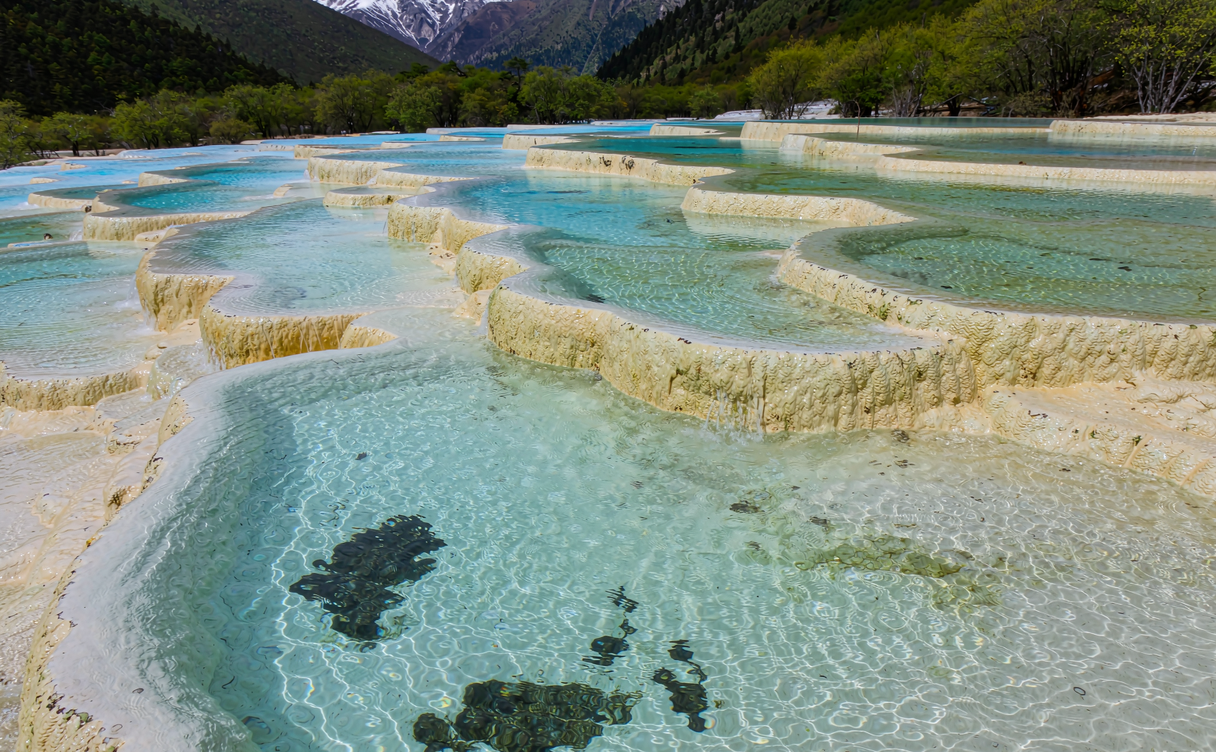
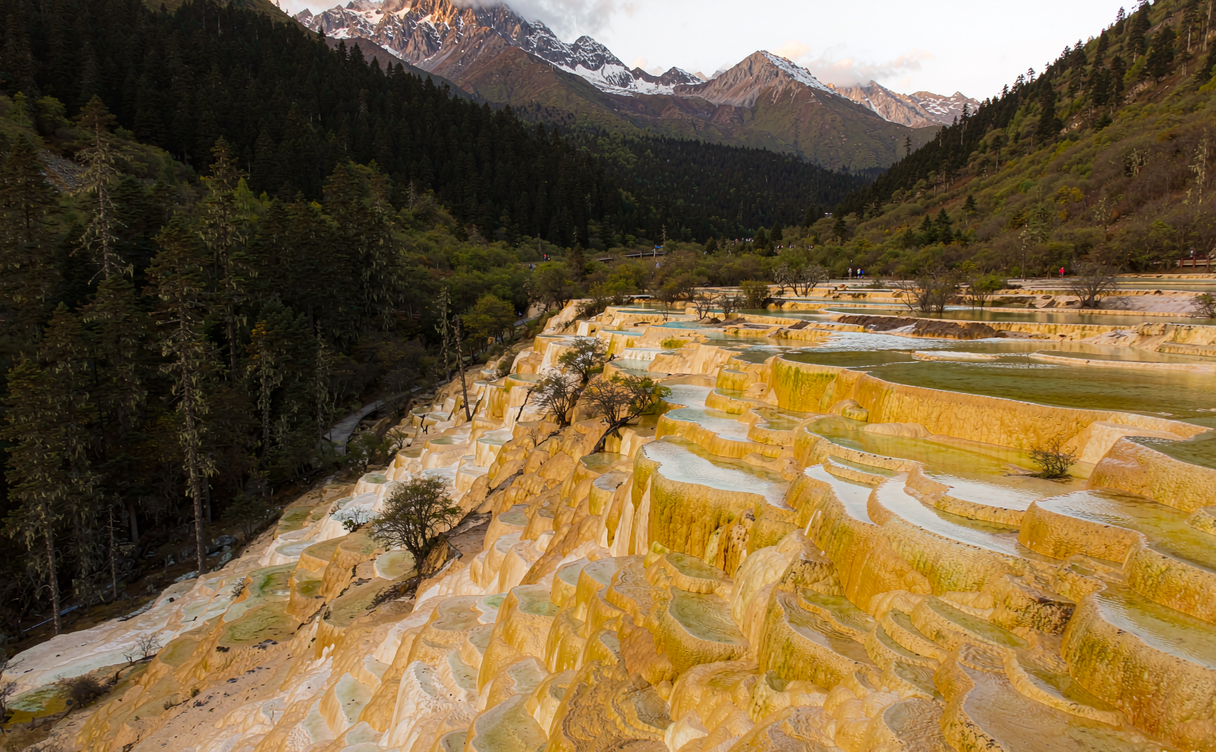
The headline sight is the travertine terrace system, the largest of its kind in China. Water carrying dissolved calcium carbonate spills down a gentle slope, and as it loses carbon dioxide the mineral precipitates into pale golden dams and pools. Sunlight through the clear water turns the basins every shade from electric blue to milky green. The centerpiece is the Five-Color Pools (Wucaichi), a cluster of small terraces near the top that concentrate the color like a spilled paint box. Higher still, Xuebaoding (Snow Treasure Peak) rises to 5,588 meters as the easternmost summit of the Min Mountains, usually snow-capped well into spring.
Huanglong was inscribed as a UNESCO World Heritage Site in 1992, recognized alongside Jiuzhaigou for its exceptional travertine landforms and intact mountain ecology. In our experience the comparison with Jiuzhaigou is unavoidable but unfair to both: Jiuzhaigou is about lakes and forest, Huanglong is about the living stone staircase. They complement each other rather than compete, and most travelers who make the long trip west do both.
Tickets, the bus, and the cable car
For the 2026 season the entrance ticket is 170 RMB in peak period (April 1 to November 15) and drops to 60 RMB in the off-season (November 16 to March 31). On top of that you must take the sightseeing bus from the gate to the lower trailhead, which costs 90 RMB year-round. Most visitors also use the cable car, which runs 80 RMB one way or 120 RMB round trip.
A realistic full visit totals about 280 RMB with the round-trip cable car in peak season. The cable car is strongly worth it here, not as a luxury but as a strategy: it lifts you to near the top so you walk the terraces downhill, which is far easier on the lungs at altitude. Children under 1.2 meters ride free, and students get a discount on the gate ticket with a physical ID. The park generally opens around 8:00 and the last entry is near 16:00 in peak season, earlier in winter. Buy tickets online in advance during holidays, when the daily cap can sell out and leave walk-ups disappointed.
A typical visit flows like this: shuttle bus up to the upper station, cable car (or walk) to the top terraces, then a slow downhill stroll past the Five-Color Pools and the Golden Sand section to the exit, where the bus returns you to the gate. Budget three to four hours door to door, and add another hour if you stop for photos at every turn — which you will. The descent is the easy part physically, but the thin air still bites, so we encourage clients to pause at the benches rather than push through.
How to get to Huanglong
The simplest access is Jiuzhaigou Huanglong Airport (JZH), about 50 kilometers from the Huanglong entrance, with flights from Chengdu taking roughly one hour and a handful of routes from other hubs. From the airport a taxi or arranged shuttle covers the final stretch in under an hour.
Coming overland from Chengdu is a long haul — about 400 kilometers and 8 to 10 hours by road — so we rarely recommend it as a day trip. The far more common plan is to fly into JZH, spend a night on the plateau to acclimatize, then do Huanglong and Jiuzhaigou together across two days. Buses connect the two parks in roughly two to three hours, and most travelers book a private car or join a small tour for the transfer. If you are building a Sichuan route, the mountain scenery pairs naturally with the province’s other high-country sights, and the food along the way is its own reward — our Sichuan cuisine guide maps the regional dishes worth chasing before you fly west.
Things to do at Huanglong
- Walk the Five-Color Pools slowly. The top terraces are the photographic payoff; arrive before 11:00 for flat, glare-free light and fewer tour groups.
- Stop at the Huanglong Temple near the upper pools, a small Qing-era shrine that frames the travertine nicely.
- Ride the cable car up, walk down. This single choice saves the most energy and keeps the best views in front of you.
- Watch for the Golden Sand section on the lower terraces, where the freshly deposited travertine glows almost white in the right light.
Best time to visit Huanglong
The best time to visit Huanglong is October and early November, when the surrounding larch and maple forests turn gold and the pools are at their clearest after the rainy season. Late April to June is the second-best window, with snowmelt filling the terraces and wildflowers on the slopes. Summer (July–August) is green and dramatic but prone to afternoon rain that clouds the water. Winter sees fewer visitors and a stark snow-on-stone beauty, though some upper sections can be closed by ice and the cable car hours shorten.
Because Huanglong sits between 3,100 and 3,600 meters, altitude is the real planning factor, not the calendar. We tell clients to arrive a night early, drink extra water, and skip the heavy exertion on day one. If you are weighing seasons across the country, our best time to visit China overview helps you line up Huanglong with the rest of your route. For cheap eats in the provincial capital before you head up, the Sichuan snacks guide lists the street foods worth a detour while you wait for your flight.
Food, stay, and smart pairings
Inside the park there is only basic snack fare — instant noodles, roasted corn, and tea at 15–30 RMB a pop — so eat a real meal before you enter. Down in Songpan or Chuanzhusi, the local Tibetan-influenced cooking centers on butter tea, yak meat, and hearty noodles, a world away from the peppery Han Chinese food of the Sichuan basin. Overnight, stay either near the Huanglong gate for an early start or in Jiuzhaigou town if you are linking the two parks; both have a range of guesthouses from bare-bones to comfortable, and prices climb on holidays.
Practical tips we give every client
- Acclimatize first. Spend a night at altitude before the climb; headaches are common otherwise.
- Take the cable car up. Walking the terraces downhill is far easier than the reverse at 3,500 meters.
- Carry water and a sweet snack. Mild altitude fatigue responds well to sugar and fluids.
- Dress in layers. Mornings are near freezing even in October; afternoons can be warm and glaring.
- Start early. The first shuttle from the gate beats both the tour buses and the midday haze.
Huanglong is a half-day of walking that looks like a week of postcards. It is relentlessly photogenic, genuinely strange, and — at altitude — a little humbling. If the crowds at Jiuzhaigou wear you out, the quieter Munigou travertine valley nearby is a fine alternative, and the summit of Niubei Mountain offers a different kind of high plateau drama with its famous sea of clouds.
For the official heritage description and ecology notes, the Huanglong UNESCO World Heritage page is a solid pre-trip read.