

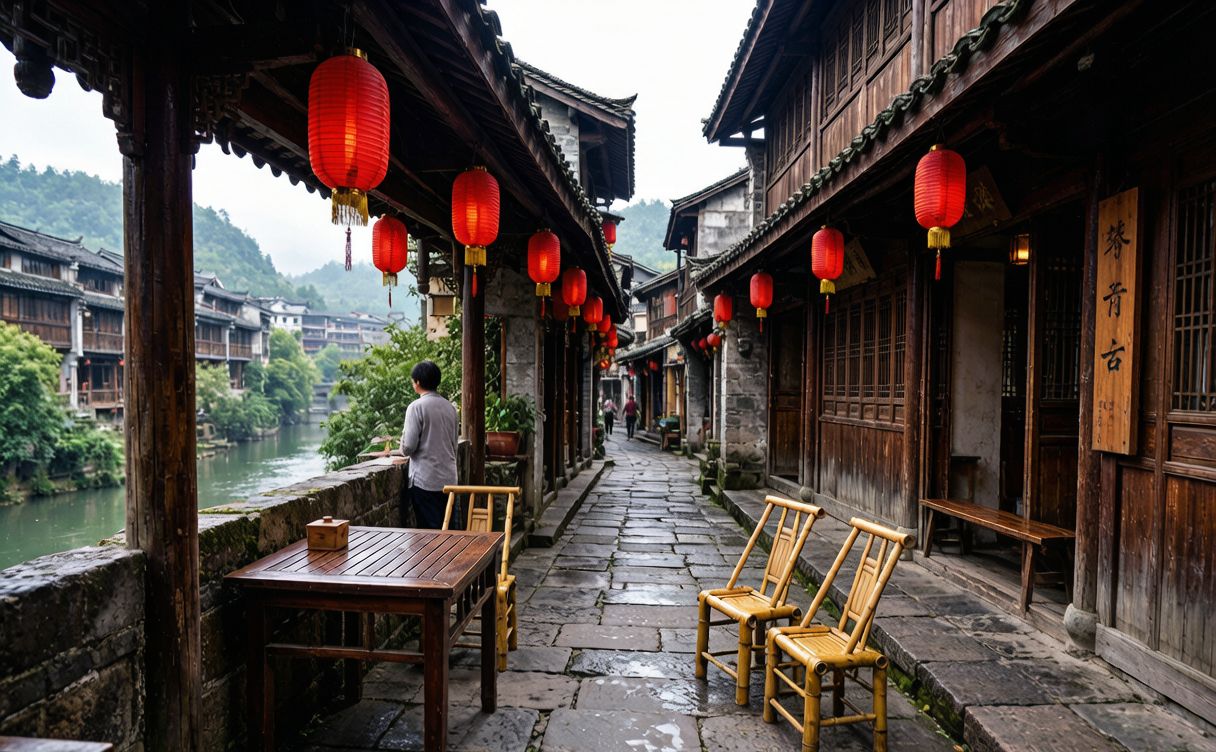
I arrived in Chongqing expecting a city of brutalist concrete and endless staircases, and I found that — but I also found something older and quieter pressed right against the Jialing River. Ciqikou (磁器口古镇) is a restored Ming- and Qing-era town on the western edge of the city, and it quickly became my favorite half-day in Chongqing. The lanes are narrow, the teahouses are loud with laughter, and the river keeps a slow, grey rhythm that the rest of the metropolis seems to have forgotten.
Getting There
Ciqikou sits in the Shapingba district, about 40 minutes by metro from the city center. I took Line 1 to Ciqikou Station (磁器口站); the moment you climb the stairs out of the station you can already smell the fried dough and hear the drumming from a street performance. The walk from the metro to the main gate is less than ten minutes, and it is flat — a rarity in Chongqing.
If you are coming from the airport, the easiest route is metro Line 3 to Line 1 with one transfer, or a DiDi (Chinese Uber) ride that runs 60–90 minutes depending on traffic. Honestly, I recommend the metro: Chongqing’s roads twist through tunnels and over bridges in ways that make a car ride feel longer than it should. Ciqikou is also an easy add-on if you are already following our Chongqing travel guide, since most visitors base themselves in the central Yuzhong peninsula and make a half-day trip out here.
What to See
The town is laid out along a single main lane that runs parallel to the river, with dozens of smaller alleys branching off like the ribs of a fish. The main street is touristy and busy — that is where the souvenir shops and the big snack stalls cluster — but the magic is in the side alleys. I wandered into one where an old man was carving wood blocks, completely unbothered by the crowds fifty meters away.
At the top of the town is the Ciyin Temple (慈隐寺), a small hillside temple where the incense smoke mixes with the river mist. Climb the stone steps and you get a clear view back down over the tiled roofs — worth the short sweat. Further along, the riverbank itself is the real attraction on a warm evening: locals fish off the rocks, kids fly kites, and the far shore glows orange as the sun drops behind the hills.
There are also small folk museums tucked between the shops — a clock museum, a shadow-puppet exhibit, and a recreated old pharmacy with drawers labeled in faded brush calligraphy. None of them take long, but together they build a picture of what this port town was before it became a postcard. Ciqikou was once a busy porcelain (ciqi) trading hub, which is exactly where the name comes from: “porcelain mouth.” Ships loaded clay here for centuries, and the river is the reason the town exists at all.
For a deeper dive into how towns like this fit into the wider picture, see our roundup of the best ancient towns in China, which compares Ciqikou with water towns in the east and fortress towns up north.
Food & Teahouses
This is the part I came for. The snack corridor is a gauntlet of sizzling woks: you will smell cishan (glutinous rice cakes dusted with brown sugar), dengying beef (paper-thin sliced beef dried and spiced), and the town’s signature — chuanchuanxiang, skewers of everything boiled in a shared, numbing chili broth. I ate standing up on a plastic stool, sweating through my shirt, and it was the best ten yuan I spent that week.
The teahouses are the soul of Ciqikou, though. Step off the main lane and you will find wooden buildings three stories tall, all open balconies and rattan chairs, where a pot of jasmine or baicha (white tea) costs almost nothing and no one rushes you. I parked myself in one overlooking the river for two hours, reading a book I never finished because the people-watching was better than the plot. A toothless grandfather at the next table taught me, with gestures, how to flip the lid of my cup when I wanted a refill. That small ritual is the entire charm of the place.
If you want a louder experience, some teahouses stage Sichuan opera face-changing (变脸) and hand-puppet shows in the afternoon. They are touristy, yes, but the skill is real and the performers are clearly having fun. Grab a front balcony seat early.
Tips
A few things I wish I had known before my first visit:
- Go early or go late. Midday and weekends are packed. I had the best luck arriving right at the 9 a.m. opening, when the lane light is soft and the only other people are vendors setting up. Evenings after 6 p.m. are calmer too, once the tour buses leave.
- Wear real shoes. The lanes are cobbled, uneven, and slick after rain. My smooth-soled sneakers slid more than once.
- Carry some cash for the tiny stalls. Most places take Alipay or WeChat, but the oldest grannies selling handmade noodles sometimes only take notes.
- Get intentionally lost. The map is useless in the best way. Pick a side alley, follow it until it dead-ends at the river, then loop back. That is where Ciqikou stops performing and starts being a place.
- Bargain lightly. Haggling is expected at the souvenir shops but the margins are small; a friendly smile gets you further than a hard line.
Best Time
Chongqing is famously hot and famously foggy. Spring (March–May) and autumn (September–November) are the sweet spots: mild, occasionally misty, and good for the riverside walk. I went in late October and the air was cool enough that a pot of tea on a balcony felt like the smartest decision in Asia.
Summer is brutally humid and the lanes turn into a slow-moving steam room — still doable if you go at open or after sunset, but bring water. Winter is grey and damp, though the fog actually makes the rooftops look like a classical ink painting, and you will have the place nearly to yourself. Avoid the first week of May (Labor Day) and the first week of October (National Day) unless you enjoy elbow-to-elbow crowds.
Good to Know
Ciqikou is free to enter — no ticket gate, no timed entry, and no guide required, though local English-speaking guides sometimes wait near the metro exit if you want context. The town is open every day, roughly 9 a.m. to around 9 p.m. for the shops, with the temples keeping shorter hours. It is stroller-friendly in the main lane but not in the stepped alleys, and there are clean public restrooms near both ends of the town.
Combine it with nearby sights: the neon fantasy of Hongyadong makes a fun contrast to Ciqikou’s quiet lanes if you want old and new Chongqing in one trip.
For official visitor information, hours, and any seasonal notices, check the Chongqing Government tourism pages before you go.
A short personal note to close: the thing I remember most is not any single sight but the moment I realized I was lost. I had turned down a lane chasing the sound of a flute, and when I looked back the main street had vanished behind a wall of hanging chilies. For a second I panicked — then a woman drying tofu on a bamboo tray laughed, pointed at the river, and said one word: “Down.” I followed the slope down, past cats and bicycle bells, and five minutes later I spilled out onto the stones at the water’s edge, exactly where I wanted to be. Ciqikou is like that: the map tells you one story, and the lanes tell you a better one.