

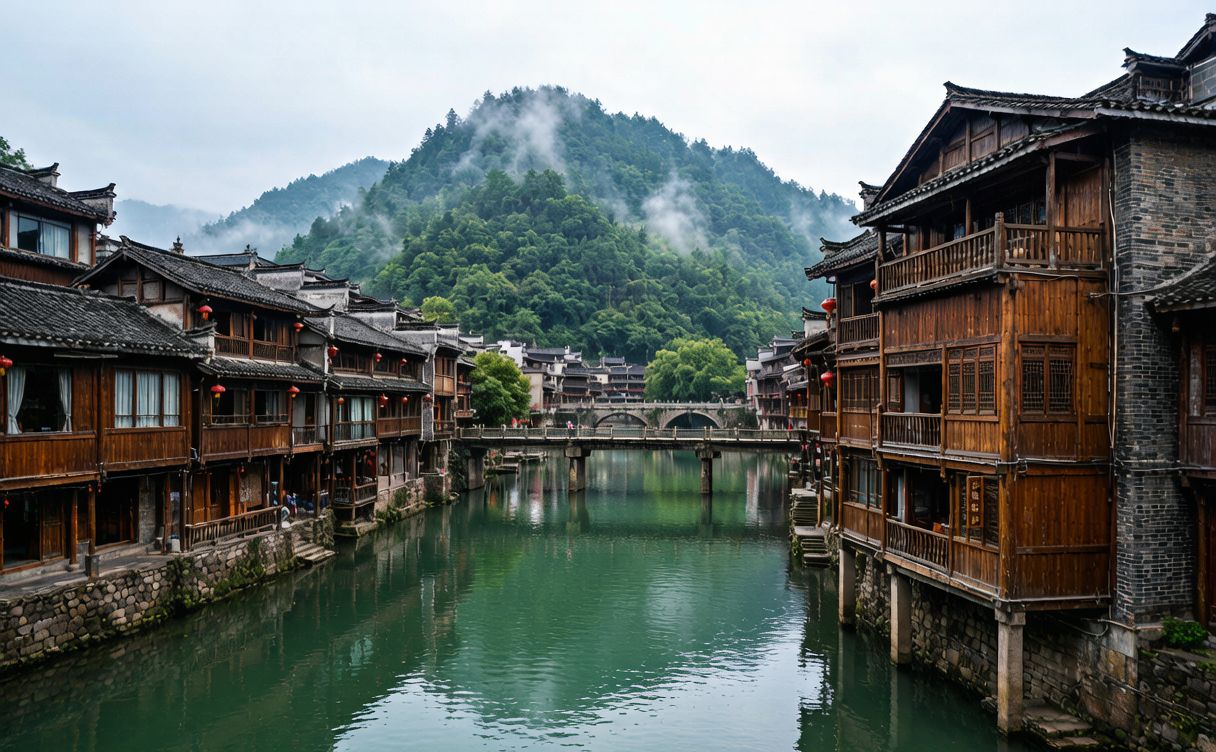
I almost skipped Zhenyuan. My original Guizhou plan was built around the headline sights — the vertical forests of Fanjingshan, the thunder of Huangguoshu, the karst pools of Libo. Zhenyuan was a “maybe” I tacked on because it sat conveniently on the train line between Guiyang and the east. I’m glad my laziness won that day. What I found on the banks of the Wuyang River was the most quietly beautiful old town I visited in all of China: no ticket gates at the entrance, no endless souvenir gauntlet, no selfie-stick stampede. Just a river bending like a silk ribbon through a valley, and hundreds of years of Ming and Qing architecture leaning out over the water.
Getting There
Zhenyuan sits in southeastern Guizhou, in Qiandongnan Miao and Dong Autonomous Prefecture, about 220 km east of Guiyang. The easiest way in is the high-speed train: Guiyang North to Zhenyuan station takes roughly 1.5 to 2 hours, and a handful of direct services run from cities like Chongqing and Kunming too. From the station it’s a short taxi or bus ride (about 15–20 minutes) down to the old town on the river. If you’re coming from the famous Xijiang Miao Village, you can also take a bus or combine a train with a ride-share — it’s a scenic half-day hop and a welcome change of pace from the bustling mountain villages.
I arrived on an evening train, and the first thing that struck me was how normal it felt. No grand arrival plaza, no amplified welcome music — just a small station, a friendly driver, and a short ride through hills that opened suddenly onto the glowing ribbon of the river. By the time I walked across my first bridge, the town was settling into night and the lanterns were just switching on.
What to See
The heart of Zhenyuan is the Wuyang River, and the old town is split into two halves the river curls between — locals call the layout an “S” shape, a natural taiji (yin-yang) symbol. The best move is simply to walk. Start on the main historic street where the Ming and Qing buildings stand shoulder to shoulder: grey-tiled roofs, wooden facades, carved doorways, and the occasional courtyard pharmacy or teahouse that has been in business for generations.
The bridges are the town’s signature. The most famous is the Qinglong (Green Dragon) Bridge, a graceful stone span you’ll cross constantly without thinking about it, and there are several older arched bridges that photograph beautifully at dusk. Climb up to the old city wall and the remaining sections of the Ming-era fortress above the river — from up there you get the classic postcard view of the S-bend and the rooftops below. I spent a lazy hour just sitting on the wall, watching boats drift and light fade across the water.
A short walk or boat ride takes you to the Wulong (Black Dragon) Cave complex, a series of temples and pavilions built into the cliff face across the river — part shrine, part riverside park, and a lovely spot for the evening light show projected on the water in summer. For something more contemplative, the old Confucian Temple and the riverside temples are quiet and uncrowded. Compared with the polished spectacle of Xijiang, Zhenyuan felt lived-in rather than performed.
If you want context for how towns like this fit into China’s wider heritage, it’s worth reading about other preserved settlements before or after your trip. Our guide to China’s best ancient towns puts Zhenyuan in good company alongside better-known walled and riverside names across the country.
Food & Local Life
Zhenyuan eats well and cheaply. The local specialty is sour and sour-hot (酸) cooking — Guizhou’s famous sourness shows up in pickled vegetables, sour fish soup, and hotpots that warm you fast on a damp evening. I ate my best meal at a riverside table with no English menu and no pretension: a clay pot of sour-fish soup, a plate of river greens stir-fried with chili, and a bowl of sticky rice. Total cost was less than a fancy coffee back home.
Street food is the real joy. Grilled river fish, stuffed tofu, rice cakes, and sweet sticky desserts appear along the lanes in the evening. The town’s older residents gather on the bridges to chat and play cards; tea houses hum with slow conversation; and in the early morning the riverbank becomes a laundry-and-tai-chi stage. This is the part I loved most — Zhenyuan doesn’t perform “tradition” for cameras. It just carries on.
Tips
- Stay inside the old town. Pick a guesthouse a few steps from the river so you can wander out at 6 a.m. before the day visitors arrive.
- Go light on planning. The pleasure here is aimless wandering, not ticking boxes. Leave the itinerary loose.
- Bring cash and a translation app. Many small eateries and guesthouses are card-shy and English-free.
- Wear good shoes. The lanes are cobbled and uneven, and you’ll climb a bit for the wall views.
- Photograph at blue hour. The hour after sunset, when lanterns glow and the water stills, is magic.
- Pair it with the big sights. Zhenyuan works beautifully as a calm counterpoint to busier stops — I slotted it between the heights of Fanjingshan and the karst pools of Libo, and it was the perfect exhale.
A short personal note: on my second evening I got briefly lost in the lanes behind the main street, ducked down a dead-end alley, and found an old man repairing a fishing net by lantern light. He waved me over, poured me a tiny cup of home-brewed rice wine, and laughed when I tried (badly) to say thank you in Mandarin. Nobody sold me anything. That five-minute exchange is the Zhenyuan I remember more than any view.
Best Time
Spring (March–May) and autumn (September–November) are ideal — mild, green, and not too humid. Summer is lively and warm, with the evening light-and-water shows on the river, but it can be damp and crowded on weekends. Winter is quiet and atmospheric, with occasional mist on the river that turns the whole town into an ink-painting, though some guesthouses and boats slow their hours. I went in late spring and the combination of clear light, full river, and near-empty lanes was close to perfect. If you want solitude, aim for a weekday in the shoulder seasons.
Good to Know
Zhenyuan is free to enter — there’s no main-ticket gate for the old town itself, though small fees apply to individual sites like the cave temples or the city-wall climb. It’s wheelchair-challenging in places (cobbles, steps, riverbanks), so plan accordingly. ATMs are limited; bring enough cash. Mobile signal is fine on major carriers. The town is safe and relaxed even at night. For official regional information, events, and transport updates, check the Guizhou Tourism site run by the Guizhou Culture & Tourism Department.
If you’re building a Guizhou route, also consider the karst wonderland of Libo Xiaoqikong, a perfect green counterpoint to Zhenyuan’s grey rooftops and slow river.