

When I first arrived in Nanjing, I expected another pleasant Chinese city with a few temples and a busy riverfront. What I did not expect was to spend two full days tracing a wall that has stood guard for more than six hundred years. The Nanjing City Wall is not a restored theme-park replica. It is the real thing — a 14th-century defensive circuit built by the first Ming emperor, Zhu Yuanzhang, and it remains one of the longest surviving ancient city walls anywhere on earth.
I came for a morning and stayed for the better part of a week. If you are planning your own trip, start with our broader Nanjing travel guide before you dive into the specifics below.
Getting There
Nanjing sits comfortably on the high-speed rail network, about an hour and a half from Shanghai and well under two hours from Hangzhou. I flew into Nanjing Lukou International Airport and took the airport metro line straight into the city, which is the easiest option if you are arriving by air.
For the wall itself, the two sections I recommend are Zhonghua Gate in the south and the walkable ramparts near Xuanwu Lake in the north. Zhonghua Gate is reachable by metro line 1, exiting at Zhonghuamen Station — the castle is a five-minute walk from there. The Xuanwu Lake section is best reached via metro line 1 to Xuanwu Men Station. Taxis and ride-hailing apps work well too, but downtown Nanjing traffic can be thick at rush hour, so I prefer the metro.
If you want to pair the wall with other sights, Zhonghua Gate is an easy walk or short ride from the Nanjing Confucius Temple, and the Xuanwu Lake ramparts connect naturally with a stroll around Nanjing Xuanwu Lake.
What to See
Zhonghua Gate
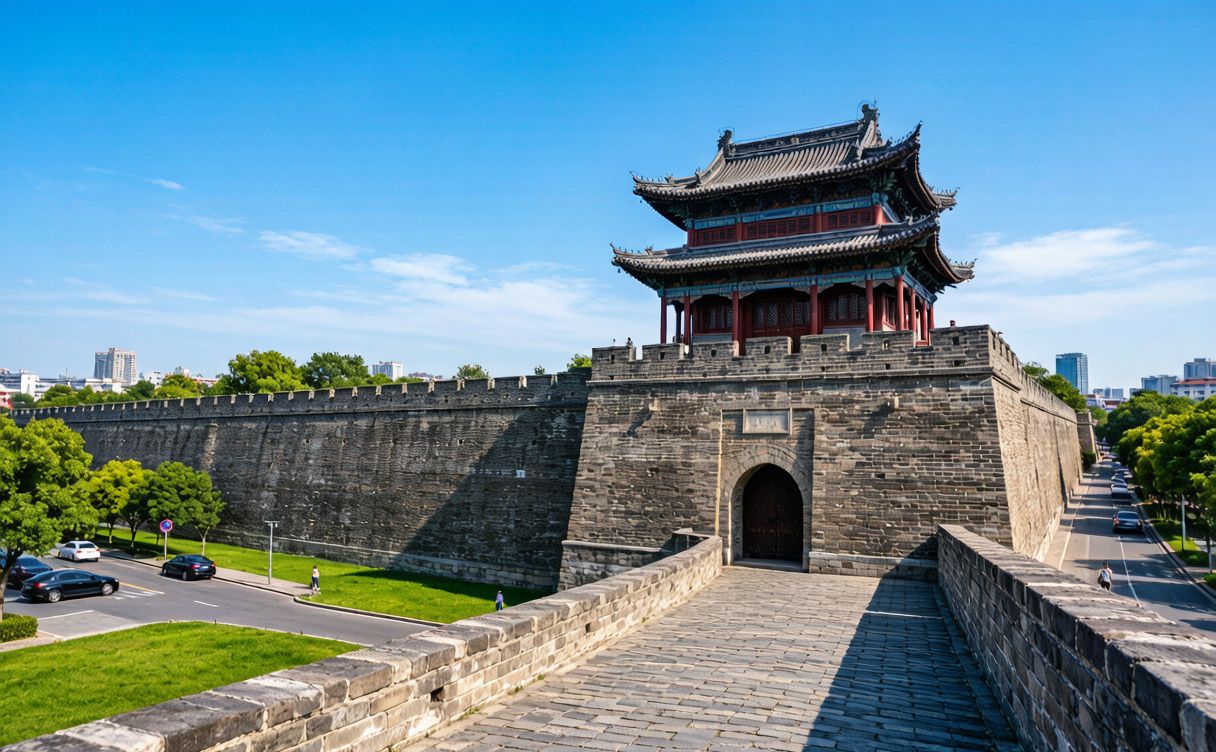
Zhonghua Gate, often called the Zhonghua Gate Castle, is the single most impressive piece of the wall and the place I tell every traveler to start. It is not just a gate — it is a layered, maze-like fortress with multiple courtyards, parallel passages, and hidden rooms where Ming soldiers stored supplies and, according to the guides, could shelter thousands of troops.
I climbed the ramps to the top and lost track of time wandering the interlocking courtyards. The scale is hard to picture until you are standing inside one of the vaulted storerooms, looking up at brickwork laid by hand in the 1380s. Each brick, I learned, was stamped with the name of the official responsible for it — a six-hundred-year-old quality-control system.
The Ramparts
The wall originally ran for more than 30 kilometers, encircling the old city. Large stretches still survive, and the most walkable portion for visitors runs along the northern edge beside Xuanwu Lake. Here the broad top of the wall has been paved into a promenade where you can actually walk on the Ming ramparts and look down at the lake on one side and the modern city on the other.
I timed my walk for late afternoon, when the light turned the bricks warm orange and the price of the crowds dropped to almost nothing. Walking the ramparts gave me the clearest sense of why the wall was built the way it was — you can see sightlines, defensive angles, and the logic of a capital designed to be held under siege.
Watchtowers
Most of the original wooden watchtowers are long gone, but the stone foundations, gate towers, and corner platforms remain, and a few reconstruction projects have returned timber towers to their posts. At Zhonghua Gate and at the repaired sections near the lake, you can climb to tower bases and imagine the signal fires and drum beats that once coordinated the city’s defenses. I found the quiet corners between the towers — where the wall meets a moat or bends to follow the terrain — the most atmospheric of all.
History of the Wall
The wall was built beginning in 1366, after Zhu Yuanzhang founded the Ming dynasty and chose Nanjing as his capital. Unlike many Chinese walls that run in straight lines, Nanjing’s followed the natural contours of hills, rivers, and lakes, which is why its shape is irregular and, to my eye, far more interesting than a simple rectangle.
Construction drew on hundreds of thousands of laborers and used bricks fired across the region, some hauled from hundreds of kilometers away. The wall was designed to be impregnable — foundations of stone, a core of packed earth and rubble, and faces of precisely laid brick set in a lime-and-tung-oil mortar. When you run your hand along the surface, you are touching material assembled for a dynasty that intended to last forever.
Nanjing later lost its status as the national capital, and over the centuries parts of the wall were dismantled or fell into disrepair. What survives today — roughly a quarter of the original circuit — is enough to earn its place among the great defensive works of the medieval world, and it is frequently compared with other famous ramparts such as those in Xi’an. If you enjoy this kind of engineering, our Xi’an City Wall Guide makes a great companion read.
Tips
- Buy the combined or section tickets at the gate; Zhonghua Gate and the Xuanwu Lake ramparts are managed separately, so plan which you want first.
- Wear good shoes. The rampart surfaces are uneven in places, and there are real staircases and ramps to climb.
- Go early or late. Midday in summer is hot and crowded; the light is better at the edges of the day anyway.
- Bring water and a hat. There is little shade on top of the open wall.
- Combine logically: south gate plus the Nanjing Confucius Temple, or north ramparts plus Nanjing Xuanwu Lake.
A short personal note: on my second morning I arrived at Zhonghua Gate before the ticket office opened and ended up chatting with a retired local who walks the wall every day. He pointed out the brick stamps I would have walked right past, and told me his grandfather remembered when the moat was still full of lotus. That ten-minute conversation turned a sightseeing stop into the moment the wall actually came alive for me.
Best Time
Spring (March to May) and autumn (September to November) are the best windows. The temperatures are comfortable, the skies are clearer, and the light on the brick is gorgeous. I visited in late April and the lake section was lined with fresh green and the occasional blossom. Summer is workable if you avoid midday, but Nanjing’s humidity is no joke. Winter is quiet and cold, but the wall against a pale sky has a stark, lonely beauty that photographers love.
Good to Know
Entry fees are modest and the wall is open year-round, though hours shift slightly by season. The site is managed by the city, and the official tourism portal has the most reliable, up-to-date details on tickets, opening times, and any maintenance closures: Nanjing Government. Accessibility varies by section — Zhonghua Gate has ramps but the wall top involves stairs, so travelers with limited mobility should check the specific gate in advance.
If your interest in old fortifications extends beyond Nanjing, our roundup of Best Ancient Towns in China — featuring well-preserved Ming and Qing towns — is worth a read before you plan the rest of your route.