

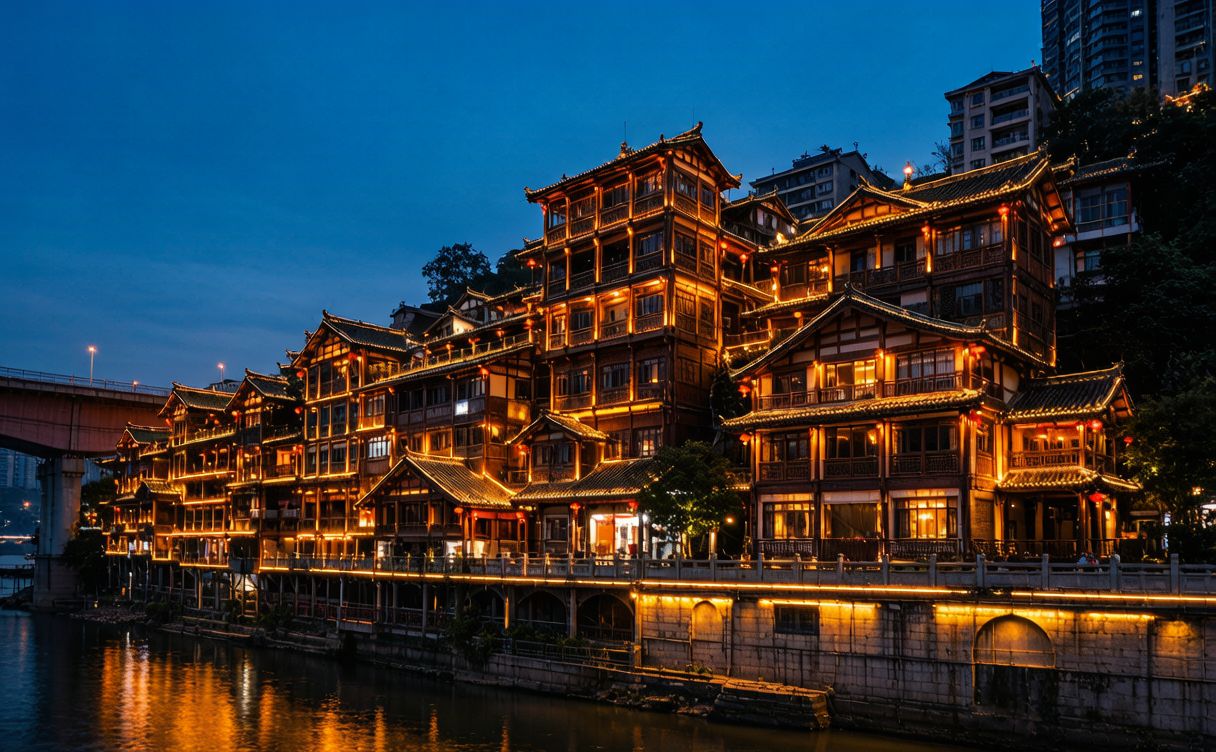
I still remember the moment Hongyadong first hit me. I had shuffled out of the Chongqing metro at around 8 p.m., squinting through the river mist, when the whole hillside suddenly lit up like someone had flipped a switch. Eleven tiers of golden stilt houses tumbled down the cliff toward the Jialing River, all glowing lanterns, stacked eaves, and crowds that looked exactly like the floating bathhouse town from Spirited Away. I stood there like an idiot for a full minute. If you have only one night in Chongqing, this is the one view that will burn itself into your memory.
I have now been back to Hongyadong three times, in mist, in rain, and once on a sweltering August evening when the air was thick enough to chew. It is loud, it is commercial, and it is absolutely worth it. Below is the real, on-the-ground guide I wish I had before my first visit, written the way a friend would tell you over a beer.
What Is Hongyadong, Exactly?
Let’s clear up the name first, because you will see it spelled two ways. “Hongyadong” is the modern pinyin; “Hongya Cave” is the older, literal translation you will still spot on some maps and tour boards. Same place, same cliff, same chaos. The complex sits where the Jialing River meets the Yangtze in central Chongqing, built into a steep rock face that was once a fortress gate in the Ming and Qing dynasties.
What you are actually looking at is a reconstruction. The original stilt-house settlement (diaojiaolou) was torn down decades ago, and the current 11-tier structure was rebuilt in the early 2000s as a commercial block. Don’t let “reconstruction” put you off — the engineering is clever and the night atmosphere is the real thing. When people search for Hongyadong online, they are almost always chasing that postcard shot of glowing tiers mirrored in the dark water.
The 11-Tier Stilt-House Architecture
Here is the part that confused me for years. Hongyadong looks like a vertical village, but each of its 11 tiers opens onto a different street level. The bottom tier sits at the riverside promenade. The top tier dumps you out onto a main road crowded with buses and taxis. When you walk through the building, you are not really going up or down — you are passing through a cliff.
My favorite “I can’t believe this is real” moment happened on tier nine. I had been climbing past hot-pot restaurants and trinket stalls for what felt like an hour, turned a corner, and walked straight out onto a six-lane city street, blinking at car headlights. There is no other building in the world where the “roof” is a highway. That disorientation is part of the charm of the hongyadong chongqing experience, and it is why locals love to send lost tourists in circles.
How Hongyadong Went Viral
You have probably seen thephoto before you ever booked a flight. Around 2018, a drone shot of the lit-up complex went supernova on Chinese social media, and travel bloggers started calling it “the real-life Spirited Away.” Hayao Miyazaki never confirmed the link, but the resemblance to the bathhouse in his film is uncanny: warm yellow light, wooden balconies stacked into the dark, a river below, and a sense that something magical is happening just out of frame.
That viral moment turned a modest local hangout into one of the most photographed spots in China. Our roundup of China bucket list attractions ranks it beside the Great Wall and Zhangjiajie. For contrast, the Shanghai Bund night view gives colonial grandeur and skyline; Hongyadong gives fairy-tale fantasy. Both belong on a first trip.
Best Photo Spots for the Hongyadong Night View
This is the section I get asked about most, so pay attention. The chongqing night view is legendary, and Hongyadong is its crown jewel — but only if you shoot it from the right angle.
- Qiansimen Bridge (north side): Walk across the bridge toward Jiangbeizui and look back. This is the classic shot, with the full stack of tiers framed against the river. Bring a tripod if you have one; phones struggle in the low light.
- Riverside promenade at the base: Stand on the walkway right by the water for the mirrored reflection. Go early (before 7:30 p.m.) to claim a spot before the tour groups arrive.
- From a Yangtze or Jialing river cruise: A short boat ride gives you a moving, crowd-free perspective. Our Yangtze River cruise guide covers how to book one.
- Inside the tiers at dusk: Once the exterior lights are on, duck inside and shoot upward through the wooden balconies for a moody, lantern-lit frame.
A photographer friend of mine swears by the “blue hour” — that 15-minute window right after sunset when the sky is deep blue and the building lights have just switched on. For more framing tricks across the country, see our China photography tour guide.
How to Get to Hongyadong in Chongqing
Chongqing’s metro is your friend, and Hongyadong is easy once you know the trick. Take Line 1 or Line 6 to Xiaoshizi Station, use Exit 9, and follow the signs for about a 10-minute walk. You will pop out near the top tiers. Alternatively, Line 2 to Linjiangmen also works and drops you close to the Jiefangbei shopping core, a five-minute stroll away.
If you are coming from the north bank, the Qiansimen Bridge is walkable but long; a didi (ride-hail) or taxi across is cheaper than you think and saves your legs. Driving yourself is a nightmare — the hills, the one-way systems, and the permanent congestion make a rental more trouble than it is worth. For the wider picture on getting around the city, our Chongqing travel guide lays out metro lines, cable cars, and the famous Yangtze River cableway.
Best Time to See the Lights
The building lights usually switch on around sunset (roughly 6:30 p.m. in summer, 5:30 p.m. in winter) and stay lit until about 11 p.m., with the brightest window between 7 and 10 p.m. Aim to arrive by 7 p.m. to catch the blue-hour transition, then linger as the crowd peaks for that full festival energy.
Season matters more than you’d expect. Spring (March–May) and autumn (September–November) offer clear air and comfortable temperatures — ideal for the chongqing night view. Summer is brutally humid and packed with domestic tourists, though the night breeze off the river helps. Winter is quieter and the bare trees actually make the lights pop, but it gets cold on the water. Avoid the first week of May (Labor Day) and the National Day holiday in early October unless you enjoy being shoulder-to-shoulder with a million people.
Food Streets and What to Eat
Hongyadong’s lower tiers are essentially a multi-floor food court dressed up as an old town. It is touristy, yes, but the snacks are fun and the prices are fair for a landmark.
- Chongqing hot pot: Every stall near the base sells individual mini-pots. Order the “yuanyang” (half spicy, half mild) if you are a chili coward like me on my first visit.
- Chuanchuanxiang: Skewers bobbing in a communal spicy broth, counted by the empty sticks at the end.
- Spicy glutinous rice cakes (ma la tang yuan): Sweet, chewy, and dusted with chili sugar — sounds wrong, tastes right.
- Sour plum drink (suanmeitang): The only thing that will save you in August.
On my second trip I made the mistake of eating a full hot pot before walking the tiers — bad idea. The stair-climbing after a spicy meal nearly finished me. Eat light, snack often. For a deeper dive into regional eating, our China food tour guide is a good companion, and you will find more atmospheric old-town wandering elsewhere in the region.
Is Hongyadong Worth It? (And How to Avoid the Crowds)
Short answer: yes, but manage expectations. It is not a hidden gem — it is a polished, commercial spectacle, and that is okay. You are here for the lights and the “did I step into a movie?” feeling, not for solitude or authenticity.
Three practical tips from a repeat visitor:
- Go on a weekday, not a weekend. Tuesday and Wednesday nights are noticeably calmer.
- Shoot the exterior from across the river, enjoy the interior on a weekday. Split the experience — the postcard shot needs distance; the food needs you inside.
- Don’t try to “see everything.” Pick two tiers, eat something good, take your photos, and leave before your feet revolt.
Where to Stay Nearby
Jiefangbei, the district wrapping Hongyadong, is the most convenient base. You can roll out of your hotel, walk five minutes, and be under the lights by dusk. It is also the hub for the metro and the river cableway. Budget travelers will find hostels; everyone else has a deep bench of international hotels. Book early in peak season, because this corner of Chongqing fills first.
Final Thoughts
Hongyadong is the kind of place that divides opinion, and I get why. It is rebuilt, it is busy, and it is unapologetically a photo op. But standing on that riverside promenade, watching eleven tiers of golden light ripple on the black water, I defy anyone not to feel a little wonder. For a first-time visitor to China, it is the single best argument that this country knows how to do spectacle with a soul.
Before you go, check the official Chongqing tourism portal for the latest opening hours and any seasonal light-show events, since timings shift through the year. And if Chongqing is just one stop on a bigger adventure, our Chongqing travel guide will help you string together the cableway, the hot-pot joints, and the mountain lifts into a proper itinerary.
I will be honest: Hongyadong will not change your life. What it will do is give you one of the most photogenic, slightly surreal, deeply fun nights you can have in any Chinese city. Go for the lights, stay for the skewers, and don’t be surprised if you, like me, end up going back for a third time.