

I almost didn’t set my alarm. After two days bouncing along the desert highways of northern Xinjiang, China, the last thing I wanted was a 6 a.m. wake-up call. But my guesthouse host in Burqin had insisted: “Go to Hemu Village before the sun, or you’ll miss the best part.” She was right. The morning I finally dragged myself up the wooden boardwalk, Hemu Village was still wrapped in blue dark, and thin ribbons of smoke were already curling out of the log cabins below me. That smoke — not the postcards, not the lake — is what I remember first.
Most travelers treat this stop as a footnote to the famous Kanas Lake, an hour’s shuttle bus deeper into the mountains. That’s a mistake. Hemu Village is the quieter, older soul of the region — a cluster of weathered timber houses where the Tuva people, a small Turkic-speaking group, have lived for generations. Spend a full day in Hemu Village and you’ll understand why the postcards don’t do it justice. If you’re sketching out a northern route, pair it with our Xinjiang travel guide and you’ll see exactly where it sits.
Where Is Hemu Village, Xinjiang, China?
Hemu sits in the Altai Mountains of northern Xinjiang, China, near the border with Kazakhstan, Russia, and Mongolia. It’s part of the greater Kanas scenic area, sharing the same ticket gate and the same long access road. The three villages of the region — Hemu, Kanas, and Baihaba — are the only settlements inside this protected alpine zone, and Hemu is the one most visitors describe as “the pretty one.”
What makes it special is the building material. Every house here is plank timber, squared logs stacked and notched at the corners, with pitched roofs built to shed snow. There are no concrete towers, no glass hotels. Just wood, smoke, and birch trees. The whole hemu village xinjiang setting — Hemu Village itself — feels like a stage set that somebody forgot to strike.
Why Travelers Call It a Tuva Village in China
The Tuva are the reason this hamlet exists. They’re a small ethnic group — maybe a few thousand people in China — and Hemu is one of their main homes. They herd horses and cattle, keep wooden stoves burning through the long winters, and still ride out to summer pastures the way their grandparents did.
I’ll be honest: I’m a tourist, not an anthropologist. I’m not going to pretend I understand Tuva life after a few mornings. But I did spend one cold afternoon in a family’s kitchen, drinking brick tea while the grandmother fed the stove and a boy no older than seven carried a bucket of mare’s milk past me without a word. That’s the version of a tuva village china experience worth having — not a performance, just a doorway you’re allowed to stand in.
If you want the deeper context before you go, the regional tourism board keeps a useful overview of the area’s culture and access on its official pages (see Lonely Planet’s Xinjiang entry for a reputable, plain-English primer).
How to Reach Hemu Village (Via Kanas or Burqin)
There is no train to Hemu. You arrive on wheels, and reaching Hemu Village is half the adventure. You have two realistic routes.
Via Burqin. Most people fly or bus into Burqin, the nearest town with hotels and a proper food street. From Burqin it’s roughly 170 km of mountain road to the Kanas scenic gate, then an internal shuttle the rest of the way. Burqin is the comfortable base — hot showers, lamb skewers, and a real bed the night before.
Via Kanas. If you’re already doing the kanas hemu loop, you’ll enter through the Kanas gate and take the scenic shuttle east to Hemu. The road between Kanas and Hemu Village is genuinely beautiful: switchbacks above a river valley, occasional glimpses of snow on the peaks. Budget two to three hours of pure transit, more if the weather turns.
A few things I wish someone had told me:
– Book your internal shuttle ticket online in advance during October. They sell out.
– The last shuttle back from Hemu leaves mid-afternoon. Miss it and you’re staying the night — which, honestly, you should plan to do anyway.
– Carry cash. The signal drops, and the card reader at the noodle stall may not care about your travel plans.
Our Xinjiang 7-day itinerary lays out a sane day-by-day order so you’re not backtracking across the whole region.
The Golden Birch Forest in Autumn
If there’s one reason to time this trip, it’s the birch. In October the hills around Hemu Village turn the color of a struck match — gold, copper, and the occasional stubborn green — and the slender white birch trunks stand out against it like bones. I hiked the ridge above the village on a Tuesday and had the whole overlook to myself except for one old man and his three horses. We didn’t speak. He offered me a dried apricot from his pocket. I took it. That’s the kind of interaction no itinerary can schedule.
The birch forest isn’t a fenced “attraction.” It’s the backdrop to everything — the boardwalk, the horse trails, the photo spots. Walk past the last guesthouse and keep going; within ten minutes the village noise is gone and you’re alone with the trees.
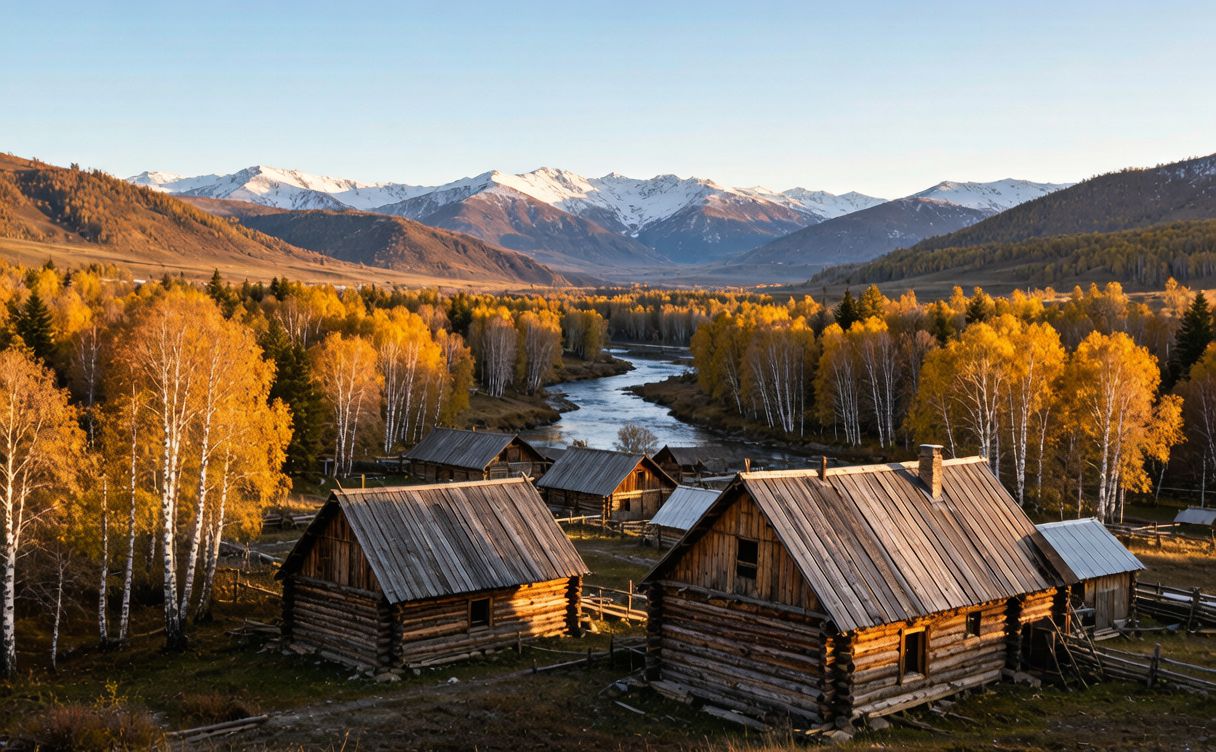
Smoke, Log Cabins, and Dawn — My Best Morning
I said the smoke was what I remembered first. Let me explain why. At dawn the whole valley cools fast, and every stove in the village lights up at once. The smoke rises slow and straight in the still air, and because the cabins are built on a south-facing slope, the first light hits the roofs while the valley floor is still in shadow. The result is a layer of blue-grey smoke floating over warm timber — a picture that, when I finally took it, looked more painted than photographed.
I got that shot in Hemu Village on my third morning, not my first. The first morning I slept through the alarm. The second the fog was too thick to see the cabin ten feet below me. Persistence, in Hemu Village, is its own reward.
Where to Stay in the Hamlet
Staying in Hemu Village gives you two choices, and they’re both wood.
Inside the village. Dozens of family-run guesthouses operate out of actual timber houses, some original, some rebuilt to look the part. Expect small rooms, shared bathrooms, and a wood stove that someone else keeps fed. The upside: you step outside at 6 a.m. and you’re already there. The downside: it’s cold, and the walls are thin.
Outside, near the gate. Newer lodges with better heating sit closer to the scenic entrance. More comfortable, less atmospheric, and you’ll shuttle in for sunrise.
I stayed inside, in a room where the floorboards creaked every time the wind moved the roof. I’d do it again. There’s something about falling asleep to a real fire two walls away that no spa hotel replicates. Book early — October is the busy season in Hemu Village and the good wooden guesthouses fill fast.
Best Time to Visit: Why October Wins
Ask any photographer and they’ll say the same: late September to mid-October. That’s when the birch turns, the air is crisp, and the summer crowds have gone home. Snow can arrive by late October, which closes some roads and empties the village entirely.
I visited Hemu Village the second week of October. Days were 8–15°C, nights near freezing. Perfect for the smoke-and-cabin shot, miserable for thin socks. Pack layers and a real coat. If you want the exact window with less guesswork, our best time to visit Xinjiang breakdown covers regional weather month by month.
Spring and summer are green and mild but crowded and, frankly, less photogenic. Winter is stunning and nearly empty — but transport gets unreliable. October is the sweet spot.
Photography Tips From a Sleep-Deprived Tourist
I’m not a pro, but when I photographed Hemu Village I left with photos I’m proud of. Here’s what actually worked:
- Shoot dawn, not sunset. The smoke needs the cold air of early morning to hang low. By midday it’s gone.
- Use a tripod on the ridge. The light is low and the cabins are dark; handheld shots come out muddy.
- Bring a telephoto. The best compositions are compressed — cabins, smoke, and birch layered together. A 70–200mm does the job.
- Watch your batteries. Cold drains them fast. I kept a spare in an inside pocket and swapped when the viewfinder dimmed.
- Respect the homes. Ask before photographing people’s doorways. Most families are happy; a few aren’t, and that’s their right.
For a broader kit-and-composition rundown across China, our China photography tour guide is worth a read before you pack.
A Few Practical Notes
- Altitude: Hemu is around 1,300 m. Mild for most, but the cold and the walking add up.
- Food: Guesthouses serve simple noodle and lamb dishes. Vegetarians will eat a lot of carbs. Our China vegetarian and vegan food guide has survival tips for the region.
- Signal: Spotty. Download maps offline before you leave Burqin.
- Etiquette: This is a living village, not a museum. Keep voices down in the lanes and don’t wander into fenced yards.
My Honest Take
Hemu Village isn’t the easiest place in China to reach, and it won’t pamper you. But it’s one of the few spots where “remote” still means something — where you can stand on a ridge at first light, watch woodsmoke drift over a thousand golden birches, and hear absolutely nothing but a horse breathing behind you. That’s not a travel cliché for me. That’s a Tuesday in October I’m still describing to friends.
If you’re building a longer trip, fly into Urumqi first; our Urumqi things to do guide covers the natural gateway city. From there, the Altai is a long but rewarding haul north.
Whatever you do, don’t skip the dawn. The cabins will still be there at noon, but the smoke won’t — and the smoke is the whole point.