

I’ll be honest: I almost skipped the Sun Yat-sen Mausoleum on my first trip to Nanjing. Purple Mountain sounded like a hike, the guidebooks called it “a must-see,” and I’d already worn myself out walking the city wall. I’m glad I didn’t skip it. The Sun Yat-sen Mausoleum — the resting place of the man credited as the father of modern China — turned out to be the single most quietly moving site I visited in the whole Yangtze region, and I’ve now made the climb three times.
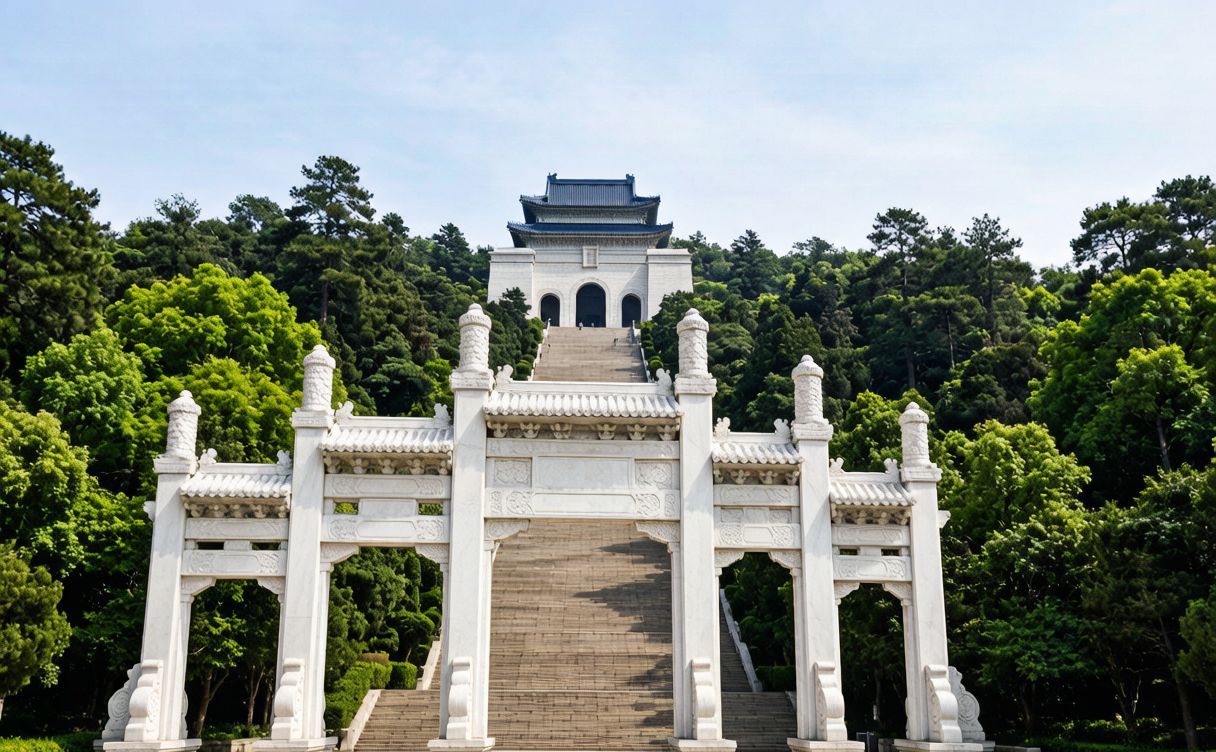
The complex is huge, the views are genuine, and the story behind it is better than any plaque admits. Here’s what I wish someone had handed me before I went.
Why I Keep Going Back to Purple Mountain
The first time, I arrived around 8 a.m. on a weekday in April. The tree-lined boulevard up from the metro was empty except for one old man practicing tai chi with slow, exaggerated sweeps of his arms. He nodded at me, then tipped his chin toward the hill — “上面, 上面” — as if to say the good part was waiting. That small, wordless welcome set the tone for the entire morning.
Purple Mountain (Zijin Shan) is its own green world on the eastern edge of Nanjing. The Sun Yat-sen Mausoleum shares the mountain with the Ming Xiaoling tomb, the old Observatory, and a scattering of lakes, so even if the main gate crowds you out, the forest around it never really does. I’ve come to think of the Sun Yat-sen Mausoleum less as a single building and more as an entire hillside designed to slow you down.
The 392 Steps of the Sun Yat-sen Mausoleum
Let’s talk about the climb, because everyone warns you about it and almost nobody explains it. From the base of the main stairway to the tomb chamber, there are 392 steps. I counted on my second visit, and yes — it’s 392, not a tidy round number, and that’s deliberate.
Here’s the trick the architecture plays on you: the steps are built so that from the bottom, looking up, the landings stretch flat and the stairway looks almost gentle. But when you reach the top and look back down, the steps vanish — the landings line up into what looks like a single unbroken slope. The architect, Lü Yanzhi, designed it this way on purpose. From below you feel the ascent; from above you feel the unity. I didn’t believe it until I turned around, breathless, and the whole staircase had disappeared into a green ramp. It’s a small, clever bit of theatre that makes the Sun Yat-sen memorial feel deliberate rather than decorative.
Pace yourself. There’s no shade on the central flight, and in summer it bakes. I made the mistake of doing it at noon in July once — never again. Bring water; there are vendors at the bottom but none halfway up.
The Blue-Tiled Archway and the Tomb Chamber
Before the steps, you pass the memorial archway — a three-gate granite structure capped with blue glazed tiles, the same imperial blue you’ll recognize from Forbidden City roofs. It’s inscribed with Sun’s own phrase, “天下为公” (the world belongs to the public), and it’s the most photographed frame on the mountain for good reason. On a misty morning the blue tiles glow against the grey sky in a way no sunny afternoon can match.
At the top sits the vaulted coffin chamber, a half-dome of white stone flanked by blue-tile eaves. Inside, you can’t enter the actual tomb — it’s sealed — but you walk a semicircle around the marble reclining statue of Sun and look down through a brass grille at the coffin itself. It’s sober, unlit, and strangely peaceful. The third time I went, a school group filed through in total silence, and I realized the place still commands respect from the people who live here, not just the tourists who photograph it.
How to Get There from Nanjing
The easy way: take Nanjing Metro Line 2 to Muxuyuan Station (苜蓿园), Exit 1. From there it’s a 15-minute walk or a short hop on the tourist shuttle (the “Ming Xiaoling–Sun Yat-sen” loop bus, cheap and frequent). A taxi from the city center runs about 25–40 RMB depending on traffic.
If you’re basing yourself downtown, the Sun Yat-sen Mausoleum is an easy half-day. I’d pair the trip with a look at our full Nanjing travel guide for where to eat and sleep nearby.
Don’t drive yourself up the mountain — private cars are restricted on the central roads and parking is a headache. The shuttle exists precisely so you don’t need to.
Visiting the Sun Yat-sen Mausoleum With the Ming Xiaoling
Here’s the move most first-timers miss: the Ming Xiaoling tomb of the Hongwu Emperor sits a 20-minute walk south through the forest, and a combined ticket often covers both. I stumbled onto it by accident the first time — I got turned around near the music stand and followed a stone spirit-way of carved elephants and camels that led me straight to the Ming gates. That wrong turn became my favorite hour of the trip. The two tombs, side by side across six centuries, tell you more about Chinese ideas of kingship and memory than any museum wall.
If you’re chasing atmospheric old towns and imperial sites beyond Nanjing, our best ancient towns in China guide is a natural next read.
Best Time to Visit the Sun Yat-sen Mausoleum
Spring (late March–April) for the plum and cherry blossoms, and autumn (October–November) for cool, clear hiking, are the obvious windows. I’ve been in both and slightly prefer late October — the leaves turn, the crowds thin after National Day, and the light on the blue tiles is golden.
To beat the crowds: arrive before 8:30 a.m., avoid weekends and Chinese public holidays, and skip the midday window entirely. If you’re building a wider China plan around good weather, our best time to visit China piece lays out the regional calendar.
A Note on the Man Himself
A quick, honest word on Sun Yat-sen (孙中山, also written Sun Zhongshan — the mausoleum’s Chinese name, Zhongshan Ling, comes from that). He’s honored across the political spectrum in China as the revolutionary who helped end the imperial system in 1911, and the Nanjing mausoleum was built between 1926 and 1929 after his death. The Sun Yat-sen memorial you climb today is essentially the man’s political philosophy set in stone: austere, symmetrical, and built to be walked toward rather than merely looked at. Locals often shorten it in conversation to the Sun Yat Sen memorial, but the formal name on every sign is the Sun Yat-sen Mausoleum. You’ll see his portrait and quotations everywhere from here to the smallest provincial museum. I’m not a historian, and this isn’t the place for a thesis — but standing at the top of those 392 steps, it’s hard not to feel that the mountain was chosen to make a point about legacy.
If you want more context before you go, the official Nanjing tourism portal publishes background and seasonal event information in English at https://www.nanjing.gov.cn/.
Practical Tips I Wish I’d Had
- Entry: The outer park of the Sun Yat-sen Mausoleum is free, but the tomb chamber area generally needs a (small) ticket or advance reservation on busy days. Check the official site the morning before.
- Footwear: Real shoes. Those 392 steps punish flip-flops.
- Combine smartly: Mausoleum + Ming Xiaoling + the nearby Linggu Temple is a full, excellent day.
- Water and snacks: Buy at the base; the upper terraces have little.
- Photos: The grand staircase shoots best from the bottom looking up, early, before the tour buses land around 10 a.m.
The Sun Yat-sen Mausoleum earns its reputation, but it rewards the prepared more than the rushed. Go early, climb slowly, and let the blue-tiled archway do the rest. If you’re plotting a bigger itinerary, our China bucket list attractions and best things to do in China guides both flag it as a Yangtze-region essential, and our China travel guide for first-timers covers the logistics of riding the high-speed rail straight to Nanjing.