

The first thing you notice about Yellow Crane Tower isn’t the tower at all. It’s the wind. Standing on Snake Hill above the Yangtze, I watched a cargo ship the size of a city block glide past where a legendary crane once supposedly flew, and I finally understood why this spot has obsessed Chinese poets for over a thousand years. Yellow Crane Tower — or Huanghelou, as the locals call it — is the wuhan landmark every visitor is told to see, and unlike a lot of “must-sees” that disappoint, this one earns the hype. It is, after all, known as the “First Tower Under Heaven.” On my first morning in Wuhan, I climbed before the crowds and found out why.
Why the “First Tower Under Heaven” Earned Its Name
The title “First Tower Under Heaven” isn’t tourist-board puff. Yellow Crane Tower has been the single most written-about tower in Chinese literary history, and that reputation goes back to AD 223, when it was first built as a watchtower during the Three Kingdoms period. The original sat on the ramparts of the old Wuchang wall, a military lookout that slowly morphed into something far grander in the cultural imagination. Emperors rebuilt it, poets climbed it, fires and wars flattened it at least a dozen times, and every generation put it back up because the idea of Wuhan without it was unthinkable.
What gives yellow crane tower wuhan its staying power is geography. Snake Hill rises right where the Yangtze and Han rivers nearly kiss before the Yangtze turns east toward Shanghai. From the top you see the whole heartbeat of central China — two rivers, a sprawling city of eleven million, and a bridge that was, when it opened in 1957, the first to span the Yangtze at all. The setting is the attraction as much as the building.
The Poetry That Made It Famous
Here is the part most travel guides rush past, and it’s the part that actually matters. When I reached the second-floor gallery, a poem on the wall stopped me cold — Cui Hao’s “Yellow Crane Tower,” written around 730 AD. In it, the poet climbs the tower, mourns that the crane and the immortal who rode it are gone, and watches the endless river below. It’s so good that, legend has it, Li Bai — China’s most beloved poet — stood on the same spot, pen in hand, and admitted he could not top it. He wrote a different poem instead and left.
I am no Li Bai, but reading that stone inscription with the real river behind it did something a museum never could. You’re not looking at a replica of a poem; you’re standing inside the exact view that produced it. That continuity — same hill, same river, same impulse to scribble something grand — is the soul of the place. If you only half-listen to the audio guide, at least catch this story. It turns a pretty pagoda into a thousand years of human feeling.
Climbing Huanghelou — What You Actually See
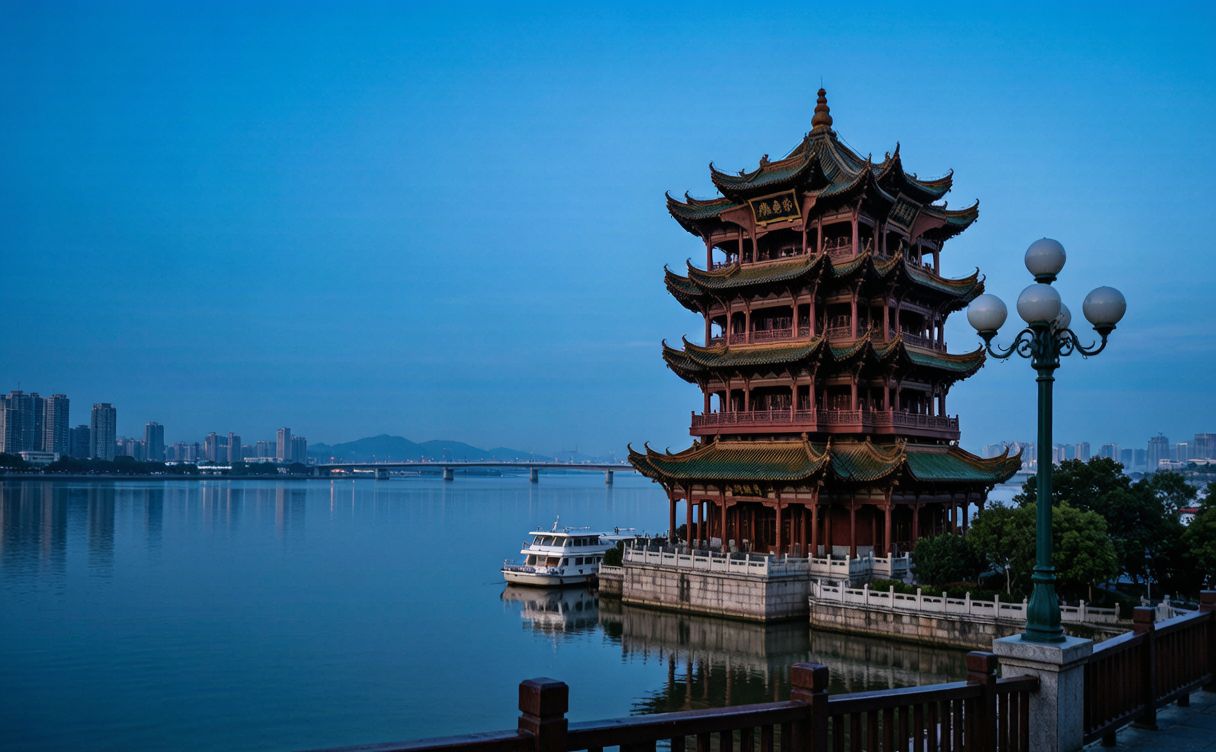
Let me be honest about the view, because I hate travel writing that oversells. The current tower is a 1980s reconstruction in Tang-dynasty style, so it’s pristine rather than ancient. But when you climb the five stories, the payoff is real. I reached the top just as the early light hit the water, and the Yangtze stretched out like a slow silver road headed for the horizon. To the north, the red arches of the First Yangtze Bridge carried a train underneath and cars overhead — a piece of mid-century engineering that still feels improbable.
Each floor has its own mood. The ground level is busy with souvenir stalls and the inevitable crowd photos. The middle floors hold calligraphy, models of past towers, and exhibits on Wuhan’s river history. The top floor is the quiet one — mostly windows, a few benches, and that view. My tip: go up once for the photos, then come back down a floor and just sit. The best version of Huanghelou is the one you feel, not the one you frame.
A Rebuilt Tower, But No Less Moving
I’ll address the elephant in the room head-on: yes, what you’re climbing is a modern rebuild. The last historical tower burned in 1884, and the structure today dates from 1985. Some purists scoff. I get it — there’s a romance to original stone. But here’s the thing I tell fellow travelers: the meaning of Yellow Crane Tower was never in the bricks. It lives in the poems, the river, the repeated act of rebuilding, the stubborn refusal to let a landmark die. Wuhan has rebuilt this tower through dynasty after dynasty precisely because it matters.
In that sense the reconstruction is the most honest thing about it. Standing on the viewing deck, watching a sunset that Cui Hao watched, I didn’t feel cheated by the new wood and tiles. I felt connected to a city that keeps choosing beauty over rubble. If you want crumbling authenticity, go elsewhere. If you want the living spirit of a place, yellow crane tower wuhan delivers it.
How to Visit Yellow Crane Tower in Wuhan
Practical stuff, because this is where trips go sideways. The tower sits in Wuchang District, on the east bank of the Yangtze, near the First Yangtze Bridge. The nearest metro is Huanghelou Station on Line 4 — a five-minute walk to the entrance. Buy tickets online in advance through the official channel or a Chinese platform; the on-site queue can be long on weekends and holidays. Entry is reasonably priced for a top-tier attraction, and students and kids get discounts.
Plan two to three hours. That covers the climb, the exhibits, the gardens around the base (there’s a pleasant park with stone steles and a small replica of the ancient city wall), and a slow coffee afterward. Go early — I mean opening time, around 8 a.m. — if you want photos without fifty strangers in frame. Late afternoon is gorgeous too, when the light goes gold on the river. Avoid Chinese national holidays unless you enjoy being a sardine; our China public holidays 2025 crowd calendar lays out exactly which weeks to dodge.
Best Time to Go
Wuhan has a reputation for brutal summers — the locals call it one of the “three furnaces” of the Yangtze — and soggy, grey winters. Spring (March to May) and autumn (September to November) are clearly the sweet spots. I went in early April and the hillside was dotted with cherry blossoms, the air was soft, and the river breeze actually cooled rather than cooked me.
Autumn, especially October, gives you clear skies and that famous golden-hour river view. If you’re building a wider China plan around good weather, our best time to visit China guide breaks the seasons down region by region. And if Wuhan is one stop on a bigger trip, our best things to do in China will help you slot it alongside the heavy hitters.
Pair It With East Lake and Hubu Alley
A tower alone is half a day; Wuhan deserves a full one. Two easy add-ons sit close by. East Lake (Donghu) is the massive urban lake north of the city, bigger than Hangzhou’s West Lake, with bike paths, plum gardens, and a calm that balances the tower’s spectacle. I rented a bike there after descending Huanghelou and spent a happy hour riding the lakeside trail while my legs recovered from the climb.
Then there’s Hubu Alley — Wuhan’s most famous food street, a short hop from the tower in Wuchang. This is where the city’s legendary breakfast culture, the “guozao,” comes alive: hot dry noodles (reganmian), steaming doupi, sweet rice wine, fried bread sticks. Go hungry. The alley gets packed in the evening, but that’s the point — you’re eating shoulder to shoulder with locals who’ve done this their whole lives. For a deeper dive into what and how to eat across the country, our Chinese food guide to the eight great cuisines is a solid primer before you slurp your first bowl of reganmian.
Why It Belongs on Your China List
I’ve now stood on towers from the Big Wild Goose Pagoda in Xi’an to the Bund’s riverfront in Shanghai, and Yellow Crane Tower holds its own. It isn’t the tallest or the oldest you can climb, but few combine poetry, river, and sheer civic pride so completely. If you’re assembling a serious itinerary, our China bucket list attractions ranks it alongside the country’s true icons — and if your route swings southwest instead, the Chongqing travel guide will show you another Yangtze city with a completely different energy.
Yellow Crane Tower rewards the traveler who slows down. Climb it, read one poem, watch one ship pass, and eat one bowl of noodles afterward. That’s the whole of Wuhan in a single day, and it’s one of the better days you’ll spend in China.
For the historical and cultural background of the tower, the Encyclopaedia Britannica entry on Yellow Crane Tower is a reliable external reference: Britannica — Yellow Crane Tower.