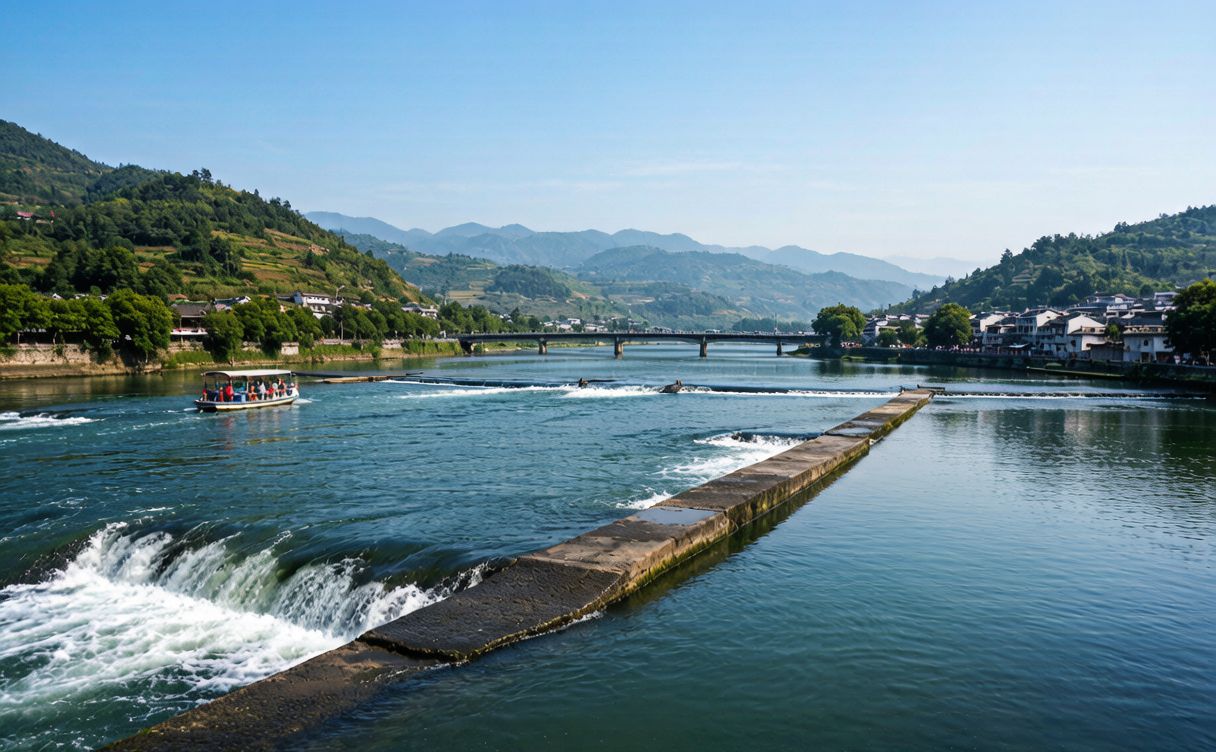
I was standing ankle-deep in spray on a narrow wooden causeway when a Chinese tour guide next to me turned to her group and said, “There is no dam.” She was right, and that is exactly why Dujiangyan stopped me in my tracks. Here in Sichuan, an engineering work built around 256 BC by a Qin-era governor named Li Bing still controls the Min River without a single concrete wall holding back a reservoir. More than 2,200 years later it waters the Chengdu Plain and keeps five million people from flooding every summer. I had come expecting a monument. I left convinced I had seen the smartest piece of infrastructure in China.
Standing on the Fish-Mouth Levee
The first thing you notice at Dujiangyan is the sound. The Min River arrives here fast and grey from the mountains, and the whole site roars. The centerpiece is the Yuzui, or fish-mouth levee, a long wedge of masonry that splits the river into an inner and outer channel. When I watched the water divide at the fish-mouth on a wet April morning, I finally understood why locals call this place alive. There is no gate to crank, no operator in a control room. The river sorts itself.
A engineer-guide explained to me that the genius is in the geometry, not the muscle. The inner channel is dug to run shallow and slow; the outer channel runs deep and fast. In the flood season the fast outer stream naturally grabs most of the water and the silt, sparing the farms. In the dry season the slower inner stream gently pulls its share across to the fields. “It balances itself,” he said, slapping the weir stone. “We just built the shape 2,000 years ago.”
How the Dujiangyan Irrigation System Actually Works
The dujiangyan irrigation system is not one trick. It is three cooperating parts, and each one does a job a modern dam would need a computer to manage.
The Fish-Mouth (Yuzui) Levee
The Yuzui is the divider. Beyond the fish-mouth, the inner channel (the Baopingkou-bound flow) feeds the plain, while the outer channel dumps excess water safely past the city. This automatic split is the first filter: it keeps the farming side from drowning in June and from starving in January.
The Flying Sand Weir
A short distance downstream sits the Feishayan, the flying sand weir. This is my favorite part. It is a low, deliberately weak spillway. When the river runs high, excess water and heavy sediment simply leap over the weir and rejoin the outer channel. When I watched thediversion during a brief downpour, I saw a brown sheet of silt-laden water lift clean over the weir without any human touching it. The dujiangyan ancient weir name makes sense once you see sand literally flying away from the farmland intake.
The Bottle-Neck Channel
Finally there is the Baopingkou, the bottle-neck channel, a human-cut throat in a rocky hill that meters the water into the irrigation canals at a fixed rate. Too much cannot get through. The bottle-neck is the regulator that turns the river’s mood swings into a steady sip for the rice paddies.
UNESCO, which lists the site as a World Heritage property, describes it as a remarkable feat of ancient hydraulic engineering that remains fully functional today. You can read the official listing here: https://whc.unesco.org/en/list/1001/
The Qingming Water-Releasing Festival
If you can time your trip for early April, do it. The Dujiangyan Qingming Water-Releasing Festival (Fangshui Jie) is the moment each spring when the winter debris-blocking poles are pulled and the irrigation season officially opens. I landed a week before the big day and watched crews rehearsing the ritual of dragging woven bamboo cages into the channel.
The festival is part engineering, part theater. A costumed ceremony honors Li Bing and his son, then symbolic barriers are removed and water crashes into the canals. A local I shared a sticky-rice bun with told me the festival has run, on and off, for over two millennia. It is the rare heritage event where the “performance” is also the actual start of the farming year. For the broader picture of seasonal events across the country, I keep this calendar handy: China festivals calendar
A Day Trip From Chengdu With the Pandas
Getting to Dujiangyan from Chengdu is easy and that is the real gift. The fastest option is the high-speed train from Chengdu’s Xipu Station to Dujiangyan Station; it runs roughly every half hour and takes about 35 minutes. From the station a bus or taxi covers the last few kilometers to the scenic area. I did the round trip in a single relaxed day and never felt rushed.
The other half of that day, and the obvious pairing, is the nearby panda research base. The Dujiangyan panda base is smaller and calmer than the busy one inside Chengdu city, and it sits close enough that you can watch giant pandas chew bamboo in the morning and walk the levees by afternoon. If you want the full Chengdu-and-pandas plan laid out, start here: Chengdu Dujiangyan panda base guide
Tickets, Timing, and Practical Tips
A few things I learned the hard way so you do not have to.
Entry to the Dujiangyan scenic area is ticketed, and prices shift with season and the festival period. Buy at the gate or through the official WeChat channel ahead of busy holidays; the line on a Golden Week morning is no joke. The site is big, with stone steps, suspension bridges, and some steep climbs to the viewing pavilions, so wear real shoes. I wore sneakers and was glad; the person in flip-flops next to me was not.
Arrive when it opens. The light on the river is best before ten, the tour groups have not arrived, and you can stand on the Anlan Suspension Bridge without a crowd pressing your back. The bridge itself is worth the trip: it sways over the full width of the divided river and gives you the single best photograph of the whole scheme.
Give yourself at least three hours. Less and you will be speed-walking past the very weirs that make the place special. If you want to stay overnight rather than dash back, our roundup of comfortable bases in the city is here: best hotels in Chengdu
Why Dujiangyan Belongs on Your China List
I have now walked a lot of China’s headline attractions, and the dujiangyan sichuan site is the one that made me quietly rethink what “ancient” means. Most old wonders are ruins you admire from a rope barrier. Dujiangyan is different. The water moving through it this afternoon is doing the same job it did when Rome was still a republic, and it is doing it better than most things we build now.
What stuck with me was not the scale but the restraint. Li Bing did not try to conquer the river. He shaped the bank, cut one channel, and let physics do the rest. Standing on the fish-mouth, soaked and grinning, I understood why locals still call the dujiangyan ancient weir their greatest ancestor. If your China trip skips Chengdu’s backyard, you will miss the one engineering marvel that is still winning.