

Most visitors come to Tekes for one reason, and it is not a mountain or a monument — it is the street grid itself. The county seat in Xinjiang, China was laid out as a giant bagua, the eight-trigram symbol from the I Ching, with a central park and eight radiating avenues curled into concentric rings. I drove in on a summer evening and got genuinely lost for twenty minutes despite a map, because every road curves back toward the middle. That disorientation is the attraction. This Tekes travel guide covers how to reach the town, when to come, and what to do once the novelty of the layout wears off.
Why the Bagua Layout Exists
The current plan dates to 1936, when the local administrator rebuilt the town on the trigram pattern, and it has been preserved remarkably intact. There are no traffic lights in the old core — roundabouts handle every junction — and the eight main spokes are named for the trigrams (Qian, Kun, Zhen, Xun, and so on). Climb the small tower or hill at the center and the design reads clearly from above. It is a quirky piece of urban planning you will not find elsewhere in China, and it makes Tekes a worthwhile overnight stop rather than a photo-and-leave town. For the planning background, the entry at Tekes County on Wikipedia maps the administrative setting.
The pattern is not merely decorative. Each of the eight spokes corresponds to one of the trigrams, and the four inner rings of the town are said to represent the elements and cardinal associations of the I Ching. Locals will tell you the layout was meant to bring harmony and, more practically, to keep the wind off the streets and the market at the heart of daily life. Some visitors rent a bicycle (¥20–30 a day) and trace the outer ring road, which is about 8 km around and gives a calm sense of the whole geometry without the confusion of the inner curves. Morning is best for this ride, before the midday heat and the tour buses from Yining arrive.
Best Time to Visit Tekes
The best time to visit Tekes is late June through early July, when the surrounding Ili River valley turns deep green and the nearby lavender fields of Huocheng are in full bloom. Daytime highs sit around 24–28°C, perfect for grassland hikes. April brings apricot blossom in the surrounding villages, while September paints the valleys gold and thins the crowds. Winters are long and cold, with snow from November to March, so I would not plan a first trip then. Our guide to the best time to visit Xinjiang breaks the region’s micro-seasons down by prefecture, since the north and south of the region diverge sharply.

How to Get to Tekes
Figuring out how to get to Tekes is the first practical hurdle. There is no train station in town; the nearest airport and rail hub is Yining (also called Ghulja), about 115 km northwest in the Ili valley. Domestic flights reach Yining from Urumqi (roughly 1 hour 20 minutes, ¥600–1,100 depending on season) and from a handful of mainland cities. From Yining airport or the Yining train station, hire a car or take a shared van — the drive to Tekes takes 1.5 to 2 hours along good highway and runs ¥150–250 per seat in a shared ride, or ¥400–600 for a private car. If you are arriving from Urumqi by rail, the sleeper train to Yining takes about 10–12 hours; book early through our China high-speed train guide for foreigners for the booking mechanics, though note this particular leg is a conventional train rather than a bullet line.
Things to Do in Tekes
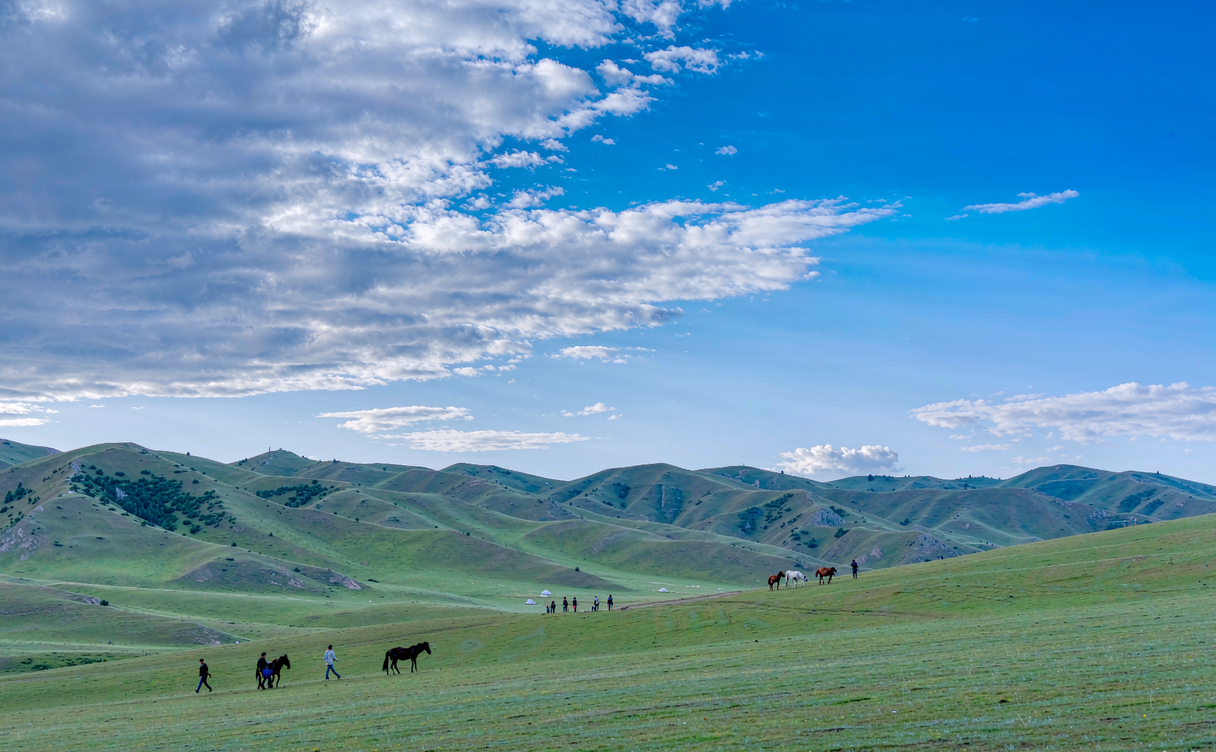
The things to do in Tekes split into two zones: the town and the grasslands outside it. Inside, walk or cycle the ring roads, visit the central Culture Park, and eat at the night market where Uyghur, Kazakh, and Han stalls sit side by side — try the grilled lamb ribs (¥15–25 a skewer plate) and the hand-pulled laghman noodles (¥20–30). Outside town, the real prize is the Kalajun grassland, a rolling alpine meadow about 40 km southeast that forms part of the Xinjiang Tianshan UNESCO World Heritage component. A day trip with the scenic-area shuttle runs ¥155–205 including entry, and the boardwalk loops give you wide views without a serious hike.
A quieter option is Xinghua village to the south, famous for its apricot blossoms in early April, and the Kuokesu canyon for those who want a longer trek. If your interest is the broader corridor, this town sits naturally on our China Silk Road itinerary, which threads the old trade routes through the region.
Beyond the headline grasslands, the area rewards slower travel. The Kurdening scenic zone to the east offers fir forests and fewer visitors than Kalajun, with entry around ¥100 including the shuttle. In late June, the road from Tekes toward Huocheng passes field after field of lavender that rivals anything in southern France, and several farms charge ¥20–30 to walk the rows and photograph the blooms. I have found that hiring a local driver for a half-day loop (¥200–300) covers two or three of these spots far more easily than piecing together sporadic village buses, which run infrequently and rarely announce stops in English.
A Tekes Itinerary That Actually Works
A realistic Tekes itinerary is two days and one night, possibly three if you want a full Kalajun hike. Day one: arrive from Yining mid-afternoon, walk the bagua core, dinner at the night market. Day two: morning shuttle to Kalajun, afternoon back in town, overnight again or push on to Huocheng or Nalati. I would not allot less than a full day, because the grasslands deserve morning light. Tekes also pairs well with the wider loop in our Xinjiang 7-day itinerary, which balances Ili’s green north against the desert south.
Where to Stay and What It Costs
Accommodation in Tekes is modest but improving: clean guesthouses and mid-range hotels near the center run ¥180–350 a night, while a comfortable four-star option reaches ¥450–600. Food is cheap and hearty — a filling bowl of noodle soup or a kebab plate lands at ¥25–45. The town is small enough to cover on foot, so you rarely need a taxi; when you do, Didi operates thinly here, so agree on a price with a local driver for grassland runs. Book your room a week ahead in late June and July, when the lavender season fills the cheaper places and walk-up availability disappears by early afternoon.
Culture and Context
Tekes sits inside the Ili Kazakh Autonomous Prefecture, and the surrounding countryside is home to Kazakh and Mongol herding communities who still move livestock with the seasons. Visiting a family yurt for milk tea and flatbread is one of the more memorable, low-cost experiences here — expect to pay ¥50–100 for a short visit with snacks. For background on the wider cultural patchwork of the region, our China ethnic minorities travel guide explains etiquette and respectful visiting across the different groups you will meet around Xinjiang, China. The Tekes bagua city Xinjiang draws are unusual, but the human landscape around them is the part that stays with you.
Planning Notes
Bring a layer even in summer — the Ili valley cools fast after sunset, and the grasslands drop to 12–15°C at night. Sunscreen and a hat are essential; the UV at this latitude is strong. Cash helps at small stalls, though Alipay is increasingly accepted. Mobile data is reliable in town but patchy on the grassland roads, so download offline maps before you leave Yining. If you are building a regional route, start from our Xinjiang travel guide for the bigger picture on permits, distances, and the north-south split that defines any trip here.
Planning a wider regional loop? Open our Xinjiang travel guide for distances, permits, and the north-south split that shapes every route.
Want the full bagua-and-grassland circuit? Our Xinjiang 7-day itinerary slots Tekes in alongside the best of the Ili valley.
Torn between seasons? Read the best time to visit Xinjiang before locking in your flight to Yining.