

The name means “sun shines first” — 日照 — and it comes from an old line about this stretch of coast being the first part of the province to catch the morning light. That is not marketing. Stand on the sand at Wanpingkou at 05:00 in June and you will share the beach with a few hundred Chinese families, all of them facing east, all of them silent for about ninety seconds. This Rizhao travel guide covers a working port city in southeastern Shandong with roughly sixty kilometres of soft-sand coastline, a fishing fleet that still unloads at dawn, and almost no international visitors — which is exactly why it is worth the detour from Qingdao.
Content Preview
- How Rizhao differs from Qingdao
- Best time to visit
- How to get there, with a fare table
- Beaches, the lighthouse headland, the pine forest park and the mudflats
- Where to stay
- A two-day plan
- Seafood, green tea and how to order
- Practical tips
- FAQ
Why Rizhao Is Not Just a Smaller Qingdao
Qingdao has the German architecture, the beer festival and the crowds. Rizhao, about 130 kilometres down the coast, has the sand — wider, flatter, far less built up, backed in long stretches by planted black pine rather than apartment towers. The city itself is unremarkable 1990s port-boom blocks and nobody comes for the architecture.
What it does well is a specific kind of Chinese seaside holiday: barefoot mornings, a bucket of clams dug at low tide, steamed shellfish on a plastic table at 18:00, and the beach again after dark. If you are working down the coast from our Qingdao travel guide, Rizhao is the two-day exhale in the middle.
Best Time to Visit Rizhao
May to mid-June. My pick. Air around 20–26°C, dry, clear, and the beaches are still half-empty. The sea is cold for swimming — typically 17–20°C — but fine for wading.
July and August. Peak season, and the water finally warms to roughly 23–26°C. Expect 28–32°C days with high humidity, packed sand at Wanpingkou, and hotel rates two to three times the shoulder-season price. Weekends are worse than weekdays by a wide margin.
September to early November. The best all-round window. Warm sea into late September, crisp air by October, and seafood at its cheapest and fattest after the summer fishing moratorium lifts on 1 September. Avoid 1–7 October.
December to March. Cold, grey and windy, 0–8°C. Some coastal hotels close. Come only for an empty beach and low prices, and pack a proper coat.
The northern-coast fishing ban runs roughly May to the end of August, so the boats you see in June are mostly small inshore craft.
How to Get There
Almost everyone arrives by train. Rizhao West Station (日照西站) handles the fast services on the Qingdao–Yancheng coastal line and the Rizhao–Lankao line that links inland to the Beijing–Shanghai high-speed route at Qufu East. It sits about 15 kilometres from the seafront, so budget a taxi at the far end.
| From | Mode | Typical duration | Approx. cost |
|—|—|—|—|
| Qingdao North → Rizhao West | High-speed rail | 1 hr 10 min | ¥60–90 (US$8–13) |
| Lianyungang → Rizhao West | High-speed rail | 1 hr | ¥55 (US$8) |
| Jinan East → Rizhao West | High-speed rail | around 3 hr | ¥180 (US$25) |
| Qufu East → Rizhao West | High-speed rail | 1 hr 40 min | ¥130 (US$18) |
| Beijing South → Rizhao West | High-speed rail, usually 1 change | 4 hr 30 min – 5 hr 30 min | ¥400+ (US$56+) |
| Shanghai Hongqiao → Rizhao West | High-speed rail | around 5 hr | ¥430 (US$60) |
| Rizhao West Station → Wanpingkou beach | Taxi / Didi | 25 min | ¥35 (US$5) |
Rizhao Shanzihe Airport (RIZ) has a thin domestic schedule and is rarely useful for foreign visitors. In town, city buses cost ¥1–2 and a Didi across the seafront strip rarely tops ¥25. If you have not booked Chinese rail tickets before, read our step-by-step China high-speed train guide for foreign travellers before you turn up at the station — you will need your passport at every stage.
A Rizhao Travel Guide to the Coast: Top Things to Do
Wanpingkou Scenic Area (万平口)
The city’s front room: a broad crescent of sand with a shallow tidal lagoon behind it, a sailing basin used by the local training centre, and a promenade of food stalls and kite sellers. Free. Crowded in July and August, but walk fifteen minutes north or south and the density drops fast. Lifeguards work the marked swimming zone in summer only.
The Lighthouse Scenic Area (灯塔风景区)
Immediately south, the shoreline turns from sand to low black reef with a white lighthouse at the point. This is the sunset spot — locals climb the flat rocks with beer and boiled peanuts. Free, always open, and far better an hour before dusk than at midday.
Rizhao Seaside National Forest Park (日照海滨国家森林公园)
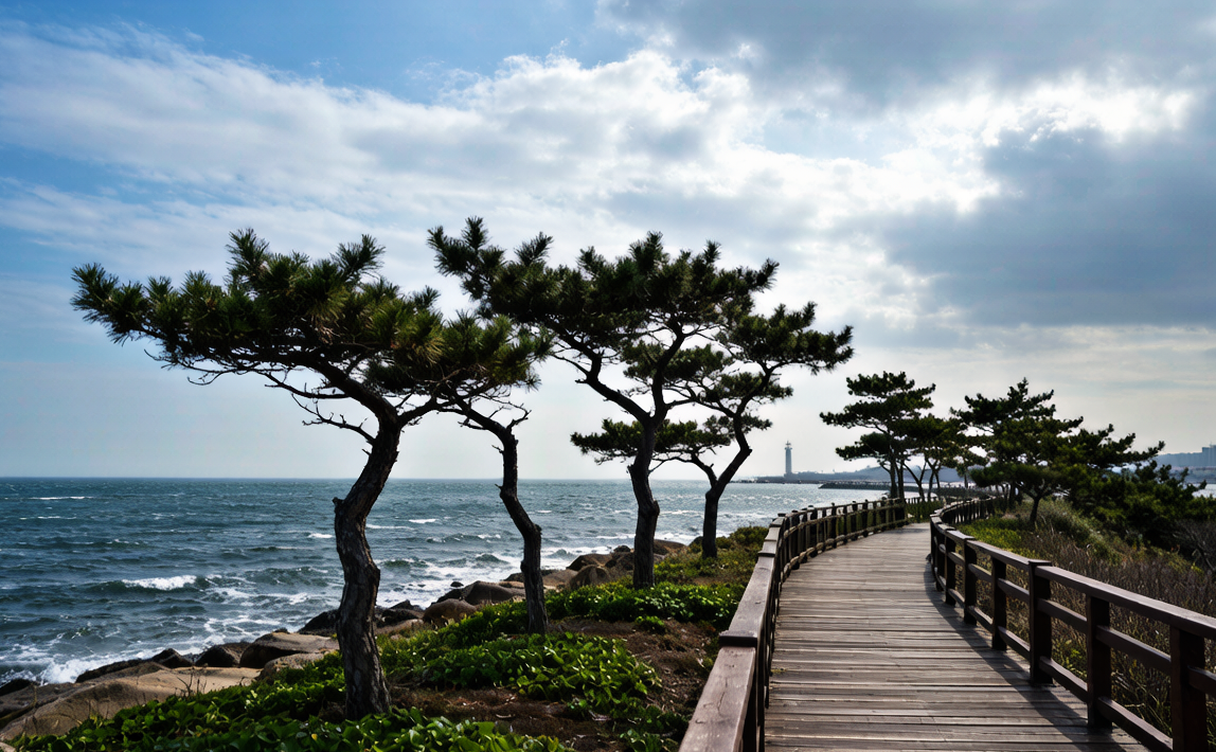
North of the city, a plantation of wind-bent black pine runs right down to the beach, which is rare on the Chinese coast. Boardwalks thread through the trees to a beach much quieter than Wanpingkou. Tickets typically under ¥60, bicycles for hire at the gate.
Going ganhai at Liujiawan (刘家湾赶海园)
Ganhai (赶海) means “chasing the sea”: walking the flats at low tide with a rake and a bucket for razor clams, cockles and crabs. Liujiawan, 40 minutes south, is the organised version — pay around ¥60, borrow a rake, join a few hundred delighted Chinese children. Check the tide first, because it is pointless at high water; any hotel desk knows the day’s low.
The old ginkgo at Ju County (莒县)
If rain kills the beach, drive an hour inland to Ju County, where the courtyard of Dinglin Temple on Fulai Mountain holds a ginkgo traditionally said to be some three thousand years old — the trunk takes about a dozen people to encircle. The county museum next door has strong Neolithic pottery from the Dawenkou culture. Entry around ¥50.
Wulian Mountain (五莲山)
Also inland: a granite ridge with a Ming-dynasty temple, wild azaleas in late April and May, and a two-to-three-hour circuit for around ¥80. No competition for the sacred peak two hours west — see our guide to climbing Mount Tai in Shandong — but a decent half-day.
Where to Stay
Budget — ¥130–260 (US$18–37). Chain hotels around Rizhao Railway Station and the Yingbin Road area, plus family guesthouses two or three streets back from the beach. Off season you can get a clean seaview double for ¥200.
Mid-range — ¥350–700 (US$49–99). The Wanpingkou strip. This is where I would stay: you can walk to the sand, the lighthouse and the night food stalls, and skip taxis entirely. Prices roughly double in late July.
Splurge — ¥900–2,000 (US$126–280). A handful of international-brand resorts along the north shore near the forest park, most with pools and private beach access. Book two months ahead for August.
One warning: many small guesthouses are not licensed to register foreign guests. Filter for hotels that accept international passports when you book, or you may be turned away at check-in after a long train ride.
Sample Itinerary: Two Days
Day 1 — the water
- 05:00 sunrise from the Lighthouse headland (June sunrise is brutally early; September is a civilised 05:45)
- 08:00 breakfast of jianbing and soy milk on the promenade
- 09:30 Wanpingkou beach, sailing basin and lagoon
- 13:00 lunch at a seafront stall, then a nap out of the midday sun
- 16:00 low-tide ganhai at Liujiawan, or the pine boardwalks at the forest park
- 19:00 seafood dinner and the night market
Day 2 — the edges
- 08:00 taxi to the fishing harbour to watch the morning unload
- 10:00 Rizhao Seaside National Forest Park, walk the pine trail to the beach
- 13:00 lunch, then either Wulian Mountain or the Ju County ginkgo
- 18:30 back to Rizhao West for the evening train to Qingdao
Food and Local Specialties
Rizhao eats plainly and very well. The default technique is steaming with almost nothing added, on the reasonable grounds that the ingredient does not need help.
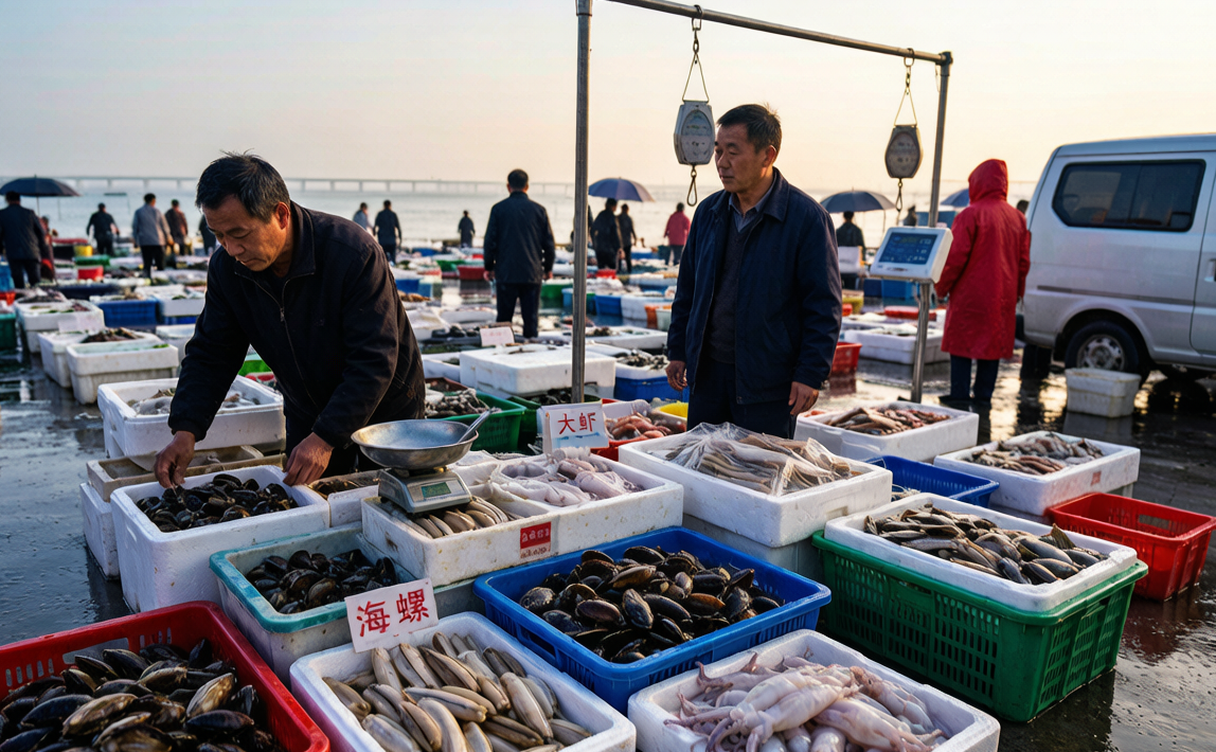
- Steamed shellfish by the jin. Point at the tanks, agree a weight, and it comes back ten minutes later. Razor clams (蛏子), cockles (蛤蜊) and scallops run roughly ¥25–60 per jin (500g).
- Mantis shrimp (虾虎, xiāhǔ). Best in spring when the females carry roe. Messy; use your fingers and follow whoever is next to you.
- Xishi clam (西施舌). A large, sweet local clam, usually flash-fried with chives. A regional point of pride.
- Swimming crab (梭子蟹). Peak season September to November, steamed whole with ginger vinegar.
- Rizhao green tea (日照绿茶). Shandong sits far north of the classic tea belt, and the slow winter growth gives these leaves a thick, chestnut-like body quite unlike Zhejiang greens. A tin makes the best souvenir from the city.
For a broader primer on ordering along this coast, our Shandong seafood guide explains the tank-pointing ritual in detail.
Practical Tips
- Payment. Alipay and WeChat Pay both accept foreign Visa and Mastercard; set one up before you arrive. Seafood stalls and ganhai rake hire may be cash-only, so carry a few hundred yuan in notes.
- Tickets and reservations. Rail tickets are sold against your passport number and you scan the passport at the gate. Larger scenic areas increasingly want a free WeChat mini-program reservation — ask your hotel to do it, since none are in English.
- English. Very little. Beach signage is bilingual; menus and taxis are not. Save your hotel address in Chinese characters.
- Swimming. Stay inside the marked zones at Wanpingkou and the forest park beach, and only when lifeguards are on duty. Rip currents on unpatrolled stretches are a real hazard, and the reef near the lighthouse is for looking at.
- Sun and jellyfish. Both peak in July and August. Buy one of the cheap rash guards sold along the promenade.
- Distances. The sights are strung over 40 kilometres. Didi is cheap, but a car with driver for a day (around ¥500) makes the inland trips painless.
FAQ
Is Rizhao worth visiting?
If you want a Chinese beach town without a resort strip, yes. It will not impress you architecturally and there is no single must-see monument. It is a place for two slow days of sand, seafood and sunrise between bigger stops.
How many days do I need?
Two is right. Three if you want to add Wulian Mountain or the Ju County ginkgo without rushing.
How do I get to Rizhao from Qingdao?
High-speed trains from Qingdao North take a little over an hour and run frequently, with fares around ¥60–90. Buy with your passport on the 12306 app or at the station counter. Coaches take about two and a half hours and are worth it only if trains are sold out.
Can you actually swim in the sea?
Yes, roughly late June to mid-September. Outside that the water is bracing at best. Water quality on the main beaches is generally good, though it dips after heavy summer rain.
Is Rizhao good for families?
Very. Shallow, gently shelving sand, the clam-digging park, an aquarium near Wanpingkou, and short distances between everything.
Do people speak English?
Barely anyone. Plan on translation apps, pre-saved Chinese addresses and a lot of pointing. Locals are friendly about it.
Written by Karl · Updated August 6, 2026