

Quanzhou was the great port of the Maritime Silk Road, and its old town still hums with the food of a thousand years of trade — Fujianese, Southeast Asian, and Arab influences layered like the red-brick qilou shophouses on Xijie Street. I spent four days there eating almost continuously, and it remains one of the best cheap-food cities in China. This Quanzhou food guide is the route I’d hand a friend.
Mian xian hu: the noodle paste that starts the day
The dish Quanzhou owns is mian xian hu (面线糊) — a thin, slurpable paste of fermented wheat vermicelli dissolved into a savory broth until it’s almost a gruel. You customize it at the counter: add braised intestine, oyster, squid, a crull of fried dough (you tiao), and a spoon of bright za cui pickle. A bowl with toppings is ¥8–15, eaten standing at a tiled counter before 9 a.m.
The mian xian hu noodle paste Quanzhou ritual is breakfast, fast and hot. The best I had was at Shuimen Guozhen (水门国仔), a cramped, famous hole-in-the-wall near the mosque where locals queue at 6:30. Break the you tiao over the top and let it soften. Our Quanzhou travel guide walks you from the mosque to this stall in five minutes.
Ordering is half the fun: you call out your toppings from a glass case — braised pork intestine (zhū cháng), soft-boiled egg, squid, or a spoon of za cui (a sweet-pickled vegetable relish that cuts the richness). The base broth is pork-and-shrimp, savory and a little glutinous from the dissolved noodles. A plain bowl is ¥6; loaded with intestine and egg it’s ¥13 and a full breakfast. Locals drink the last of it straight from the bowl — slurp encouraged, napkins optional.
Oyster omelette: the noisy street classic
Quanzhou oyster omelette (hai li jian) is the city’s loudest, greasiest joy. Fresh oysters are folded into a sweet-potato-starch batter with egg, then fried on a flat iron griddle until the edges crisp and the centre stays gooey. It’s dressed with a coriander-and-shrimp-paste sauce that’s gloriously funky. A plate is ¥15–25 at any night stall.
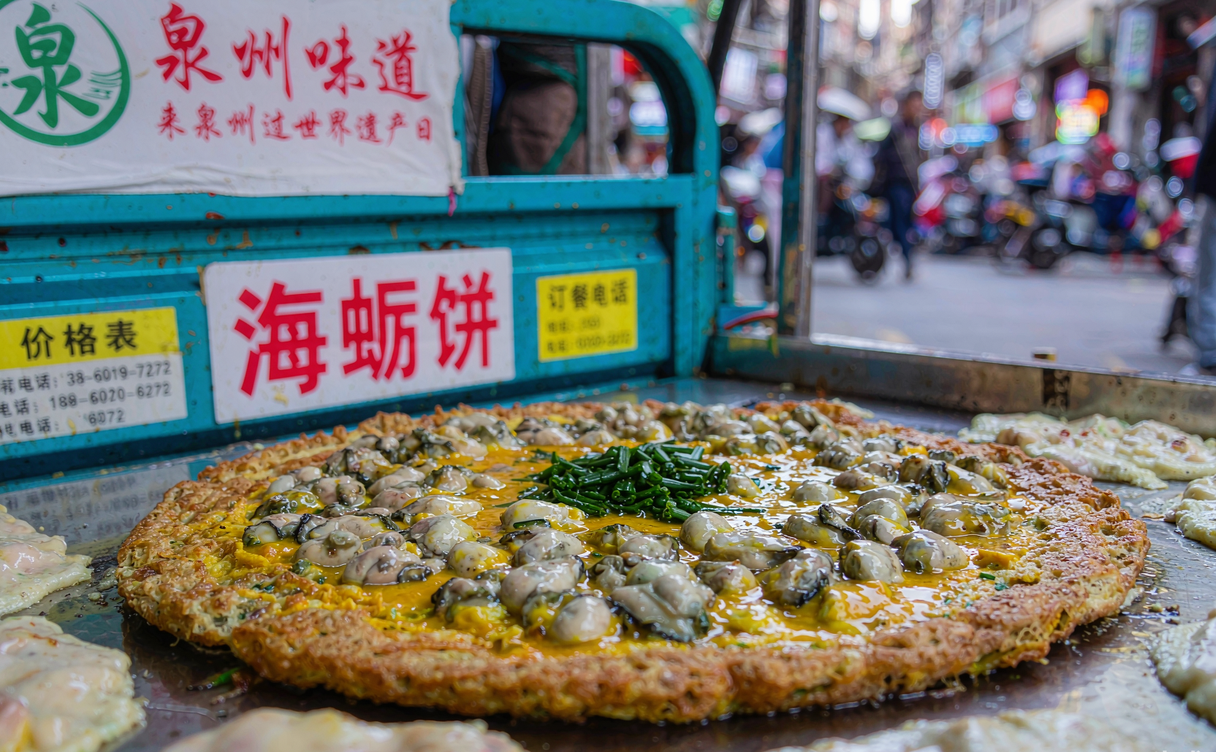
Where: the lanes off Xijie (西街) and the Bell Tower (钟楼) night cluster. Watch the griddle; the perfect one is golden at the rim, trembling in the middle. Our Fujian Min cuisine guide explains how this dish varies across the province’s port cities.
The starch is the secret: sweet-potato flour gives the omelette its signature slippery-centre, chewy-edge texture that you won’t find in a wheat-flour version. A good stall uses a generous handful of plump local oysters — Quanzhou Bay’s are small but sweet — and finishes with coriander, a smear of shrimp-paste sauce (shī lù), and a dab of chilli. Eat it straight off the griddle with a plastic fork; it firms up and loses its magic within minutes. Budget ¥15–25 and order one per person — sharing defeats the point.
Tu sun dong: the sandworm jelly dare
The most famously weird Quanzhou bite is tu sun dong (土笋冻) — “sandworm jelly.” It’s not a plant: a tiny marine worm is boiled until its collagen sets into a clear, jellied cube, served cold with vinegar, garlic and chilli. Texture is a cool, briny wobble; flavour is clean ocean. Locals love it; visitors either grin or gag. A plate of six is ¥10–20 at Anhai-style stalls.
Try it once for the story. Our street food in China safety guide covers how to judge a clean stall so you can take the dare without the regret.
Old town food streets: graze on foot
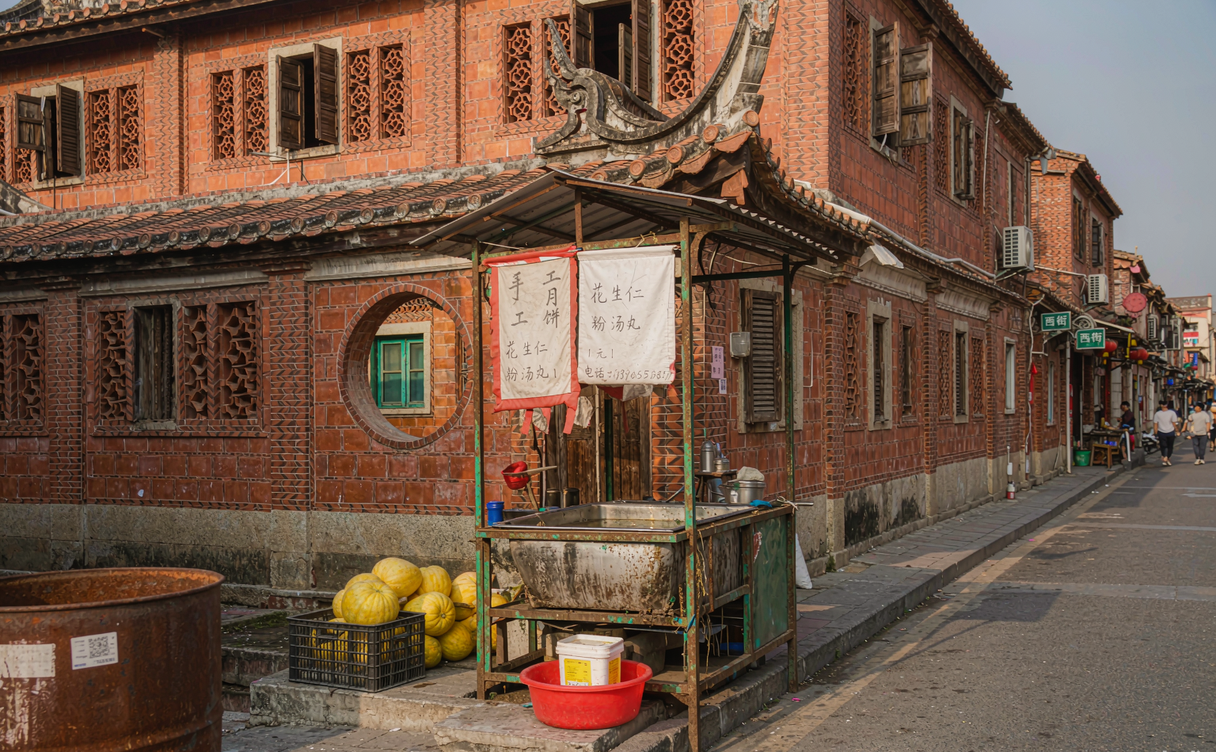
The Quanzzhou old town food streets centre on Xijie and Zhongshan Road, where red-brick arcades hide a century of snack shops. Beyond the headliners, hunt for:
- Rou zong (肉粽) — sticky-rice parcels with pork, mushroom and a sweet-savory soy, ¥6–10.
- Run bing (润饼) — Fujian spring rolls you roll yourself with shredded veg and peanut candy, ¥8.
- Geng (羹) — sour seafood soups, ¥10.
- Shuibing (水饼) — rice-flour wrappers with peanut-sugar filling, ¥5.
A where to eat in Quanzhou rule: follow the oldest storefront and the longest local queue. Our China breakfast guide lists Quanzhou’s morning staples among regional greats.
Seafood and the coastal cousin
Quanzhou’s coast adds steamed grouper, braised squid, and the famous Anhai braised duck (Anhai dun ya), dark, soy-rich and falling off the bone, half a bird ¥40. For a deeper seafood dive across the strait, our Xiamen seafood guide extends the same kitchen north. And for the province’s banquet pinnacle, our Fujian Buddha jumps over the wall guide explains the luxurious soup that began as a Fuzhou dish.
Quanzhou drinks, sweets and a one-day grazing plan
Quanzhou’s sugar comes gentle. Shi hua gao (石花膏) — a clear seaweed jelly with honey and fruit — is the summer cooler at ¥6, sold from ancient storefronts on Zhongshan Road. Tian mo (甜粿), a sticky brown-sugar rice cake, is the festival treat, ¥5 a slice. To drink, the old teahouses pour tieguanyin oolong, grown in neighbouring Anxi, by the pot for ¥20.
For a single-day plan, begin at Shuimen Guozhen for mian xian hu at 7 a.m., walk Xijie for run bing and rou zong mid-morning, lunch on Anhai duck near the Bell Tower, then graze Xijie night stalls for oyster omelette and tu sun dong after dark. Everything sits within a 20-minute walk of the old town’s core, so you never need a taxi. Our Quanzhou travel guide maps the exact loop.
Seasons and tips
Autumn (September–November) is best — oysters fat, weather cool, fewer tourists. A few honest notes:
- Mian xian hu is a breakfast food; stalls close by late morning.
- Oyster omelettes are evening and night only.
- Tu sun dong is an acquired texture — one plate is plenty.
- Carry small cash; many old-town stalls don’t take cards.
- Quanzhou is mild and walkable; wear comfortable shoes for grazing.
- The Kaiyuan Temple area near Xijie closes some stalls on the biggest festival mornings — time your food walk for a normal day.
- If tu sun dong puts you off, the same stalls usually sell ha li jian (clams in broth) as a gentler sea-snack alternative.
- Quanzhou’s sweet-sour za cui relish is the flavour thread tying mian xian hu, omelettes and rice cakes together — try a little on everything.
- The Luoyang Bridge sunset walk after dinner is the perfect digestif, with night-food stalls reopening along the water for a second round of snacks.
- Many old-town shops close one midweek day; Tuesday and Wednesday are the quietest, so aim your big graze for Thursday through Sunday.
Quanzhou rewards the curious eater — noodle paste at dawn, oyster omelettes at dusk, and a jelly made from a worm if you’re brave. For the city’s place in the region’s food history, the Wikipedia page on Quanzhou gives helpful background. Come with an empty stomach and a sense of adventure.