

Zhejiang is sold to the world as canals, tea hills, and the boutique lanes of Hangzhou. All true — and all at low altitude. Push southwest toward the Fujian border, into the mountains of Lishui, and you reach Qingyuan: a county of cloud forests, covered wooden bridges, and a mushroom culture so deep it shapes the local calendar. This Qingyuan Zhejiang travel guide is for readers who want the green, quiet Zhejiang that the tour buses skip.
Qingyuan is a county in the southwest of Zhejiang, wedged against Fujian at elevations of 600–1,800 metres. It is the kind of place where the county town sits in a river valley and the headline sights are an hour’s drive up forest roads. Its fame rests on two things: the Qingyuan mushroom culture that has made it China’s shiitake capital for 800 years, and a remarkable collection of lounge bridges (廊桥) — covered wooden arches that are among the last of their kind in the country. The encyclopaedic entry on Qingyuan County gives the administrative and ecological background.
Best time to visit Qingyuan
The best time to visit Qingyuan is late spring through autumn. April–May brings fresh green, blooming azaleas on the higher slopes, and comfortable 16–25°C days — our favourite window before the summer humidity. September–October is the second sweet spot: the rice terraces turn gold, the mushrooms are in their autumn flush, and the air is clear for mountain views.
Summer (July–August) is warm and lush, with the highest chance of afternoon thunderstorms; it is also when the forests are at their most alive, and the higher peaks stay breezy. Winter is cold and sometimes snowy above 1,200 metres, and some mountain roads ice over — we don’t send first-timers then. For the provincial pattern, the trade-offs across Zhejiang follow the same spring-and-autumn rhythm as the rest of the southeast.
How to get to Qingyuan
Figuring out how to get to Qingyuan takes a moment, because there is no airport or high-speed station in the county. The realistic routes:
- High-speed train to Lishui or Longquan, then bus/car: The nearest rail is at Lishui (about 2–2.5 hours by road from Qingyuan) or the closer Longquan station. Buses run Longquan–Qingyuan in roughly 40 minutes (¥15–¥20). Our Lishui travel guide covers the hub and onward transport.
- Train to Hangzhou, then bus: Long-distance buses link Hangzhou (about 5–6 hours) to Qingyuan; the rail leg is covered in our China high-speed train guide for foreigners, and our Hangzhou travel guide explains the capital as a starting point.
- Self-drive: Genuinely the best option. The county’s sights are scattered up valley roads, and a car lets you link the bridges and the forest reserve into a single loop at your own pace.
Within the county, local buses reach the main villages but run sparsely; a hired driver for the day (¥300–¥500) is the efficient, low-stress choice.
Things to do in Qingyuan
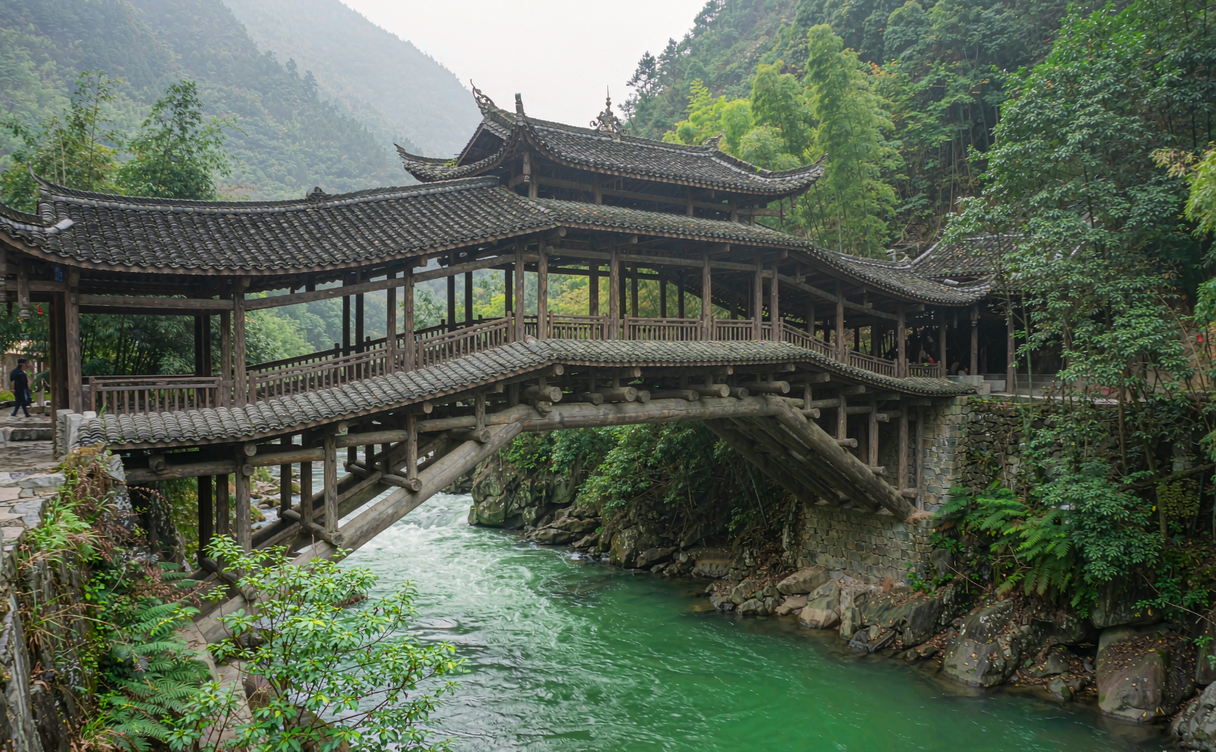
The heart of things to do in Qingyuan splits between its bridges and its mountains. The county holds the highest concentration of surviving wooden-arch lounge bridges in China. The standout is Rulong Bridge (如龙桥) in Juyu village — the oldest known wooden-arch lounge bridge still standing, with a curved, dragon-like roof and a small shrine inside. Yueshan village (月山村), an hour from the seat, has five such bridges strung along a single stream, plus a Ming-dynasty pagoda; it is our default recommendation for a half-day of slow wandering. Entry to the bridges is free; the villages welcome visitors without ticketing.
For the high country, Baishanzu National Nature Reserve (百山祖) protects the Baishanzu fir (百山祖冷杉), one of the rarest trees on earth — fewer than a dozen wild individuals remain — and the second-highest peak in Zhejiang at 1,857 metres. The reserve has boardwalk trails through primeval fir forest and a visitor centre (¥50–¥80) explaining the conservation story. Allow half a day.
The Daji Scholar Village (大济进士村), near the county seat, is a preserved clan village that produced a striking number of imperial examination graduates; its arches and lanes are free to explore. For a regional roundup, our best things to do in China guide places Qingyuan among Zhejiang’s most underrated green escapes.
The Qingyuan mushroom culture
You cannot write about Qingyuan without its fungus. The Qingyuan mushroom culture dates to the Yuan dynasty, when local cultivators developed the “segmented log” method of growing shiitake — a technique that spread across China and, later, the world. Today the county produces tens of thousands of tonnes a year, and the autumn harvest (September–November) is the time to see drying racks heavy with mushrooms outside every farmhouse.
The China Shiitake Museum in the county seat (¥20) tells the 800-year story with surprisingly good displays, and the surrounding hills have designated foraging trails where, with a local guide, you can learn to read the forest for edible species. We tell food-minded travelers to time a visit to a market day, when the range of wild and cultivated mushrooms on sale — from 香菇 to 牛肝菌 to seasonal 竹荪 — is genuinely eye-opening. A mushroom hotpot for two runs ¥80–¥140 and is the dish to order.
The Qingyuan Zhejiang forests on foot
The Qingyuan Zhejiang forests are the county’s quiet glory, and Baishanzu is only the beginning. Below the reserve, the Jinzifeng (巾子峰) area has easier boardwalk loops through broadleaf and conifer forest, good for families, with a summit viewpoint back toward the Fujian hills. The Songyuan Creek valley, south of the seat, is a gentler walk along terraced paddies and covered bridges, ideal after rain when the waterfalls run.
A practical note: the higher trails are damp and leech-prone in summer — wear long trousers and proper boots, and start hikes before 10 a.m. to be off the exposed ridge by the time afternoon storms build. Signal drops quickly in the valleys, so download offline maps. For a wider view of Zhejiang’s older settlements, our best ancient towns in China guide lists several within reach that pair well with a Qingyuan base.
Where to stay and eat
Qingyuan town has the practical lodging: clean hotels at ¥150–¥280 a night, a few newer ones at ¥350–¥500. For atmosphere, stay in Yueshan village (¥200–¥350 in a renovated farmhouse) so you can walk the bridges at dawn before the day-trippers arrive. Baishanzu has a basic lodge near the entrance (¥200–¥400) for early starts.
Food centres on the mushroom. Beyond hotpot, try 蘑菇包 (mushroom-stuffed buns, ¥3–¥5 each), 笋干 (dried bamboo shoot) stir-fries, and the local 庆元米糕 (steamed rice cake) at breakfast. A casual dinner for two runs ¥60–¥110; the county-seat night market is the best place to graze. Tea from the surrounding hills is cheap and good — buy a bag from a village stall rather than a shop.
Practical tips before you go
Lessons from our trips: carry RMB, because the villages and small hotels rarely take foreign cards; pack a rain layer even in October, as the mountains make their own weather; and book any Baishanzu lodge ahead in autumn, when the fir and the colours draw domestic botanists. A translation app with offline Chinese is worth loading — outside the seat town, English disappears.
First-timers should read our China travel guide for first-timers, which covers payment apps, SIM cards, and the logistics of reaching a remote county like this one.
Stay a night in Yueshan village and walk its five bridges at first light — the morning mist on the covered arches is the image you’ll keep, and you’ll have the village to yourself before the day-trippers arrive.
Pairing Qingyuan with Lishui and Hangzhou
Most travelers approach Qingyuan from one of two cities. Lishui, two hours north, is the closer base and a green destination in its own right — our Lishui guide details the transfer. Hangzhou, the provincial capital, makes a logical bookend with West Lake and the tea hills before you head into the mountains. Either way, give Qingyuan a full day and a half rather than a rushed stop.
What to do beyond the obvious
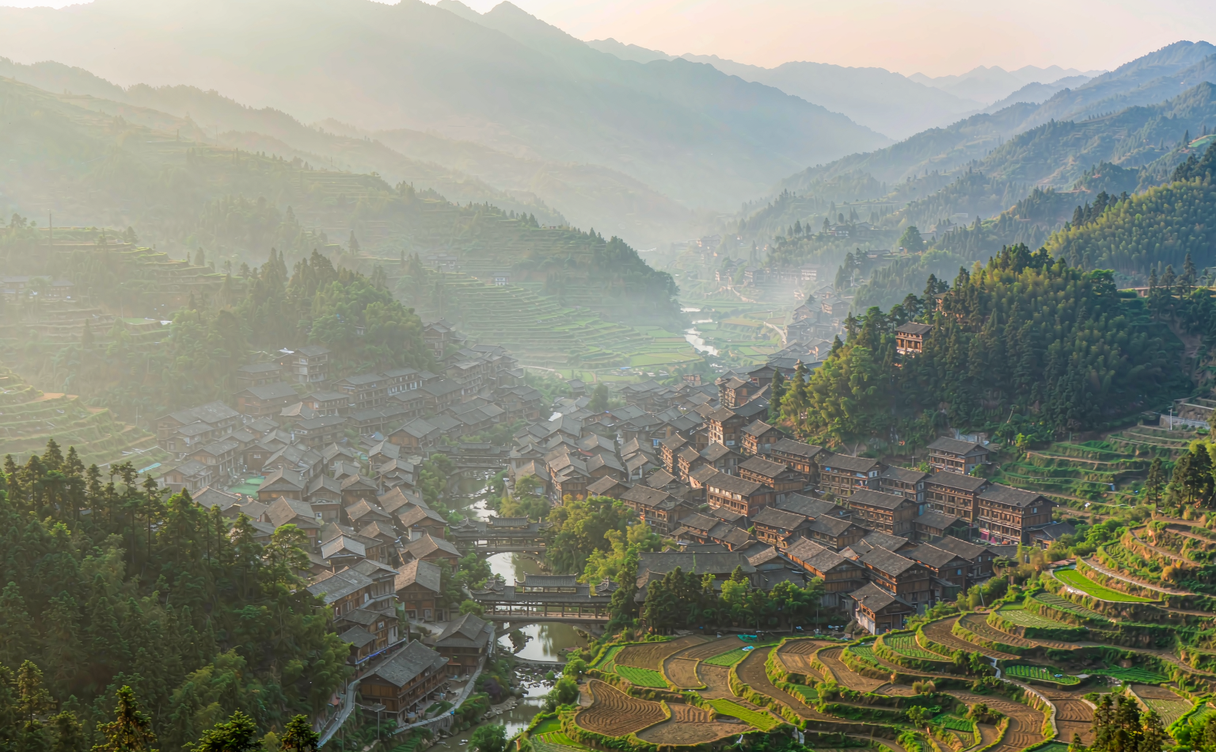
Once the bridges and Baishanzu are done, two quieter rewards remain. The Daji Scholar Village at dusk, when the lane lamps come on and the examination-arch silhouettes against the hills, is a fine slow walk. And the higher forest roads toward Fujian pass unnamed lookout points over a sea of green ridgelines — pull over; there is no ticket and no crowd, just the sound of the wind in the firs.
If you are linking Qingyuan with the Lishui or Wuyi mountain country, give the southwest corner of Zhejiang three days — the bridges, the fir forest, and the mushroom tables each deserve their own morning.
Final thoughts
Qingyuan is the Zhejiang that doesn’t make the postcards — no canal boats, no teahouse queues, just cloud forest, covered bridges, and a mushroom culture that has quietly fed the country for eight centuries. We keep sending readers here because it is the green, unhurried China that the headline cities have lost. Come for the bridges; stay for the mountains.
Ready to plan the rest of your Zhejiang route? Explore more of our China guides, from the high-speed rail into Lishui to the ancient-town itineraries that make the most of the southwest.