

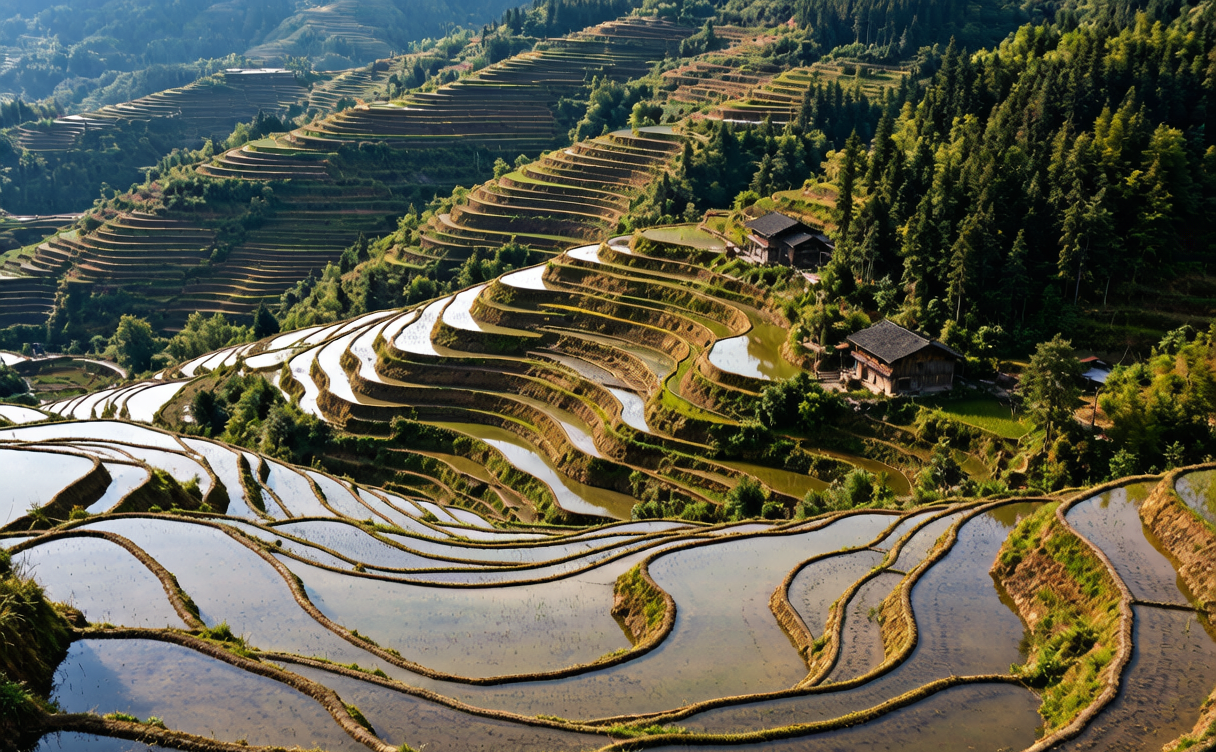
At 5:40 in the morning on the ridge above Chongtou, the valley below has disappeared. Cloud sits in it like milk in a bowl, and the only things breaking the surface are the top three or four curves of the rice terraces and a pine tree that everyone with a tripod has already claimed. Twenty minutes later the sun clears the eastern hills, the cloud starts sliding downhill, and eight hundred years of hand-cut paddies come out of it stair by stair. That view is the reason this Lishui travel guide exists, and the reason I keep going back to a prefecture that most visitors to Zhejiang skip entirely on their way between Hangzhou and Wenzhou.
Why Lishui Is Worth the Detour
Lishui (丽水, Lìshuǐ) is the largest and least developed prefecture in Zhejiang, roughly 80 percent forest, wrapped around the Oujiang River in the mountainous southwest. There are no queues here and almost no English signage. What there is: the Yunhe rice terraces, more than a hundred intact Ming and Qing villages in Songyang county, the celadon kilns of Longquan, and an irrigation weir still diverting water since the year 505. Domestic photographers have known this for two decades — Lishui hosts a serious international photography festival — but foreign visitors remain rare enough that guesthouse owners sometimes refuse to let you pay for breakfast.
Best Time to Visit
The terraces are the calendar here, and they look completely different four times a year.
Mid-April to late May is my pick. The paddies are flooded for transplanting, so each terrace becomes a mirror; at sunrise the whole hillside turns pink and silver. Daytime temperatures run 18–26°C, mornings are cool enough for a fleece, and the sea-of-cloud odds are at their highest.
Late June to August turns everything green and pushes the thermometer to 30–35°C in the river valleys, though Yunhe sits at 1,000m and stays around 25°C. This is Zhejiang’s rainy season through June; expect afternoon storms.
Late September to mid-October is the golden harvest, and the single most photographed window of the year. Days are 20–27°C and dry. Avoid 1–7 October, when the National Day holiday fills every guesthouse in Chongtou and doubles the rates.
December to February brings 0–8°C, occasional snow on the terrace lips and the cleanest cloud seas of all — but Songyang’s mountain roads ice up and some village guesthouses close.
If you are still assembling the wider route, our guide to the best time to visit China sets Lishui’s seasons against the rest of the country.
How to Get There
Lishui has no airport of its own yet. Everything arrives by train on the Jinhua–Wenzhou line, and the station sits in Liandu district about 3km from the city centre — 10 minutes and ¥15 (US$2) by taxi, or bus 20.
| From | Mode | Duration | Fare |
|—|—|—|—|
| Hangzhou East | D-train (EMU) | 2h 10m | ¥104 (US$15) |
| Shanghai Hongqiao | D-train, change at Hangzhou | 3h 50m–4h 30m | ¥185–240 (US$26–34) |
| Wenzhou South | D-train | 1h 05m | ¥46 (US$7) |
| Ningbo | D-train | 2h 30m | ¥122 (US$17) |
| Wenzhou Longwan airport (WNZ) | Airport shuttle + train | 2h 30m | ¥85 (US$12) |
| Lishui → Yunhe county | D-train (12 min) or bus | 12–50m | ¥12–25 (US$2–4) |
| Yunhe county → terrace gate | Taxi / didi | 45m | ¥90–120 (US$13–17) |
Buses from Lishui’s long-distance station reach Songyang in an hour (¥26 / US$4) and Longquan in two (¥45 / US$6). But a driver at ¥500–650 (US$70–91) a day is the sane way to do Songyang’s villages, strung along thirty kilometres of switchbacks with two buses a day.
Lishui Travel Guide: Where to Go First
Yunhe Rice Terraces (云和梯田)
The headline sight, and the one that justifies the journey. Roughly 5,000 mu of terraces climb from 200m to 1,400m above Chongtou township, cut into the slope from the Tang dynasty onward. Admission is ¥100 (US$14) including the internal shuttle, gates open 06:00 in summer and 06:30 in winter, last entry 16:30. Three viewpoints matter: Qixingdun for the classic concentric curves, Baiyin Long Lake for reflections, and Meiyuan village for terraces with houses in the frame. Skip the middle of the day — the light is flat and the terraces read as grey mush. Come for sunrise or the last ninety minutes of daylight.
Songyang’s old villages (松阳古村落)
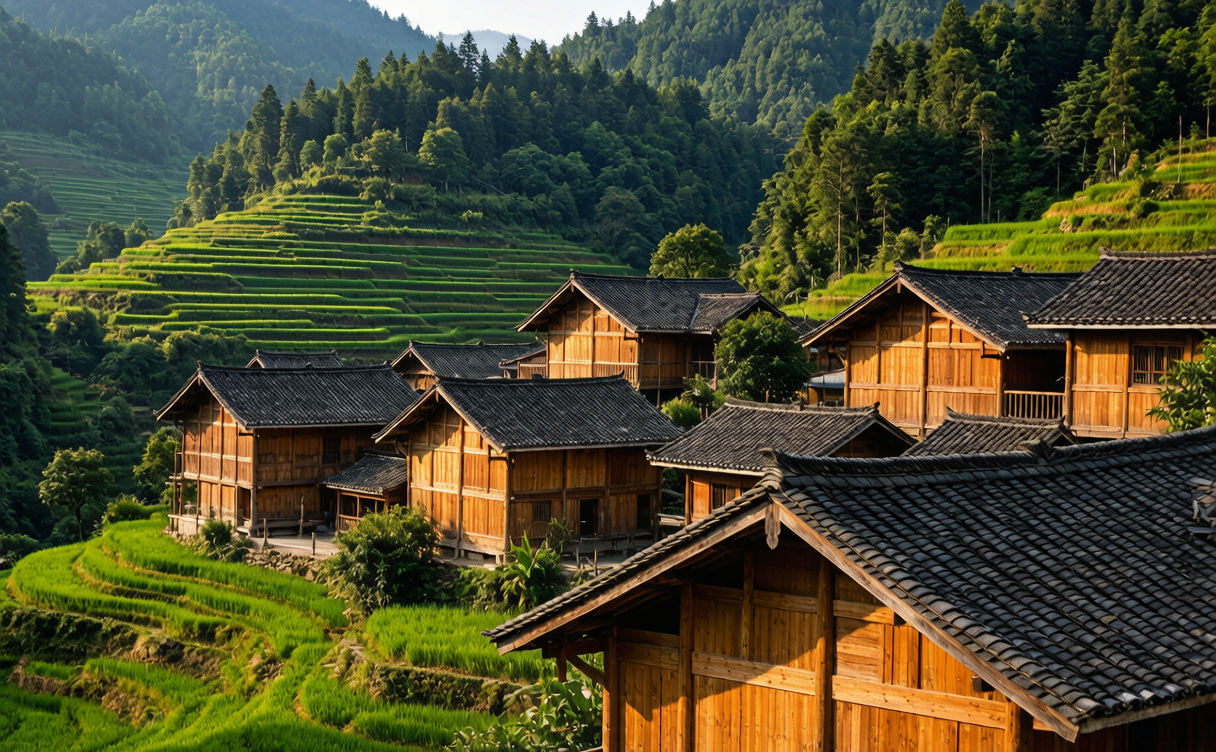
Songyang county holds one of the densest concentrations of surviving traditional villages in eastern China. Yangjiatang (杨家堂), the “golden village”, is a stack of ochre rammed-earth houses on a 40-degree slope, best in late autumn when persimmons hang off the eaves; entry ¥20 (US$3). Chenjiapu (陈家铺) sits on a cliff edge at 850m and has an Avant-Garde bookstore built into an old grain hall, all glass and cantilevered floor — free to enter, open 09:30–17:30, and genuinely one of the most beautiful rooms in China. Pingtian (平田) has been sensitively rebuilt by architects into workshops and a small farming museum.
Guyan Huaxiang (古堰画乡)
Twenty-eight kilometres southwest of Lishui city, this riverside pair of villages is where the local painting school works. The draw is Tongji Weir, a curved arch dam completed in 505 CE and still irrigating the plain — it was recognised as a World Heritage Irrigation Structure. Combined ticket ¥50 (US$7) including the ten-minute ferry across the Oujiang; open 08:00–17:00. Bus 207 from Lishui takes an hour for ¥8.
Longquan (龙泉)
Two crafts, one town. Longquan celadon has been fired here for 1,600 years, and its traditional firing technique is on UNESCO’s Representative List of the Intangible Cultural Heritage of Humanity. The county museum is free; in Baoxi village, dragon kilns are still fired communally a few times a year and workshops charge ¥80–150 (US$11–21) for a throw-your-own session. The other craft is sword-forging, which is more showroom than spectacle — visit one workshop, not four.
Xiandu, Jinyun (缙云仙都)
An hour north, a 170m rock column called Dinghu Peak rises out of a bend in the Lianduo River, with mist, water buffalo and a hovering film crew (this valley doubles as a wuxia backlot). Reckon on ¥70 (US$10) for the core area, though the county periodically runs free-entry campaigns — check at the gate. It pairs perfectly with lunch, because Jinyun is the home of China’s best flatbread.
Where to Stay
Budget. Chain hotels around Lishui railway station and Zhongshan Street run ¥140–220 (US$20–31): Hanting, Home Inn, JI Hotel. Village guesthouses in Chongtou near the terraces start at ¥180 (US$25) with breakfast.
Mid-range. This is where Lishui shines. Restored earthen-wall minsu in Songyang — Yangjiatang, Chenjiapu, Sidu — go for ¥350–650 (US$49–91), usually four to eight rooms, wood-fired water and a home-cooked dinner for ¥60 a head. Book ahead in October; there are perhaps forty good rooms in the whole county.
Splurge. The cliff-edge cabins at Chenjiapu (¥1,300–2,200 / US$183–310) have floor-to-ceiling glass over a thousand metres of empty valley. Near the terraces, the higher-end lodges above Chongtou charge ¥900–1,500 (US$127–211) for sunrise from bed — which, given a 5am alarm otherwise, is money well spent.
What to Eat
Mountain food, heavy on preserved vegetables, river fish and sweet potato starch.
- Jinyun shaobing (缙云烧饼) — pork, pickled greens and spring onion sealed in dough and slapped onto the wall of a clay barrel oven. ¥6 (US$0.85). Eat two.
- Qiao rou geng (敲肉羹) — pork pounded flat with sweet potato flour into a thick, sour-savoury soup. The Jinyun household dish.
- Shanfen jiao (山粉饺) — translucent dumplings with a chewy starch skin, filled with tofu and bamboo shoot.
- Doufu niang (豆腐娘) — Songyang’s breakfast: unstrained soy milk simmered with greens, ¥8 a bowl, sold before 9am.
- Anren yutou (安仁鱼头) — Longquan’s big-headed reservoir fish braised with tofu, ¥90–130 (US$13–18) for a table of four.
Sample Itinerary: Three Days
Day 1 — Arrive and Guyan Huaxiang. Morning train from Hangzhou, drop bags in Liandu by 11:00. Bus 207 to Guyan Huaxiang, ferry across, walk the weir and the plane-tree waterfront until 17:00. Dinner on Nanming Mountain road.
Day 2 — Yunhe terraces. 06:30 car to the terrace gate (or sleep in Chongtou and be at Qixingdun for 05:30). Shoot sunrise, walk down through Meiyuan village to the Long Lake viewpoint, roughly 90 minutes on stone paths. Lunch at a farmhouse, afternoon nap, second shoot at 17:30. Overnight Chongtou.
Day 3 — Songyang. 08:00 transfer, 2 hours. Yangjiatang from 10:00, lunch in Sidu, Chenjiapu bookstore 14:00–16:00, back to Lishui for the 19:00 train — or stay a night and add Longquan.
Practical Tips
Carry cash for village buses and small kilns; Alipay and WeChat Pay cover everything else. Almost nobody speaks English outside the two biggest hotels, so download offline translation before you leave Hangzhou. Terrace paths are wet stone — proper shoes, not sandals. Check the Yunhe forecast the night before: a cloud sea needs a clear, cold morning after evening rain, and continuous drizzle means you will see nothing but grey.
FAQ
How many days do I need in Lishui?
Three is the minimum for the terraces plus one other cluster. Five lets you do Yunhe, Songyang, Longquan and Xiandu without rushing, which is what I would recommend if you have already covered Hangzhou.
Is Lishui doable as a day trip from Hangzhou?
Technically yes, but you would spend four and a half hours on trains to stand on a ridge in flat midday light. Everything good here happens at dawn or dusk. Stay overnight or don’t come.
Do I need a car?
For Yunhe alone, no — train to Yunhe county and taxi up. For Songyang’s villages, effectively yes. Public buses are infrequent and the villages are far apart; a driver for two days costs about the same as three taxis.
When are the rice terraces flooded versus golden?
Flooded and reflective from roughly mid-April to early June. Green through July and August. Golden from about 20 September to 15 October, with harvesting well underway by the third week of October.
Will anyone speak English?
Rarely. Guesthouse hosts in Songyang and Chongtou are used to guests translating on their phones and are extremely patient. Write your destination in Chinese characters before getting into a taxi.