

In the winter of 1128 a man named Kong Duanyou fled south with the collapsing Song court, carrying his family’s most precious possession: a portrait of his ancestor, Confucius, painted six centuries earlier. He never went home. The branch that settled here built a second ancestral temple, and nine hundred years later it still stands in a Zhejiang city almost no foreign traveller has heard of. An hour away, three rock towers the height of a skyscraper rise out of a rice valley, and beneath a nearby village lie two dozen man-made caverns nobody can explain. This Quzhou travel guide covers a corner of eastern China that gets a fraction of the visitors it deserves.
Where Quzhou Is and Why It Mattered
Quzhou sits at the far western edge of Zhejiang, pressed against Anhui, Jiangxi and Fujian. The old phrase for it is si sheng tong qu (四省通衢) — the crossroads of four provinces. For a thousand years goods moved through here between the Yangtze delta and the southern ports, which is why a prefecture of two million people has a Ming city gate and a national-rank Confucian temple. Its counties spread west and north, but nothing worth seeing is more than 90 minutes from the centre.
Best Time to Visit
March to May. 12–25°C, rapeseed and camellia in the valleys, Kaihua’s forests coming into leaf. April is close to perfect.
Mid-June to early July. The plum rains: three weeks of drizzle, low cloud on Jianglang, slippery stone paths. The grottoes and temple are unaffected; the hills are not worth it.
July and August. Inland Zhejiang gets hot — 33–38°C with high humidity, and the basin holds it. Kaihua’s forests run several degrees cooler and are where locals go.
September to November — the best of the year. Dry, clear, 15–26°C, with the Changshan pomelo harvest through November. Skip 1–7 October.
December to February. 3–10°C, damp, no domestic heating. Quiet, cheap, and the temple in winter light is lovely, but pack more than you think. Our guide to timing a China trip covers how this fits a longer route.
How to Get There
Quzhou is on the Shanghai–Kunming high-speed line and easier to reach than its obscurity suggests. Quzhou Airport (JUZ) serves a handful of domestic routes; almost everyone arrives by train.
| From | Mode | Duration | Cost |
|—|—|—|—|
| Hangzhou East → Quzhou | High-speed rail | 1 hr 5 min | ¥110 (US$16) |
| Shanghai Hongqiao → Quzhou | High-speed rail | 2 hr 20 min | ¥210 (US$30) |
| Huangshan North → Quzhou | High-speed rail | 1 hr | ¥95 (US$13) |
| Nanchang West → Quzhou | High-speed rail | 2 hr | ¥220 (US$31) |
| Wuyishan East → Quzhou | High-speed rail | 1 hr 10 min | ¥100 (US$14) |
| Quzhou → Jiangshan, for Jianglang Mountain | Rail 20 min + taxi 25 min | 50 min | ¥20 + ¥60 (US$11 total) |
| Quzhou → Longyou Grottoes | Rail 15 min + taxi | 35 min | ¥15 + ¥25 (US$5.60 total) |
| Quzhou → Kaihua | Coach from the west bus station | 1 hr 20 min | ¥35 (US$5) |
City buses cost ¥2 and Didi rides rarely exceed ¥20. For a day covering two counties, a car with driver runs ¥450–650 (US$63–92).
Quzhou Travel Guide to the Sights That Matter
The Southern Confucian Family Temple
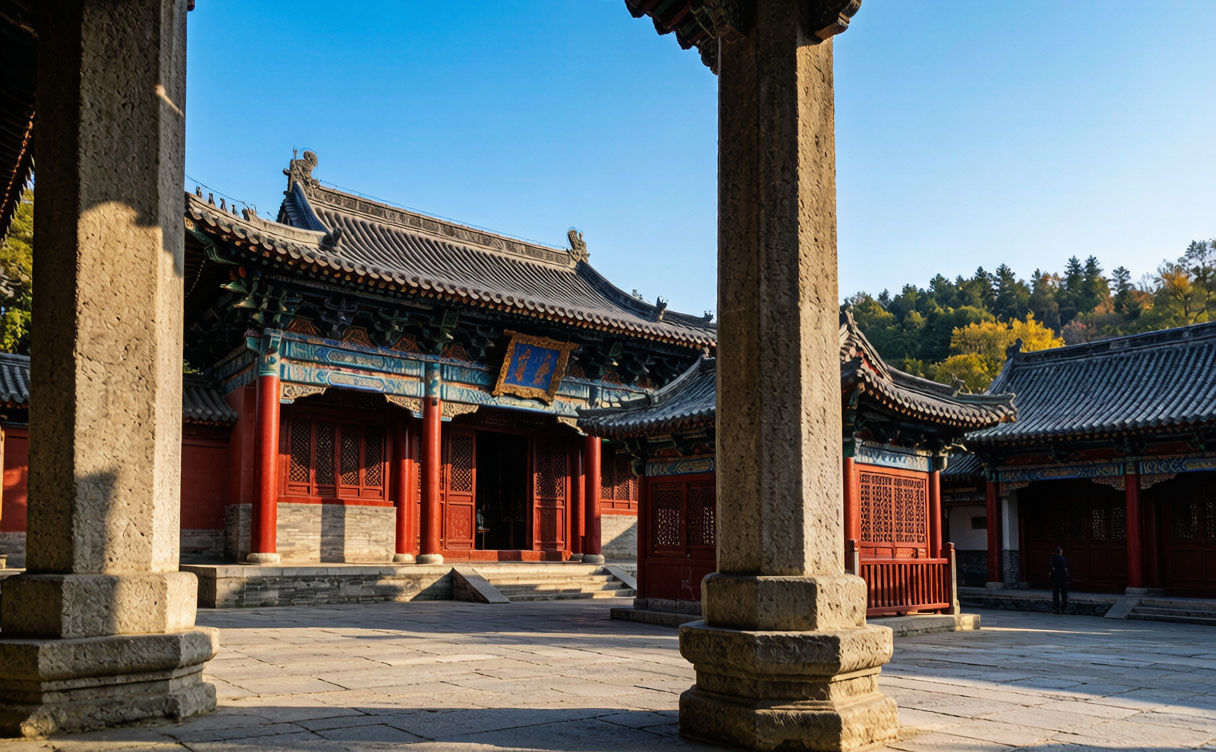
There are only two Kong family temples in China: the enormous complex at Qufu in Shandong, and this one. When the northern capital fell, the 48th-generation descendant brought the family’s ritual objects and portraits south, and the emperor granted the branch land and a hereditary title here. The Kong Family Temple of the Southern Branch (孔氏南宗家庙) was rebuilt in 1520 — a spirit gate, a courtyard of old cypresses, a main hall with the portrait, a scattering of stone stelae.
It is smaller than Qufu and better for it; on a weekday morning there might be a dozen people inside. Entry is free, with passport registration. Open 08:30–17:00, worth an hour.
Shuitingmen and the old riverfront
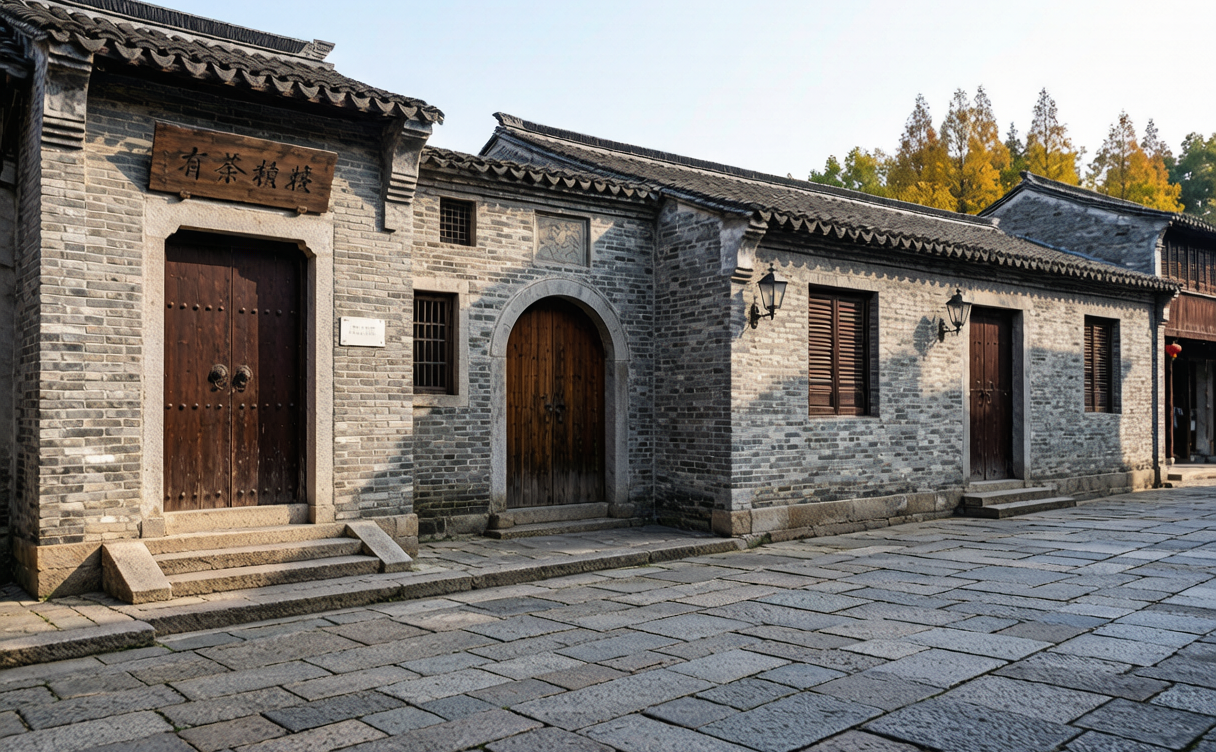
Five minutes away, Shuitingmen (水亭门) is the surviving western gate of the Ming city wall and the block behind it. Restored rather than pristine, but the scale is right: two-storey grey-brick shophouses, teahouses, a church from 1902, and the Qu River below. Free, and best after dark when the gate tower is lit.
Jianglang Mountain
Take the twenty-minute train to Jiangshan for the region’s headline sight. Jianglang Mountain (江郎山) is three colossal columns of red conglomerate rock — Lang, Ya and Ling peaks — rising abruptly out of farmland, the tallest some 369 metres above its base. They are widely described as the tallest freestanding danxia pillars on earth, and in 2010 the mountain joined the UNESCO World Heritage list as part of China Danxia.
The experience is the Yixiantian (一线天), the “thread of sky”: a 312-metre crevice between two columns, three to five metres wide, walls three hundred metres high. Walking it in late-afternoon light is unnerving. Tickets ¥100 (US$14), 08:00–16:30; the full circuit with the ridge stairs takes four hours. No cable car — if stairs are a problem, walk the crevice and turn back.
Longyou Grottoes
In 1992 villagers in Longyou county drained what they believed were bottomless ponds and found enormous rectangular chambers cut into sandstone — two dozen of them, some over a thousand square metres, pillars left to hold the roofs. No historical record mentions them. Nobody knows who dug them, when, or why.
Whatever the answer, the Longyou Grottoes (龙游石窟) are startling to stand inside. Ticket ¥65 (US$9), 08:00–17:00, allow 90 minutes. The lighting is theatrical and a little tacky, but the scale survives it.
Kaihua: Qianjiangyuan and the Root Palace
Qianjiangyuan National Park (钱江源) protects the source of the Qiantang River and one of the better-preserved subtropical broadleaf forests at this latitude. Around ¥60 (US$8.50), with waterfall trails and cool August air.
Also in Kaihua, the Root Palace (根宫佛国), ¥120 (US$17), is a museum of monumental root carvings — tree stumps worked into figures over years. Magnificent or exhausting depending on your tolerance.
Xianxia Pass
For walkers, the Xianxia Ancient Path (仙霞古道) above Jiangshan is a stone-paved Tang and Song trade route with four surviving gate forts, climbing through bamboo towards Fujian. Around ¥40 (US$6), two to three hours.
Where to Stay
Budget — ¥130–260 (US$18–37). Chain hotels around Quzhou Railway Station and Xin’an Road; ¥150 for a clean double is normal. County-town guesthouses in Jiangshan and Kaihua cost about the same.
Mid-range — ¥300–550 (US$42–78). Hotels in Kecheng district around Shuitingmen, the area I would choose: walk to the temple, the gate and the riverfront food streets, and taxis to the station are ¥15.
Splurge — ¥700–1,600 (US$99–225). Forest resorts in Kaihua and a few good properties at the foot of Jianglang Mountain, several with valley views and outdoor pools. Book ahead for October, when they fill with Hangzhou and Shanghai weekenders.
What to Eat: Three Heads and a Paw
Here is the surprise. Zhejiang cooking has a national reputation for being delicate and slightly sweet. Quzhou is the exception — its food is aggressively, sinus-clearingly spicy, closer to Hunan than Hangzhou, and locals are proud of it.
The signature is santou yizhang (三头一掌), “three heads and a paw”: rabbit head (兔头, tùtóu), duck head (鸭头, yātóu), fish head (鱼头, yútóu) and duck feet (鸭掌, yāzhǎng), braised for hours in chilli, star anise and rice wine, eaten with your hands and a stack of napkins. Fiddly, messy, delicious. ¥15–30 per head at a night-market stall.
- Quzhou kaobing (衢州烤饼) — a crisp baked flatbread with pork and pickled greens, ¥5, from barrel ovens on every corner.
- Longyou fagao (龙游发糕) — steamed rice sponge cake, faintly sweet with rice wine. ¥10 a slab, and the local gift item.
- Kaihua qingsi (开化青蛳) — small river snails stir-fried with chilli, sucked from the shell. ¥30 a plate, spring and autumn only.
- Changshan huyou (常山胡柚) — a bitter-sweet pomelo harvested from November, sold by the crate at the roadside.
If you are not a chilli person, say bu yao la (不要辣) and repeat it. It will still be spicy.
Sample Itinerary: Two Days
Day 1 — the city
- 09:00 Kong Family Temple of the Southern Branch, before the school groups
- 10:30 Shuitingmen gate and the old block; coffee on the river
- 12:00 kaobing and noodles; 14:00 train to Longyou for the grottoes
- 17:30 back to Quzhou; night market for three heads and a paw
Day 2 — Jiangshan
- 07:30 first train to Jiangshan, taxi to Jianglang Mountain
- 08:30 through the Yixiantian crevice, then the ridge stairs
- 12:30 lunch in Jiangshan town
- 14:00 Xianxia Ancient Path, or an early return for the 16:00 train to Hangzhou
A third day buys Kaihua’s forest park and Root Palace, or Changshan’s stone forest.
FAQ
Is Quzhou worth visiting?
If you have already covered Hangzhou, Suzhou and Huangshan and want somewhere with substance and no queues, yes. Jianglang Mountain is a World Heritage site with a fraction of the crowds of comparable Chinese peaks, and the Confucian temple is the only one of its kind outside Shandong.
How many days should I spend?
Two days covers the temple, the old town, Longyou Grottoes and Jianglang Mountain. Three lets you add Kaihua’s forests or the Xianxia Pass walk.
Do I need to book Jianglang Mountain tickets in advance?
Not usually, though scenic areas across Zhejiang increasingly ask for online reservation through WeChat mini-programs, especially at weekends and holidays.
Is English spoken in Quzhou?
Almost none. This city receives few international visitors and even the temple’s signage is only partly translated. Bring an offline translation app and save addresses in Chinese.
How spicy is the food, really?
Genuinely spicy — more so than most of Sichuan’s tourist restaurants, and it is dry chilli heat rather than numbing peppercorn. Noodle shops and kaobing stalls are safe ground.
Can I combine Quzhou with Huangshan or Wuyishan?
Easily. Huangshan North is an hour away by high-speed rail and Wuyishan East about seventy minutes, making Quzhou a natural hinge between the Anhui mountains and northern Fujian.