

Lie flat on your back on a plank boat, hands folded on your chest, and a boatman hauls you on a rope through a gap in the rock with maybe thirty centimetres of clearance above your nose. Ten metres of darkness, cold water an inch below the hull, then a limestone chamber the size of a church. Every schoolchild in China has read an essay about this cave; almost no foreign visitor has heard of it. That is Jinhua in one sentence. This Jinhua travel guide covers a central Zhejiang prefecture most travellers pass through at 300 km/h without looking up — and which holds a village built on a divination diagram, the world’s largest film studio, and the market that supplies much of the planet’s Christmas tat.
Wuzhou: The Old Name Still Matters
Jinhua was called Wuzhou (婺州) for most of its history, and the character 婺 is still everywhere — ham labels, opera posters, the dialect’s name, the old city district. “Wuzhou culture” means a distinct central-Zhejiang identity: woodcarving, cured ham, a fierce merchant streak, and villages laid out by classical cosmology rather than convenience.
The prefecture is polycentric. Jinhua city is the core, but Yiwu, Dongyang, Lanxi and Wuyi are separate towns of substance within an hour’s radius. Plan around that.
Best Time to Visit
Late March to May — the best window. Rapeseed turns the Jinqu basin yellow in late March, azaleas cover Xianhua Mountain in April, and temperatures sit at a comfortable 15–25°C.
Mid-June to early July. The plum rains: three weeks of drizzle and heavy humidity. Indoor sights like Hengdian and the Yiwu market are unaffected; hill villages are miserable.
July and August — brutal. Jinhua is one of Zhejiang’s hottest cities. The hills trap heat in the basin, afternoon highs of 36–40°C are routine and nights barely drop below 28°C. Locals call it the furnace. Do caves and markets by day, villages at dusk.
October and November — my pick alongside spring. Dry, 15–26°C, clear light, tangerine and persimmon harvests. Avoid 1–7 October, when Hengdian becomes unmanageable.
December to February. 2–10°C and damp, with no domestic heating — which is exactly when Wuyi’s hot springs make sense. Our month-by-month China timing guide gives the national context.
How to Get There
Jinhua sits on the Shanghai–Kunming high-speed line, making it one of the easiest “unknown” cities in China to reach. The Jinyidong light rail, a tram-metro hybrid opened in 2022, links Jinhua, Yiwu and Dongyang.
| From | Mode | Duration | Cost |
|—|—|—|—|
| Hangzhou East → Jinhua | High-speed rail | 1 hr | ¥90 (US$13) |
| Shanghai Hongqiao → Jinhua | High-speed rail | 2 hr | ¥180 (US$25) |
| Huangshan North → Jinhua | High-speed rail | 1 hr 30 min | ¥130 (US$18) |
| Nanchang West → Jinhua | High-speed rail | 2 hr 30 min | ¥260 (US$37) |
| Hangzhou Xiaoshan Airport → Jinhua | Airport coach | 1 hr 45 min | ¥100 (US$14) |
| Jinhua → Yiwu | Jinyidong light rail | 45 min | ¥12 (US$1.70) |
| Jinhua → Hengdian, Dongyang | Light rail + shuttle bus | 1 hr 20 min | ¥18 (US$2.50) |
| Jinhua → Lanxi, for Zhuge Village | Coach from the south bus station | 1 hr | ¥25 (US$3.50) |
Many travellers now arrive under the 240-hour visa-free transit arrangement through Shanghai or Hangzhou, which covers Zhejiang. Check current eligibility on the National Immigration Administration’s English site before booking — the list of qualifying nationalities and ports changes.
Jinhua Travel Guide to What Is Actually Worth Doing
The old city and Bayong Tower
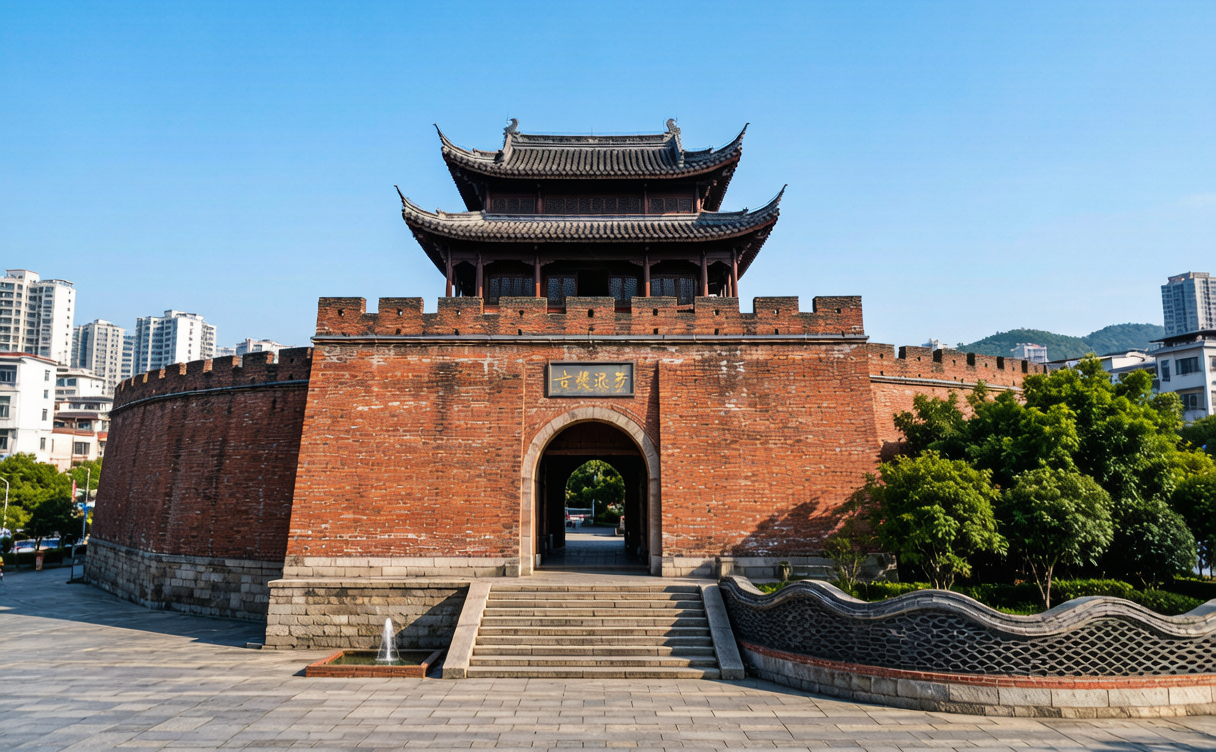
The Guzicheng (古子城) district is the surviving fragment of old Wuzhou: a few hundred metres of low grey buildings, teahouses and antique shops above the Wuyi River. Free, best in the early evening.
Its anchor is Bayong Tower (八咏楼), raised in 494 AD by the prefect and poet Shen Yue; in 1134 the poet Li Qingzhao, a refugee from the north, climbed it and wrote one of her most quoted verses. Entry ¥15 (US$2), 08:00–17:00. Ten minutes away the Jinhua Museum is free, closed Mondays, with a good gallery on Wuzhou celadon.
Shuanglong Cave on Jinhua Mountain
Shuanglong (双龙洞, “twin dragons”) is the boat-under-the-rock cave described above, and far more fun than it sounds. A combined ticket covering Shuanglong, the Bingdong ice-jar cave with its underground waterfall, and Chaozhen Cave runs ¥85 (US$12); Shuanglong alone is ¥50 (US$7). Open 08:00–17:00. It is 15°C inside all year, which makes this the best possible thing to do on a 38°C August afternoon — bring a jacket. Buses 12 and 52, 50 minutes from central Jinhua.
Zhuge Bagua Village, Lanxi
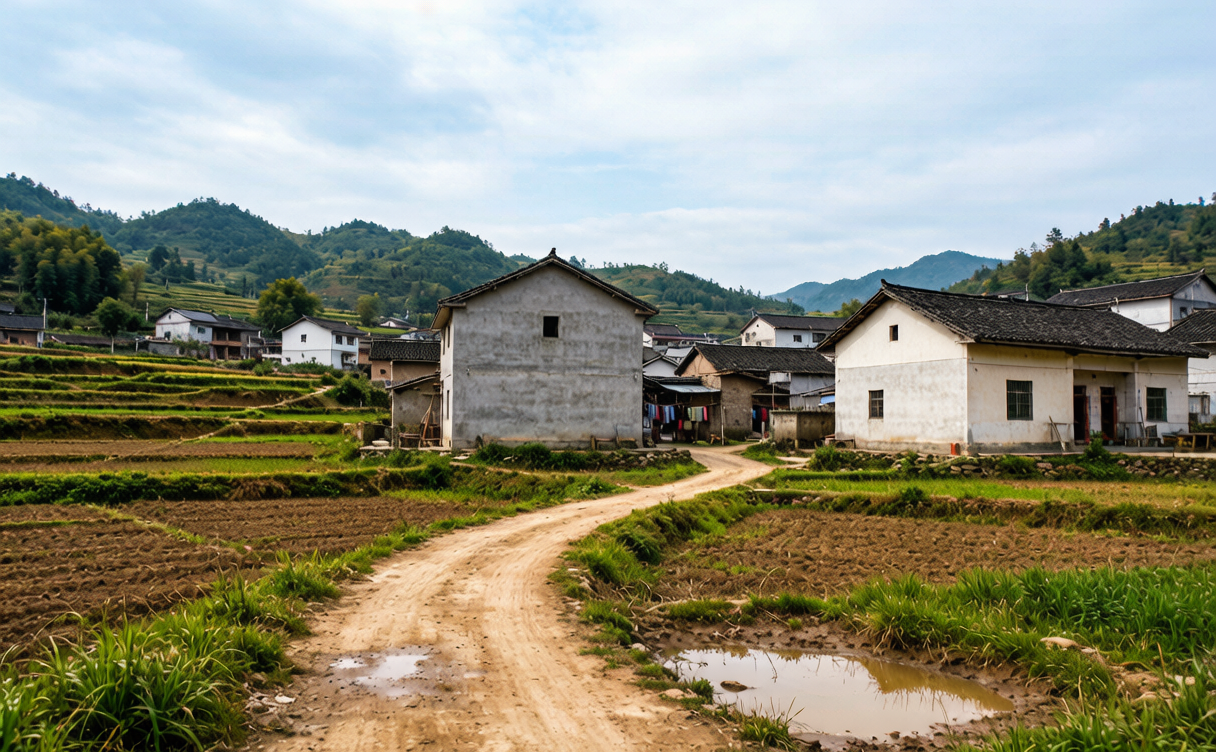
The one sight I would tell anyone to prioritise. Zhuge Bagua Village (诸葛八卦村) houses roughly 4,000 descendants of Zhuge Liang, the Three Kingdoms strategist, and their ancestors laid it out around a half-moon pond in the pattern of the eight trigrams — eight lanes radiating outwards, eight hills on the perimeter. The result is a maze in which outsiders reliably get lost, which was rather the point. Two hundred Ming and Qing houses survive, plus an ancestral hall and a street of herbal medicine shops, the family’s traditional trade.
Tickets ¥100 (US$14), 07:30–17:30. Allow three hours and go on a weekday — this is a living village, and weekend coaches overwhelm it.
Hengdian World Studios
In Dongyang, Hengdian (横店影视城) is the largest outdoor film studio complex on earth: full-scale sets including a replica of the Forbidden City, a Qin palace and a Hong Kong, China street of the 1930s. Dozens of productions shoot at once and costumed extras eat instant noodles between takes. Individual parks ¥110–340 (US$16–48); a multi-park pass around ¥620 (US$87). Open 08:00–17:00.
Be clear-eyed: this is a theme park, not heritage. Superb if you enjoy Chinese period drama; otherwise skip it for Wuyi.
Yiwu International Trade City
Not a tourist attraction, and better for it. Yiwu (义乌) runs the world’s largest small-commodities wholesale market — five vast districts, tens of thousands of booths, everything from zip fasteners to inflatable Santas. Entry free, passport registration at the service desk, roughly 09:00–17:00. Two hours here tells you more about global manufacturing than any museum.
Wuyi’s hot springs and star-pattern villages
Wuyi county (武义) is the soft-landing zone: geothermal resorts with outdoor pools from ¥168 (US$24) a day, plus two remarkable villages. Yuyuan (俞源), ¥60 (US$8.50), was replanned in the fourteenth century to a taiji star chart, its stream bent into an S-curve through the fields. Guodong (郭洞), ¥40 (US$6), is a walled hamlet in a forested bowl.
Where to Stay
Budget — ¥130–280 (US$18–39). Chain hotels around Jinhua Railway Station and Bayi Street, often ¥150 for a clean double. Guesthouses inside Zhuge Bagua Village charge ¥180–300 and give you the lanes to yourself once the day-trippers leave — worth it over a city night.
Mid-range — ¥320–600 (US$45–85). Hotels around the Guzicheng old city and the Wuyi River promenade, or business hotels in Yiwu near the trade city, unusually good value midweek because they are built for buyers.
Splurge — ¥700–1,800 (US$99–254). Hot spring resorts in Wuyi with private thermal pools, or the themed hotels at Hengdian. Rates spike at the October holiday and Chinese New Year.
What to Eat
- Jinhua ham (金华火腿, Jīnhuá huǒtuǐ) — cured here since the Song dynasty, salt-rubbed and air-dried for months, used across Chinese cooking the way prosciutto is in Italy. Eat it as huǒtuǐ lǎoyā bāo (火腿老鸭煲), a clay pot of old duck and ham simmered for hours. ¥88–140 for three.
- Jinhua subing (金华酥饼) — small, dark, intensely crisp sesame cakes filled with dried mustard greens and pork fat, slapped onto the inner wall of a barrel oven. ¥2 from a street cart, and the best thing to eat here.
- Lanxi jizi guo (兰溪鸡子馃) — a flaky pancake fried with egg and greens poured inside. ¥6.
- Yongkang meat pancake (永康肉麦饼) — thin dough around minced pork and pickled vegetable. ¥8.
- Yiwu donghe roubing (东河肉饼) — a paper-thin double-layered meat pancake the size of a dinner plate. ¥15.
Eat around the Guzicheng lanes in the evening, or the night market near Jinhua Railway Station.
Sample Itinerary: Two Days
Day 1 — Jinhua city and the mountain
- 08:30 bus to Jinhua Mountain; Shuanglong, Bingdong and Chaozhen caves
- 12:30 lunch of ham-and-duck pot back in town
- 14:30 Jinhua Museum, then the Guzicheng lanes and Bayong Tower
- 18:00 subing and river-front noodles as the lights come on
Day 2 — Lanxi and Zhuge
- 08:00 coach to Lanxi, connecting bus to Zhuge Bagua Village
- 09:00–12:00 the village: ancestral hall, half-moon pond, medicine street
- 13:00 lunch in the village; 14:30 Lanxi’s riverside old street
- 18:30 train onwards to Hangzhou, one hour
Add a third day for Hengdian or Wuyi; a fourth if you want Yiwu.
FAQ
Is Jinhua worth a stop?
For a first-time visitor to China, no. For anyone on a second trip who wants Zhejiang without the Hangzhou crush, yes — Zhuge Bagua Village alone justifies the hour on the train, and everything is cheap.
How many days do I need in Jinhua?
Two days covers the city, the caves and Zhuge Bagua Village. Three or four if you add Hengdian, Wuyi or Yiwu.
Can Jinhua be done as a day trip from Hangzhou?
Yes, for one target. An hour each way leaves time for either Shuanglong Cave plus the old city, or Zhuge Bagua Village. Not both.
Is English spoken?
Rarely. Jinhua sees few Western visitors, so staff are less practised than in Hangzhou. Ticket offices take Alipay and WeChat Pay, and both apps translate. Save addresses in Chinese characters.
Is Hengdian World Studios worth the ticket price?
Only if you have some interest in Chinese television and film. At ¥620 for the multi-park pass it is the most expensive thing in this guide, and nothing about it is historic.
What should I bring back?
Vacuum-packed Jinhua ham is sold at supermarkets, but check your home country’s import rules on cured meat — many ban it outright. Dongyang woodcarving, Wuzhou celadon and boxes of subing travel better.