

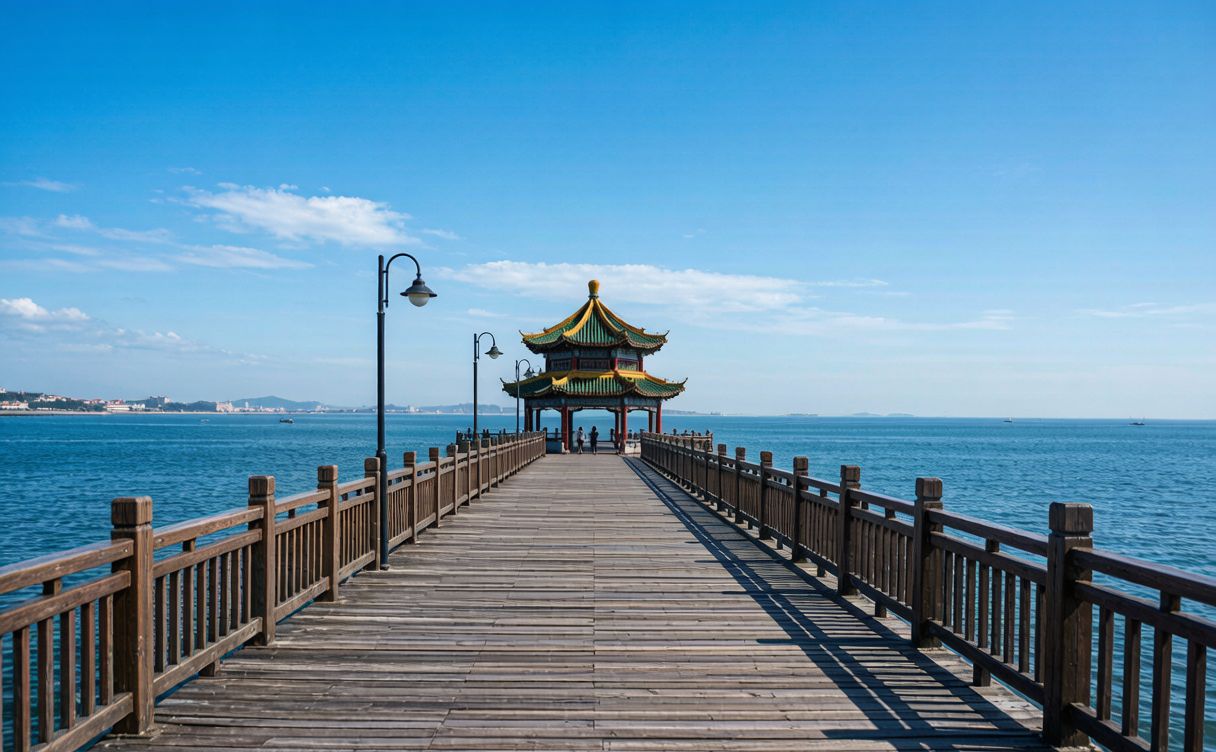
The first time I stepped onto Zhanqiao Pier, I understood immediately why it appears on nearly every postcard of Qingdao. This long, narrow boardwalk stretches straight out into the yellow-green waters of Jiaozhou Bay, ending in a traditional Chinese pavilion that looks like it was plucked from a classical painting. I had arrived in Qingdao expecting a modern port city, but the pier pulled me straight back to the town’s 19th-century origins.
Zhanqiao Pier is more than a photo stop. It is the symbol of Qingdao, the place locals point to when they say “this is our city.” If your China trip includes the coast, this is one seaside walk you should not skip.
I had budgeted only an hour here and ended up staying closer to two. Part of that was the walk itself, but part was simply sitting on a bench near the railing, watching ferries cut across the bay and listening to the gulls. There is very little pressure to “do” anything at the pier — you just arrive, walk, and look. For a traveler who spends most days rushing between temples and train stations, that slowness was a genuine relief.
One thing that surprised me: the pier is busy at every hour but never feels chaotic. Even with a steady stream of visitors, the long, narrow layout spreads people out, so you can always find a quiet stretch of railing to lean on. It is also stroller-friendly and easy for older travelers, which is rare for a scenic spot with this much character.
Getting There
Zhanqiao Pier sits in the heart of central Qingdao, in the Shinan District, just southwest of the historic railway station (Qingdao Zhan). That central location is exactly why I recommend it as your first stop in the city — you can walk here from most downtown hotels, and it connects easily to the rest of the waterfront.
I took the Qingdao Metro to Qingdaozhan Station (Line 1 or Line 3). From the station exits it is a flat, five-minute walk to the pier entrance. Taxis and ride-hailing apps (Didi) will also drop you at the south end of Tai’an Road, right where the boardwalk begins. If you are staying near the Qingdao travel guide loop of sea-side attractions, the pier is walkable from the badaguan (Eight Great Passes) area in about 25 minutes along the coast.
There is no ticket gate and no entrance fee. The pier itself is open to the public day and night, which makes it an easy, low-commitment stop between other sights.
What to See
The pier is roughly 440 meters long. As you walk out, the city skyline slowly shrinks behind you and the open bay opens up ahead. I liked pausing about halfway, turning around, and watching the rectangular grid of Qingdao’s old town climb the hills.
A few things caught my eye on the walk:
- The railings and sea breeze. Simple as it sounds, the half-hour stroll is the attraction. Bring a light jacket even in summer — the wind off the bay is real.
- Fishing and gulls. In the colder months, thousands of seabirds wheel over the water and vendors sell small sticks of food to feed them. It is a classic Qingdao moment.
- The coastline panorama. Looking back toward land, you get one of the best wide shots of Qingdao’s red roofs, green trees, and blue sea — the “red tiles, green trees, blue sea, azure sky” postcard the city is famous for.
On my visit the water had that distinctive Yellow Sea tint, and the far side of the bay faded into haze. It is not a tropical beach, but the scale and the old-world feel are the point.
I also want to flag the contrast that makes Qingdao unusual in China. Most Chinese coastal cities feel brand new; Qingdao wears its history openly. The pier was built the same year the town was founded as a naval station, and you can still sense that layered past as you look from the German-era architecture of the old town toward the container cranes of a working port. Standing at the end of the boardwalk, I could see both the city’s 19th-century roots and its 21st-century skyline in a single glance. That compression of time is exactly what I came to China to feel, and the pier delivered it in one short walk.
The Huilan Pavilion
At the very end of the pier stands the Huilan Pavilion (回澜阁, “Waves-Returning Pavilion”), the octagonal, double-eaved structure with a pointed roof that defines the Qingdao skyline. The original pier was built in 1891 as a simple military landing stage when Qingdao was first developed as a naval base. It was later extended and the pavilion was added in 1933, giving the pier the look you see today.
I climbed the steps into the pavilion (there is a small indoor exhibition space at the base, and an upper viewing deck). From up there the perspective flips: the city is a thin ribbon on the horizon and the bay stretches endlessly. On a clear day you can watch ships glide in and out of Qingdao’s massive port to your right.
The pavilion is the single most photographed object in the city, and for good reason. Go early in the morning if you want a clean shot without the crowds that build up after 9 a.m.
Inside, the lower floor usually holds a small display on the pier’s history, with old photographs showing how the structure has changed since 1891. I spent about ten minutes there and found the timeline genuinely useful — it explains why a “pier” in a landlocked-feeling old town exists at all. The short version: Qingdao began as a modest fishing and military landing point, grew under German concession planning in the late 1800s, and the pier was extended repeatedly to serve ships before the modern deep-water port was built farther out. By the 1930s it had outlived its practical job and become a public promenade, which is the role it still plays today. Knowing that backstory made the walk feel less like a random jetty and more like a thread through the city’s whole story.
Tips
A few practical notes from my own visit that will make your stop smoother:
- Go early or go at sunset. Midday in summer is hot, bright, and crowded. I had the calmest, most photogenic walk at around 6:30 p.m., when the light turned golden.
- Wear shoes with grip. The boardwalk can be slippery where gull droppings and sea spray collect. I saw more than one visitor catch their step.
- Cash for snacks. The small stalls near the entrance sell roasted squid, ice cream, and chestnuts. Mobile pay dominates, but a few older vendors prefer cash.
- Combine it with nearby sights. The pier is a short walk from the Qingdao Railway Station, the Catholic Church (St. Michael’s), and the Lu Xun Park waterfront path. String them together on foot.
- Watch your belongings. It is a popular, busy spot. Keep your phone and wallet secure in the crowds.
- Bring water in summer. There is shade at the very end near the pavilion, but the middle stretch is fully exposed. I finished my bottle faster than expected.
- Don’t feed the gulls from the railing edge. It is tempting, but the birds dive aggressively and have knocked phones out of hands. Stand back and use the long sticks the vendors provide.
- Photography timing matters. The pavilion faces roughly east, so morning light hits its front and evening light warms the city behind you. Pick your shot before you leave the entrance.
If you are building a broader China itinerary, the pier pairs naturally with other coastal and landmark stops. See our picks in the China bucket-list attractions roundup, and if your route also covers Tianjin, our Tianjin travel guide covers another historic port waterfront worth comparing.
Best Time
Qingdao has four clear seasons, and the pier feels different in each:
- Spring (April–May): Cool, breezy, fewer tourists. Good for quiet walks, though the sea is still chilly.
- Summer (June–August): Peak season. Warm water, seabird feeding, and the liveliest atmosphere — but also the biggest crowds and occasional fog.
- Autumn (September–October): My favorite window. Clear skies, comfortable temperatures, and the light is excellent for photography.
- Winter (November–March): Cold and windy, but dramatically empty. This is when the gulls are most abundant and the pier feels almost private.
For most foreign visitors, late September or early October gives you the best balance of weather and manageable crowds.
Good to Know
Zhanqiao Pier is free, open all day, and wheelchair-accessible along the flat boardwalk (the pavilion interior has steps). There are public restrooms near the entrance and plenty of food stalls within a two-minute walk. For official opening details, events, and other Qingdao sights, check the Qingdao tourism board before you go.
If you want a deeper dive into the city beyond the pier, our Qingdao travel guide walks through beaches, breweries, and day trips. Architecture fans might also enjoy the Shanghai museum guide and the Guangzhou Canton Tower for two very different takes on Chinese city landmarks.