

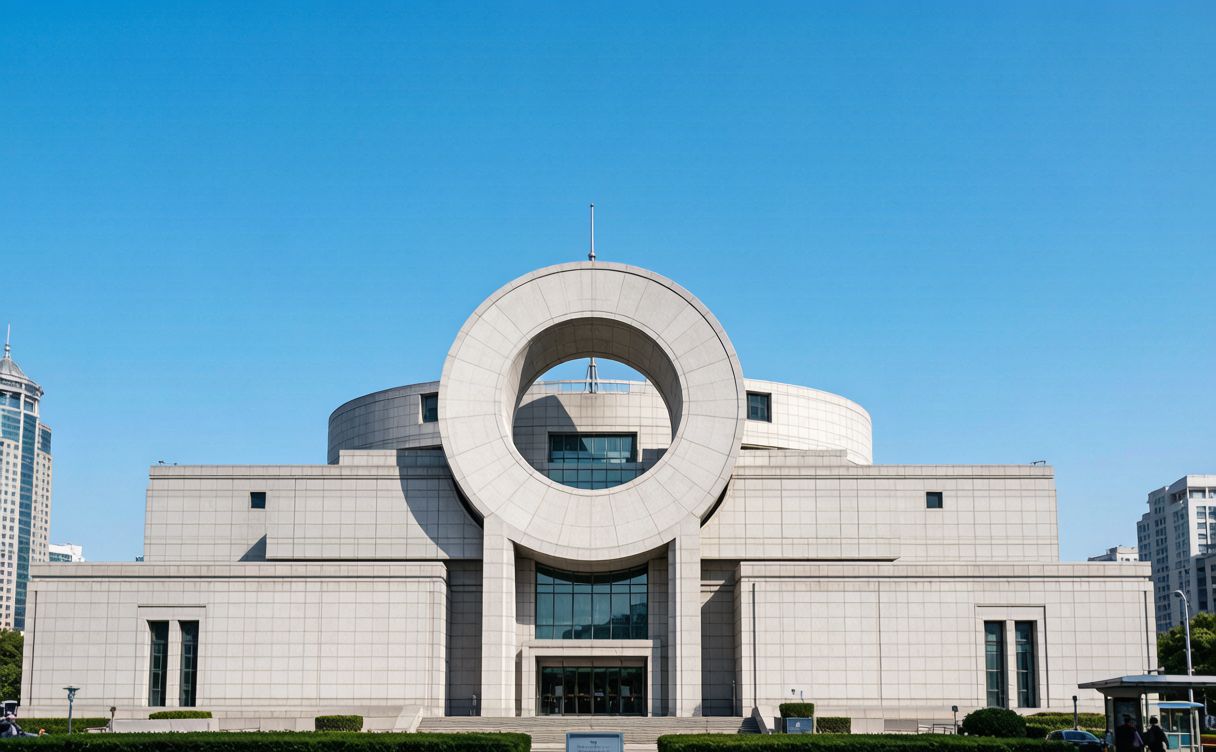
When I first stood in front of the Shanghai Museum, I honestly didn’t expect to lose an entire afternoon inside. From the outside it looks like a big bronze cooking pot — a ding — and that shape turns out to be the perfect hint for what’s waiting inside. This is one of the best places in China to see ancient Chinese art collected in one building, and unlike many tourist stops in Shanghai, it’s completely free and (almost) never feels like a trap.
I’d come to Shanghai for the skyline and the food, but the museum ended up being the single thing I kept thinking about after I left. If you’re planning your trip and feeling overwhelmed by the city’s size, treat the Shanghai Museum as your calm, air-conditioned anchor right in the middle of town. Here’s everything I wish I’d known before I went.
Getting There
The museum sits on the south side of People’s Square (人民广场), dead center in Huangpu District. This is the easiest major attraction in the city to reach by metro.
The metro is your friend here. Take Line 1, Line 2, or Line 8 to People’s Square Station (人民广场站). Use Exit 1 — it puts you right up at street level on the square, and the museum entrance is a short walk across the plaza. I timed it at about five minutes from the turnstile to the front doors.
A few practical notes from my visit:
– People’s Square is a massive interchange, so follow the “People’s Square / 人民广场” signs carefully. The station is huge and the exits are not obvious.
– If you’re coming from the Bund or Nanjing Road, it’s a flat 15–20 minute walk south, or two quick metro stops.
– Taxis and DiDi can drop you near the square, but traffic around here is slow. The metro is faster almost every time.
The museum is walking distance from a lot of other sights, which makes it easy to pair with a day of central Shanghai exploring. If you want to build a sensible day around it, my Shanghai first-time travel guide lays out a route that includes this stop.
Tickets and Reservations
Good news: general admission to the Shanghai Museum is free. You don’t pay at the door.
What you do need is a reservation, and this is the part that trips up a lot of visitors. When I went, same-day walk-up entries were limited and often gone by mid-morning, especially on weekends and holidays. The system works like this:
- Book a free timed-entry slot in advance through the official WeChat mini-program or the museum website.
- Slots usually open a few days ahead. Pick a morning slot if you can — the galleries are quietest right at opening.
- Bring your passport. They check ID against the reservation at the entrance.
- Special temporary exhibitions sometimes cost extra and need a separate ticket; the permanent collection is the free part.
My tip: book the earliest slot you can get. I arrived ten minutes before opening on a weekday and walked straight into near-empty rooms. By noon the bronze gallery was shoulder-to-shoulder.
What to See
The museum has around 120,000 objects, but you don’t need to see them all. The permanent collection is organized into themed galleries, mostly on the first three floors. On my visit the highlights were:
- Bronze (my favorite, more below)
- Ceramics — a sweeping walk through 8,000 years of Chinese pottery and porcelain
- Calligraphy and Painting — rotating scrolls, so what’s on the wall changes
- Jade
- Ancient Coins
- Furniture from the Ming and Qing dynasties
- Minority nationalities’ art from China’s various ethnic groups
Don’t try to read every label. Pick two or three galleries that match your interests and spend real time in them. The quality of the pieces is the point, not the count.
The Bronze Gallery
If you only have time for one room, make it this one. The Shanghai Museum bronze collection is genuinely world-class — over 1,200 pieces, some dating back more than 3,000 years to the Shang and Zhou dynasties.
What got me wasn’t just the age. It was the detail. There’s a Western Zhou dynasticthe “Ke Ding” with hundreds of characters cast into its interior wall — an actual historical document from the 9th century BC, not a replica. Standing in front of it, I realized I was reading someone’s words from three millennia ago.
A few pieces worth hunting for:
– Da Ke Ding — a massive ritual cauldron, the kind of object that defined what “bronze” means in Chinese art.
– The bronze wine vessels and bells shaped like animals, with surfaces covered in taotie (animal-mask) patterns.
– The sword of King Goujian of Yue — a beautifully preserved ancient blade that barely looks its age.
The lighting in this gallery is excellent and the cases are low enough to see into without craning. I spent close to an hour here alone. If you’re interested in how these objects connect to China’s deeper history, the Things to do in Shanghai list points you to other spots that round out the story.
Ceramics, Jade, and the Rest
The ceramics gallery is the other heavyweight. It traces Chinese porcelain from rough Neolithic pots all the way to the blue-and-white Ming and Qing wares that the whole world wanted to own. The Ming dynasty blue-and-white pieces are the ones you’ve seen in every textbook.
The jade room is smaller but soothing — jade has been prized in China for 8,000 years, and the carvings show an almost obsessive level of skill. The furniture gallery surprised me: full Ming-dynasty scholar’s studios reconstructed with huanghuali wood, which made the whole “how did people actually live” question click into place.
One thing I’d flag: the calligraphy and painting galleries rotate their exhibits often because the works are light-sensitive. Whatever is up during your visit is what you get, but it’s always strong. Check the board near the entrance for the day’s open galleries — a couple of rooms were closed for rotation when I visited.
A Half-Day Walking Route
Here’s the loop I’d suggest if you have about three hours:
- Start at the bronze gallery (top floor) right at opening, before the crowds.
- Work down through ceramics, then jade.
- Swing through calligraphy/painting if it’s open.
- End on the furniture floor so you leave on something visually calm.
- Step outside onto People’s Square, then walk north to Nanjing Road or east toward the Bund.
That last bit is the move. The museum empties you out right where you can pivot to completely different energy — shopping, river views, nightlife. I did the museum in the morning, grabbed lunch nearby, then walked to the waterfront for the evening. For timing that second half of the day, the Shanghai Bund night-view guide explains exactly when the lights come on.
Insider Tips
A few things that made my visit smoother:
- Go on a weekday. Tuesdays through Thursdays were noticeably emptier. Mondays it’s closed — don’t make my mistake of showing up on a Monday on a different trip.
- Cloakroom is free. Bags and umbrellas go in at the entrance. Use it; the galleries are more enjoyable with empty hands.
- Photography is allowed in most galleries without flash, but tripods are not. Be respectful — some visitors come to study, not perform.
- The audio guide is worth it if you care about context. There’s a multilingual version; I used the English one and it added a lot to the bronze room.
- Eat before or after, not during. There’s no real restaurant inside, just a small café and a gift shop. People’s Square has plenty of options within a block.
- Don’t skip the basement level. The minority nationalities gallery down there is less famous and far quieter — a nice reset if the upper floors are packed.
If classical Chinese aesthetics click with you here, you’ll probably love a day trip to Suzhou’s gardens. The Suzhou Humble Administrator’s Garden guide covers the best one and how to get there from Shanghai.
Best Time to Visit
Timing depends on what you want. The museum itself is indoors and climate-controlled, so weather barely matters — but crowd levels swing hard with the calendar.
- Best months overall: March–May and September–November. Shanghai’s weather is pleasant, so you can pair the museum with outdoor walking easily.
- Avoid the big holidays: Chinese New Year (January/February), May Day (early May), and National Day (early October) turn People’s Square into a sea of people. The museum gets slammed.
- Best time of day: The first hour after opening. I can’t stress this enough — the bronze gallery at 9 a.m. versus noon is a different experience.
If you’re building a longer China itinerary and want another museum-style history stop, the Xi’an Small Wild Goose Pagoda guide pairs well with a trip to the Terracotta Warriors for a different slice of the country’s past.
Good to Know
The museum’s main People’s Square building holds the core ancient-art collection. There is also a separate East Wing that has opened more recently with additional galleries, so check the official site before you go to see what’s currently on display and which entrance to use. For the most accurate opening hours, closure dates, and reservation rules, always confirm on the official page: Shanghai Museum official site.