

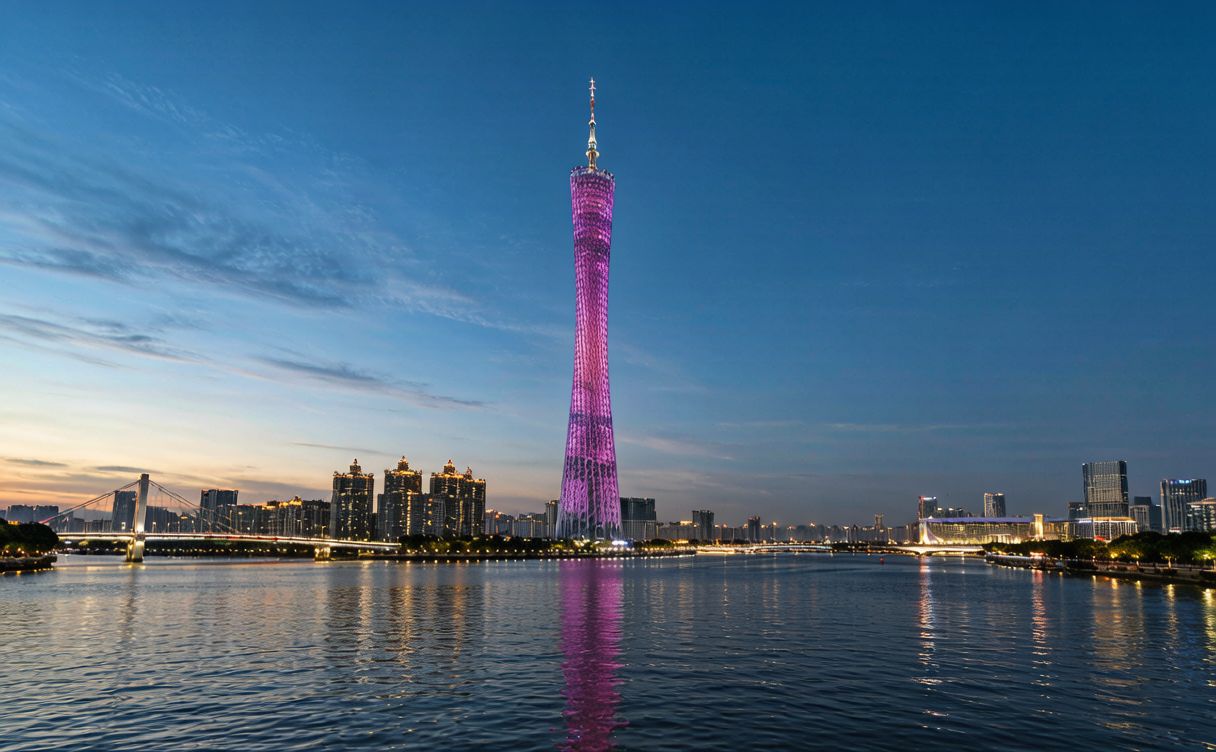
I had seen the photos for years — a slim, twisting tower glowing like a piece of neon ribbon against a humid southern sky — but nothing prepared me for the real thing. On my first night in Guangzhou, I walked out of the metro and there it was: the Canton Tower, all 600 meters of it, lit up in shifting waves of color and reflected in the Pearl River below. Locals call it Xiaoman Yao, “Little Waist,” because of the way it narrows at the middle. Stand at the base and look straight up and you’ll understand the nickname.
This is the tallest structure in Guangzhou and, until recently, one of the tallest towers in the world. But it isn’t just a height contest. The Canton Tower is the kind of place you visit once for the view and end up returning to three times because the mood changes completely between afternoon, blue hour, and midnight. Here is everything I learned, including the mistakes, so you can get it right the first time.
Getting There
The single best way to reach the Canton Tower is the metro, and Guangzhou’s system makes it almost impossible to get lost. Take Line 3 or the APM line (the automated people-mover that loops through the Zhujiang New Town core) and get off at Canton Tower Station (广州塔). The English signage is clear, and you’ll emerge within a few minutes’ walk of the tower base.
If you’re staying on the north bank near Beijing Road or the older city center, you have two pleasant alternatives. The first is to ride the Metro Line 3 south and transfer; the second, which I actually preferred on a clear evening, is to take a taxi or walk to the river and cross by one of the pedestrian bridges, then look back. Walking up from the south side of the Pearl River means the tower rises in front of you for a good ten minutes before you arrive, which builds the anticipation nicely.
A practical note: ride-hailing apps like Didi work fine here, but during holidays the roads around the tower get jammed. The metro is faster and drops you closer. Save the taxi for the way back if you want, once the crowds thin out.
What to See
The tower sits on a slender island in the Pearl River called Haixinsha area, right across from Zhujiang New Town, Guangzhou’s glittering financial district. Even before you go up, the surroundings are worth an hour. There’s a riverside promenade where families fly kites, couples take evening strolls, and amateur photographers set up tripods at dusk. The waterfront squares host music fountains and light shows on some evenings.
The tower itself is the work of Dutch architects Mark Hemel and Barbara Kuit, and the design is genuinely clever rather than merely showy. Two elliptical concrete cores rise and gradually twist around each other, with a steel lattice mesh wrapping the outside. As you walk around it, the shape appears to change — slim from one angle, wide and graceful from another. I spent a surprising amount of time just circling the base.
Inside, the base has a small exhibition area, ticket halls, and a few shops. Most visitors head straight for the lifts. But if you have time before your deck visit, the nearby Opera House and the Guangdong Museum (both a short APM hop away in Zhujiang New Town) make an easy half-day of modern Guangzhou.
The Observation Decks
This is the heart of the visit, and where the ticket tiers matter. The Canton Tower has several public levels at different heights, and you can buy a combined ticket or pick individual experiences.
The indoor observation decks start around 428 meters and climb to roughly 433 meters. These are enclosed, air-conditioned, and fitted with thick glass, so they’re comfortable even on a hot August evening. The floor-to-ceiling windows give you a clean sweep of the city: the Pearl River curving through the center, the older districts to the north, and the forest of new towers in Zhujiang New Town.
Higher still is the outdoor sky deck near the top, where you can feel the tower sway ever so slightly in the wind — a strange, thrilling sensation 500 meters up. On a clear day I could make out the distant hills that ring the city.
Two experiences sit at the very top and are the real reason people come: the Bubble Tram and the Sky Drop. The Bubble Tram is a circle of transparent gondolas that runs around the tower’s antenna ring at about 450 meters, giving you a slow, open-air 360-degree tour without ever leaving your seat. It takes around 20 minutes per loop and is, for my money, the most photogenic part of the whole visit.
The Sky Drop is the opposite kind of thrill. It’s a pair of seats that drop straight down the side of the tower from near the top at surprising speed. I watched a few brave souls scream their way down and decided my photos were adventure enough. If you like a controlled adrenaline hit, it’s included in the higher ticket tiers.
Ticket prices shift with the season and which combination you choose, but as a rough guide, a basic indoor-deck ticket runs modestly while the full package with Bubble Tram and Sky Drop costs noticeably more. Buy at the official counters or the tower’s site to avoid reseller markups.
Tips
A few things I wish someone had told me before my first visit:
- Go up twice if you can. The afternoon light shows the city’s layout; the night lights are the postcard shot. If a second ticket is too much, at least stay on the ground promenade through blue hour so you see both.
- Book the Bubble Tram early in your visit. Slots are timed and fill up on weekends. I nearly missed it by treating it as an afterthought.
- Bring a light jacket. The outdoor sky deck is breezy and cooler than the street, even in summer.
- Avoid the dense holiday windows (Golden Week in early October and the Spring Festival travel period) if you can. The queues at the lifts can stretch to an hour.
- Charge your phone. You will take far more photos than you expect, and the low-light night shots drain batteries fast.
- Eat beforehand or nearby. There’s a revolving restaurant in the tower, but it’s a splurge. The streets of Zhujiang New Town and the old city have excellent dim sum a short metro ride north.
For official ticket prices, opening hours, and the latest visitor info, check the Canton Tower official site.
Best Time
Guangzhou is subtropical, so the experience varies a lot by season. I visited in late spring and found the evenings warm, the air reasonably clear, and the crowds manageable. Autumn (October to early December) is arguably the best window: cooler, drier, and with the clearest views across the river. Winter is mild by northern standards but can be hazy, which softens the skyline. Summer is hot and humid with frequent afternoon thunderstorms — dramatic light if you’re lucky, but also the highest chance of a washed-out view.
For the time of day, I’d argue the sweet spot is arriving about 90 minutes before sunset. That lets you catch the city in daylight from the decks, watch the transition as thousands of building lights switch on, and walk the riverside as the tower hits full neon. Weeknights are calmer than Friday and Saturday, when the light-show crowds swell.
Good to know: Before you go, check opening hours and any maintenance closures directly on the official site — https://www.cantontower.com/ — since the top-deck experiences occasionally pause for weather or upkeep.
My Take
The Canton Tower isn’t the oldest or the most “Chinese” sight in the country, but it might be the most fun to actually experience. Where a pagoda or a temple asks you to stand back and admire, this tower invites you to ride, circle, drop, and gawk. Pair it with a slow dinner along the river afterward and you’ve got one of the better evenings any southern Chinese city offers. If your trip is built around landmark sightings, put it high on the list — and bring a camera that handles low light.