

The first time I stepped out of a taxi on Tongjiang Street and looked up at Saint Sophia Cathedral Harbin, I stopped talking mid-sentence. I had seen the photos, of course, but nothing prepares you for the scale of that brick-red dome rising against the grey northern sky. It is the kind of building that makes you reconsider what you thought China would look like.
I have now visited Harbin four times, and I still build at least one afternoon around this church every trip. If you are planning a first visit to the city, Saint Sophia Cathedral is not just one of many things to do — it is the thing that explains Harbin itself.
Getting There
Saint Sophia Cathedral sits in the heart of central Harbin, in Daoli District, about two kilometers southwest of the main Harbin Railway Station. The official address is 88 Toulong Street, and the surrounding square is pedestrian-friendly and easy to find.
When I arrive by train, I usually take a short taxi or Didi ride — it costs roughly 10 to 15 yuan and takes about 10 minutes in light traffic. If you prefer the metro, take Line 1 or Line 2 and walk the last few hundred meters; the station names change, but any local can point you toward “Suofeiya” (the Chinese rendering of Sophia).
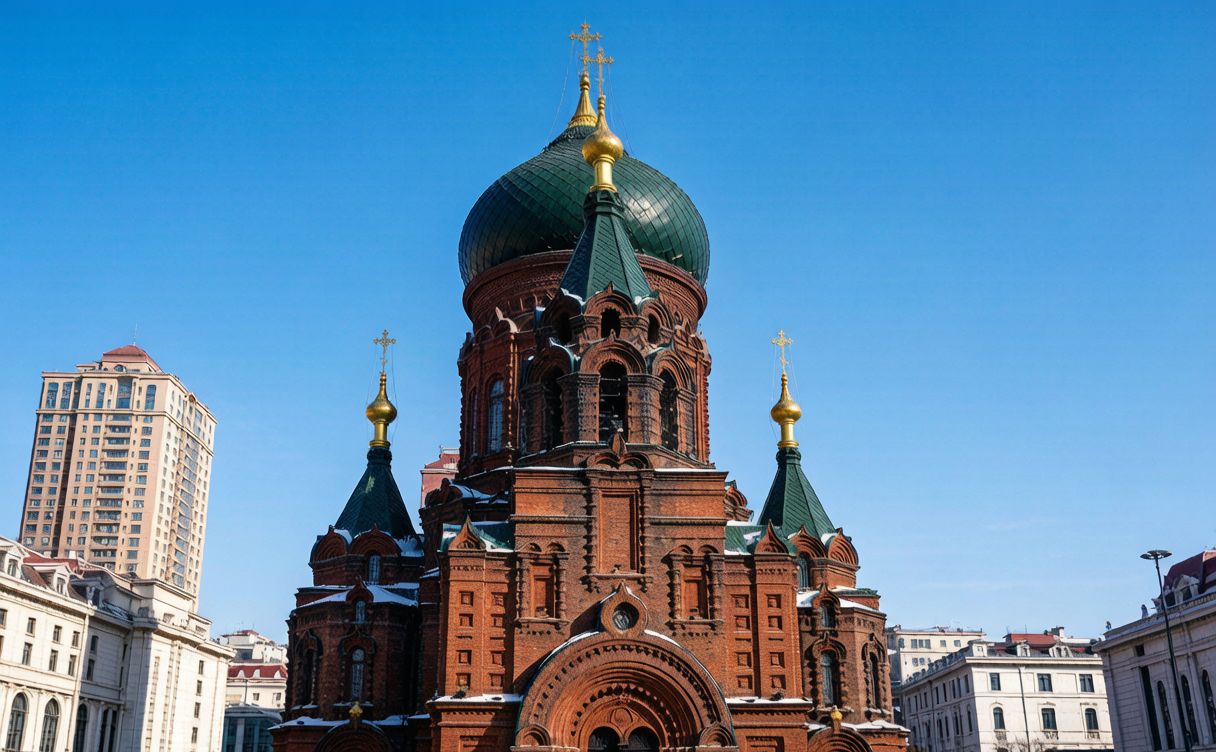
The square in front is large and open, which is good for photos but also means it gets windy. Harbin is one of the coldest major cities on Earth, so I always check the wind chill before leaving the hotel, even in spring.
If you are staying near the Songhua River or the flood-control monument area, the walk to the church takes about 20 minutes along flat streets. I actually enjoy that walk in the evening, because you pass smaller Russian-style buildings and get a sense of how much of old Harbin survives between the modern towers. Taxis are plentiful, but during rush hour the central roads clog up, so walking is often faster than sitting in traffic.
What to See
The cathedral was built in 1907, originally as a Russian Orthodox church for the city’s growing Russian population during the construction of the Chinese Eastern Railway. The current structure dates from 1932, when it was rebuilt in its present Byzantine style with a central onion dome and four smaller turrets around it.
I love walking the full perimeter before going inside. The brickwork is a warm terracotta red, and the green-tipped domes catch the light differently throughout the day. At night the whole building is lit, and in my opinion that is when it looks most dramatic — almost like a film set.
Inside the grounds, you will find a modest park with benches, a small fountain, and often local photographers offering instant prints. Pigeons gather on the square, and during festivals the area fills with street food stalls selling roasted sweet potatoes and candied haws.
Don’t miss the contrast with the modern shopping malls just behind the church. That collision of Russian nostalgia and 21st-century Chinese city life is exactly what makes Harbin feel unique.
The Interior Museum
Here is something many first-time visitors miss: Saint Sophia no longer holds regular religious services. Since 1996 it has functioned as the Harbin Architecture Art Museum, and the interior is a museum rather than an active church.
I spent a good hour inside on my last visit. The main hall displays black-and-white photographs of old Harbin, showing the city as it looked a century ago under Russian and later Japanese influence. There are scale models of the city’s historic buildings, including the railway station and the now-demolished synagogue.
The upper floor holds exhibits on Harbin’s multicultural past — Russian, Jewish, Korean, and Chinese communities all left their mark. I found the old tram tickets and rail maps oddly moving. The acoustics of the empty nave are remarkable; even quiet footsteps echo upward toward the dome.
One detail I always point out to friends: look at the original wooden roof beams and the iron chandelier frames still hanging near the altar area. They survived both the Soviet withdrawal and the Cultural Revolution, which is something of a minor miracle given how much of the city’s foreign heritage was lost. The museum does a quiet but effective job of explaining why this building was saved while others were not.
Plan for at least 45 minutes inside if you read the panels, and closer to 90 minutes if you are a photography person. There is no cafe inside, so eat beforehand or save your appetite for Central Street just outside.
Entry to the museum costs 20 yuan for most visitors, and I consider it good value. Audio guides are available at the desk near the entrance, though the signage is also in English.
Tips
A few practical things I have learned the hard way:
- Go early or go late. Midday brings tour groups and harsh overhead light. I prefer arriving right at opening (around 8:30 a.m.) or after 4 p.m.
- Dress for the weather. Even inside, the museum is not heavily heated in winter, and the square is fully exposed. Wear a real winter coat from November through March.
- Bring a wide-angle lens. The dome is tall and the square is tight. A phone works fine, but a wide shot captures the whole composition.
- Combine it with Central Street. The famous cobblestone Zhongyang Dajie pedestrian street is a 10-minute walk north, and the two together make a perfect half-day loop.
- Watch for scams. The “free” photo with a costumed character often comes with a request for payment afterward. Smile, decline politely, and move on.
Best Time
I have been in both summer and deep winter, and they offer completely different experiences.
Summer (June to August) is mild and green, with long daylight and comfortable evenings. The square is lively, and you can linger outside without freezing. This is the easiest season for casual visitors.
Winter (December to February) is, for my money, the best time to see Saint Sophia Cathedral Harbin. When snow piles on the domes and the air turns blue at dusk, the church looks like something from a Russian fairy tale. It also pairs perfectly with the rest of the city’s frozen season.
If you come in January, the famous Ice and Snow World is running simultaneously, and the cathedral makes a beautiful warm-up stop before the colder attractions. I usually do Sophia in the late afternoon, then head to the ice sculptures after dark.
Autumn (September to October) is my secret favorite, honestly. The crowds thin out, the air is crisp, and the red brick glows against the golden leaves in the square’s trees. Spring is the wildcard — March and April can still bring late snow, while May suddenly turns mild. I would avoid the May holiday week if you can, because every square meter of Harbin gets packed with domestic travelers.
Good to Know
Saint Sophia Cathedral is a protected national cultural relic and one of Harbin’s most recognized symbols. For official opening hours, holiday schedules, and event updates, I recommend checking the Harbin tourism board’s information before you travel, since times shift around the Lunar New Year and the Ice Festival: Visit Harbin — official tourism information.
The site is generally open year-round, but special light shows are sometimes staged on public holidays, and those evenings draw the biggest crowds.
If your trip also covers the south, our Shenzhen travel guide is a useful counterpoint — a city that could not be more different from snowy Harbin, yet equally fascinating.
Final Thoughts
Saint Sophia Cathedral Harbin is more than a pretty photo. It is a doorway into the city’s Russian chapter, a reminder that China’s story has always been shaped by the people who passed through. I keep coming back because no two visits feel the same — the light changes, the seasons change, and the square keeps reinventing itself.
Spend an hour here, then wander north to Central Street for a coffee and a look at the rest of old Harbin. You will leave understanding why this red-domed church remains the soul of the city.
For me, the real magic is the moment you turn your back on the dome and realize the whole neighborhood tells the same story — bread shops selling Russian round loaves, signs in Cyrillic fading on old facades, and grandmothers chatting in a dialect shaped by a hundred years of migration. Saint Sophia is the headline, but the city around it is the full performance. Give yourself that context and the cathedral means far more than just a photograph.