

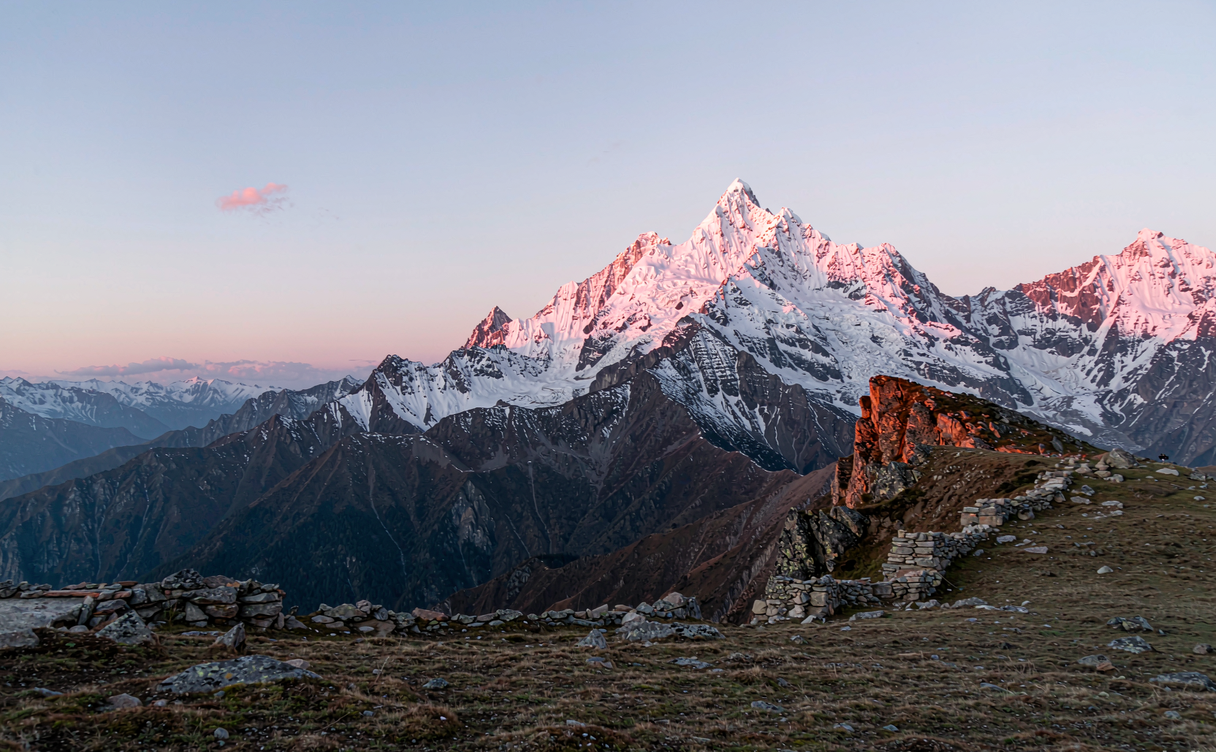
Niubei Mountain (Niubei Shan) rises to 3,666 m in Yingjing County, in the Ya’an region of western Sichuan, and it is one of the few places in the province where you can stand on an open summit and turn a full circle of snow peaks. On a clear dawn the Gongga range lights pink across a rolling sea of clouds. This Niubei Mountain Sichuan guide covers the drive up, the off-road transfer, the cold, and how to link it to Siguniang.
Why Niubei Earned Its Reputation
The mountain’s old fame came from a rough tent-camp trek, but the draw was always the view: a 360-degree horizon that takes in Gongga, the Qinghai-Tibet plateau edge, and a cloud sea that fills the valleys below. We send photographers and quiet travellers there in autumn most years, because the air is driest then and the summit stays clear for hours after sunrise. A focused Niubei Mountain Sichuan guide lives or dies on that dawn window, so we plan the whole trip around it.
How to Hike Niubei Mountain
The route has changed. The old slog is now a paved service road, so how to hike Niubei Mountain depends on your style. Most clients take a 4WD transfer from the base village (around Lengjing in Yingjing) up the switchbacks — about 1 hour of steep climbing, CNY 80–CNY 150 per person round trip, arranged through your guesthouse. Walkers can still trek the lower sections, but the top road is for vehicles, not a footpath. From the drop-off it is a 15–20 minute walk to the open summit ridge where everyone sets up.
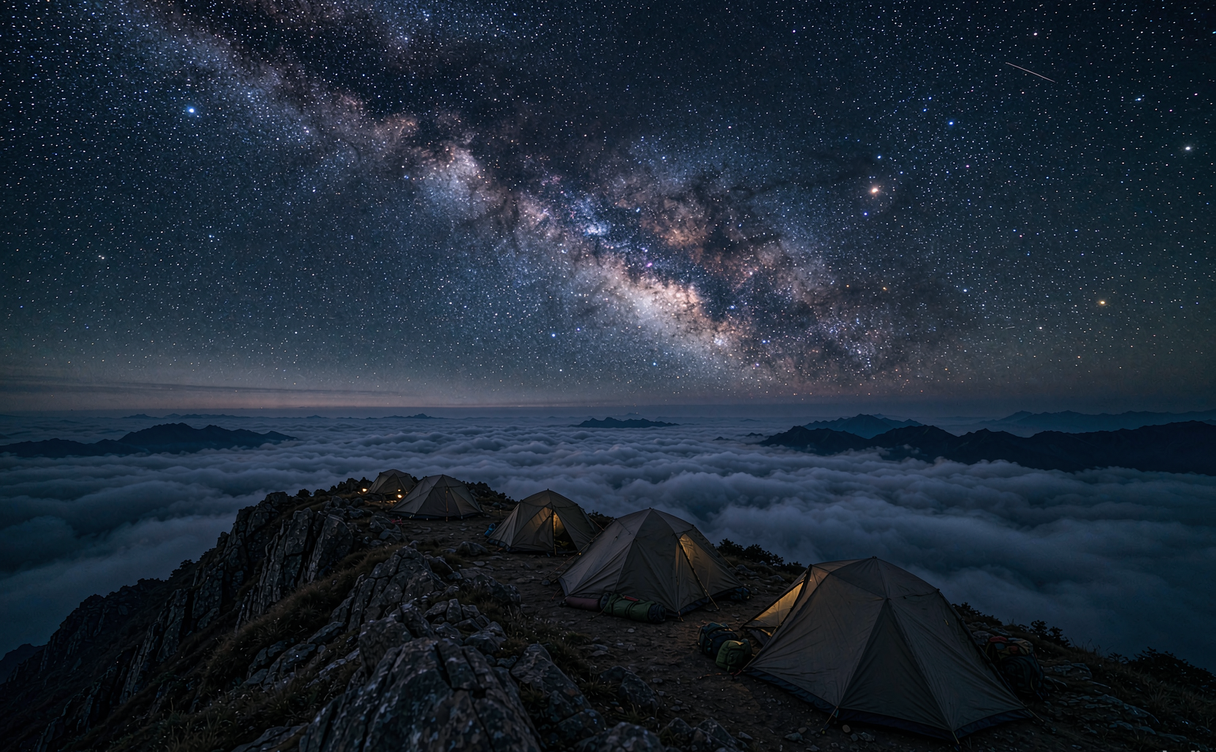
Allow a full afternoon-plus-morning: drive up in late afternoon, shoot sunset and the Milky Way, sleep at the top, then shoot sunrise. Going up and back in one day misses the whole point.
Niubei Mountain Sunrise Viewpoint
The Niubei Mountain sunrise viewpoint is simply the open southern rim — no fence, no platform, just a line of tripods. Arrive 40 minutes before first light (around 6:00 in autumn) to claim a spot. When the cloud sea catches the gold, Gongga’s summit glows behind it. We tell clients to bring a head torch and a thermos; the rim is near freezing even in May.
Niubei to Siguniang Trip
A natural extension is the Niubei to Siguniang trip. From the mountain’s east side you drop through Baoxing County and north to Siguniang Mountain (Mount Siguniang), roughly 4–5 hours of driving. It makes a strong 3–4 day west-Sichuan loop: clouds at Niubei, then alpine valleys and the four sisters peaks. We book this as a private-car run because public buses do not connect the two cleanly.
Best Time Niubei Mountain
The best time Niubei Mountain offers is October–November, when the cloud sea is steady and the haze is gone. April–May is the second choice: flowers on the lower slopes and frequent clouds without summer storms. December–February is brutal cold with possible road closure from ice; July–August is green but stormy, with clouds that often refuse to clear for the peaks. We avoid the monsoon weeks.
Getting There from Chengdu and Where to Stay
From Chengdu it is about 4–5 hours by car to the base village (CNY 1,200–CNY 1,800 private, depending on vehicle and season). There is no train; a self-drive needs confidence on mountain roads. Stay either at the summit guesthouse (CNY 200–CNY 500 a night, basic, shared, cold) or camp on the rim with your own gear — we rent sleeping bags rated to minus 10°C to clients who fly in light. Before you leave the city, fuel up on our Chengdu hotpot guide; the mountain has no real food above the base.
A practical two-day plan:
- Day 1: Chengdu drive to base (lunch en route), 4WD transfer up, sunset and night sky at the rim.
- Day 2: Pre-dawn sunrise, late breakfast, drive down, return to Chengdu or north toward Siguniang.
What to Pack for the Rim
The summit is cold even when Chengdu is sweating. A down jacket, a wind shell, and a hat are mandatory from October to May; we have seen the rim at minus 8°C in mid-May. Bring a head torch for the pre-dawn walk, a thermos of hot water, and hand warmers if you feel the cold. The guesthouse rents sleeping bags rated to minus 10°C, but if you camp, bring your own pad — the ground is hard and the chill comes up fast.
Camera kit is the other consideration. A sturdy tripod is essential for the Milky Way and the sunrise; the rim is exposed, so a weight or rocks on the legs help in wind. Wide lenses take the cloud sea, and a 70–200 mm compresses Gongga nicely when the alpenglow hits. We tell clients to charge everything at the base, because the summit has weak or no power and the cold drains batteries quickly.
Altitude and Health
At 3,666 m most people manage the short walk to the rim but sleep is light and appetite drops — normal, not dangerous. Walk slowly on arrival, skip alcohol, and drink 2–3 litres of water. The 4WD transfer spares you the climb, which is the main altitude stressor; if you feel a thumping headache or nausea that worsens overnight, go down — the base village is 1 hour away and lower. We have never had a serious case, but we brief every client because the mountain feels easy and the height is not. Spend a night in Chengdu (500 m) or Ya’an on the way up and the rim feels gentler.
FAQ
Will I get altitude sickness at 3,666 m? Mild heads and poor sleep are common. Walk slowly, skip alcohol, and hydrate; the overnight makes it easier than a day trip. If you are new to the region, our Chengdu travel guide covers acclimatisation stops on the way west.
Do I need my own car? Not strictly, but it helps. The base has guesthouse-arranged 4WDs; a private Chengdu car is the comfortable option. Our Sichuan 7-day itinerary shows how Niubei fits a longer loop.
Is it too cold to camp? Only if you are under-geared. The rim drops near freezing most nights; rent proper kit or take the guesthouse.
How does it compare with other famous peaks? The 360 view is the special part — our Huangshan Yellow Mountain guide gives a sense of ridge walking, but Niubei’s horizon is wider and wilder. For snacks on the drive, our Sichuan snacks guide lists what to pack.
Can beginners do it? Yes, with a transfer and a guide. The danger is the cold and the drop, not the walking.
The snow massif you photograph is Mount Gongga, summarised in Wikipedia’s Gongga Shan entry, the highest peak in Sichuan at 7,556 m and the anchor of the view from the rim.
From the Summit Ridge
Our drivers usually leave Chengdu by 7 a.m. so clients reach the base by early afternoon and are on the rim before sunset — that buffer is the difference between photographing Gongga’s alpenglow and missing it to traffic. We have stood on the rim in still air watching the cloud sea boil up; it is the kind of calm that sells the mountain better than any photo. The Niubei Mountain sea of clouds and the Niubei Mountain sunrise viewpoint are what our clients mention first when they get home.