

Most trip notes describe Kanas as “a pretty lake up north.” On the ground it is a 24-km glacial ribbon tucked into the Altai mountains of Xinjiang, China, fed by snowmelt and ringed by Siberian larch and spruce that turn the shoreline gold in autumn. The water shifts color through the day — jade at dawn, steel blue by noon, violet at dusk — which is half the reason people make the long haul out here, and the other half is the Tuva villages whose log cabins and morning milk-tea smoke feel a world away from China’s eastern cities. This Kanas Lake guide is built to save you that haul’s worth of mistakes: it explains the park’s shuttle-and-ferry layout, pins down the narrow autumn window, lays out the real transport math from Urumqi, and tells you which of the three villages (Kanas, Hemu, Baihaba) is worth your nights. For the wider regional picture — pairing this lake with Sayram Lake or a Silk Road spine — start with our Xinjiang Sayram Lake guide and come back here to plan the lake day itself.
Why Kanas Looks Like It Shouldn’t Be in China
Kanas sits at about 1,374 m above sea level in the Altai range, the same mountain system that runs into Kazakhstan, Russia and Mongolia. The result is a landscape that reads more Siberian than Central Asian: dense taiga, wooden herders’ homes, and a lake so clear you can see fallen trees standing upright on the bottom at 10–15 m depth. Three things pull visitors back year after year:
- The color shift. Mineral suspension and algal blooms tint the water hourly; the classic “emerald-to-indigo” show is strongest in September and October under clear skies.
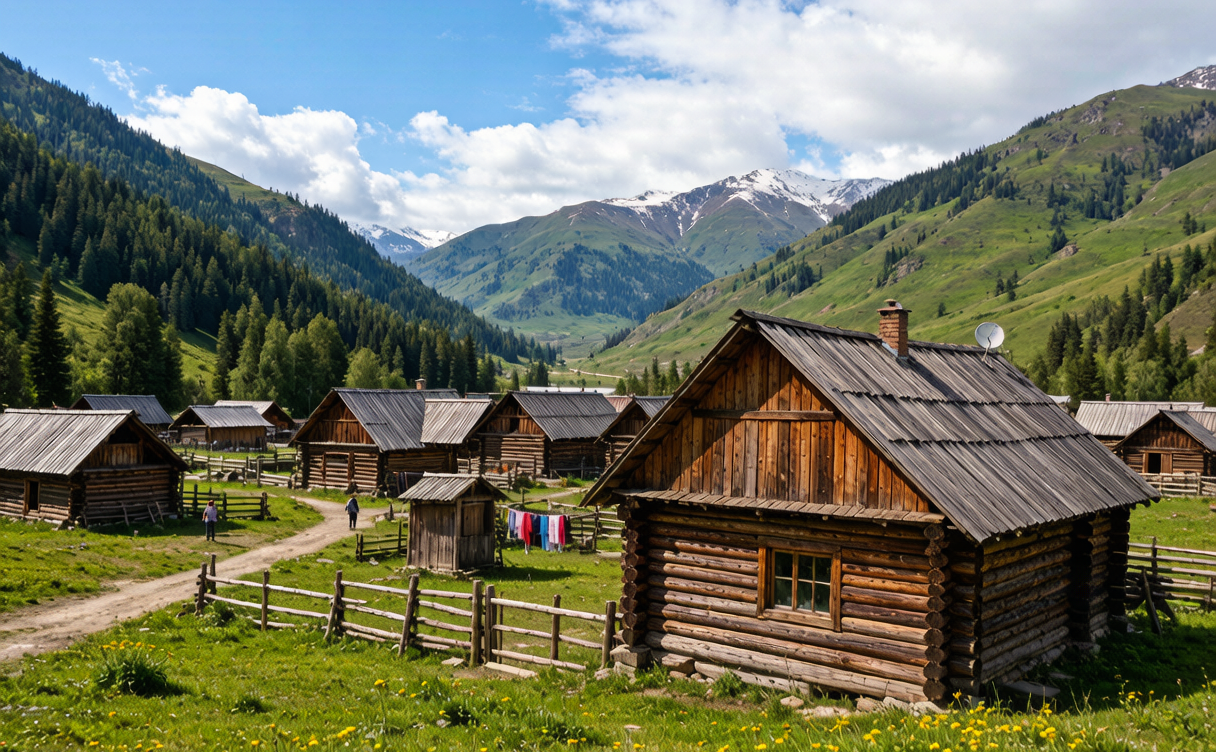
- The Tuva villages. The Kanas and Hemu settlements are home to Tuvans, a Turkic-speaking group whose timber houses, horse pastures and slow mornings are the antidote to China’s high-speed east.
- The “lake monster” folklore. Locals call a large freshwater fish (Hucho taimen, a giant trout-like salmonid) the “water ghost”; lookout platforms near the lakeside are built precisely for monster-spotting tourists with long lenses.
The Three Villages, Distinctly
Kanas Village is the park’s hub, with the main entrance, most hotels, and the jetty for the lake ferry. Hemu is 30 km northeast — the quieter, more photogenic settlement famous for its wooden fences and sunrise smoke rising over the rooftops. Baihaba, on the Kazakhstan border, requires a border permit and is the least developed of the three. A real Kanas Lake travel guide has to address the village choice, because where you sleep decides how early you reach the viewpoints before the day-trippers arrive.
Best Time to Visit Kanas Lake
The best time to visit Kanas Lake is short and specific. The park sits at high latitude (about 48°N), so the season is compressed and the famous color comes late:
- Mid-September to early October is the peak. Larch and birch go gold against the blue lake, and the light is low and warm. This is also when crowds and prices spike — the National Day holiday (Oct 1–7) should be avoided entirely, as rooms inside the park can triple and shuttles jam.
- June to August is the green season: wildflowers in the meadows, comfortable 15–25°C days, but more tour groups and the occasional afternoon rain.
- Late May offers snow on the peaks and near-empty boardwalks, with the risk of cold nights near 0°C.
- November to April the park largely closes or runs a skeleton service; roads ice over and most guesthouses shut their doors.
If you want the gold without the Oct 1 crush, target September 20–28. Slot the lake into a wider route using our month-by-month China timing guide.
How to Get to Kanas Lake
The nearest city is Urumqi, roughly 800 km southeast. There is no train to the lake; the realistic options are fly-in or drive the long highway. Note the park entrance is at Jiadenyu, about 4 km below Kanas Village, and all private vehicles must park there — you continue by park shuttle. The transport table below is the practical backbone of any how to get to Kanas Lake plan:
| Route | Option | Time | Approx. Cost |
|—|—|—|—|
| Urumqi (Diwopu) → Kanas Airport (Buerjin) | Flight | ~1.5 hr + 1.5 hr drive | RMB 700–1,400 (US$100–200) |
| Urumqi → Buerjin (county town) | Long-distance bus | 10–12 hours | RMB 180–220 (US$26–31) |
| Urumqi → Kanas | Private SUV / carpool | 9–11 hours | RMB 1,800–3,000 per vehicle |
| Buerjin → Jiadenyu entrance | Bus or taxi | 1.5–2 hours | RMB 50–120 |
| Hemu ↔ Kanas | Park shuttle | 1–1.5 hours | RMB 70–100 (in combo ticket) |
Flying to Kanas Airport (actually near Buerjin, not at the lake) is the common fast option, but flights are few and weather-cancellable in autumn. The bus-and-taxi chain is cheaper and reliable. Whichever you pick, book the park entry + shuttle combo (roughly RMB 230 entry + RMB 70 shuttle in peak, about RMB 300 / US$43 total) online before arrival — the same app discipline as any Chinese route, covered in our train and transport guide for foreign travelers.
Where to Stay
Sleep options split by village. Inside Kanas Village, hotels run from basic RMB 300 guesthouses to RMB 1,200–2,000 resorts near the jetty; book these weeks ahead in October. Hemu has the most atmospheric stays — timber cabins at RMB 400–900 — and the sunrise there is the better photograph. Baihaba is for the border-permit crowd willing to rough it at RMB 200–350. Staying inside the park (rather than down in Buerjin town) lets you catch the first 8am shuttle before the day-trippers from the county arrive. There is no camping allowed at the lakeshore itself, and the park enforces a strict evening gate.
Things to Do in Kanas Lake
This is the core of any Kanas Lake travel guide — the lake is the draw, but the activities around it are what fill a satisfying day:
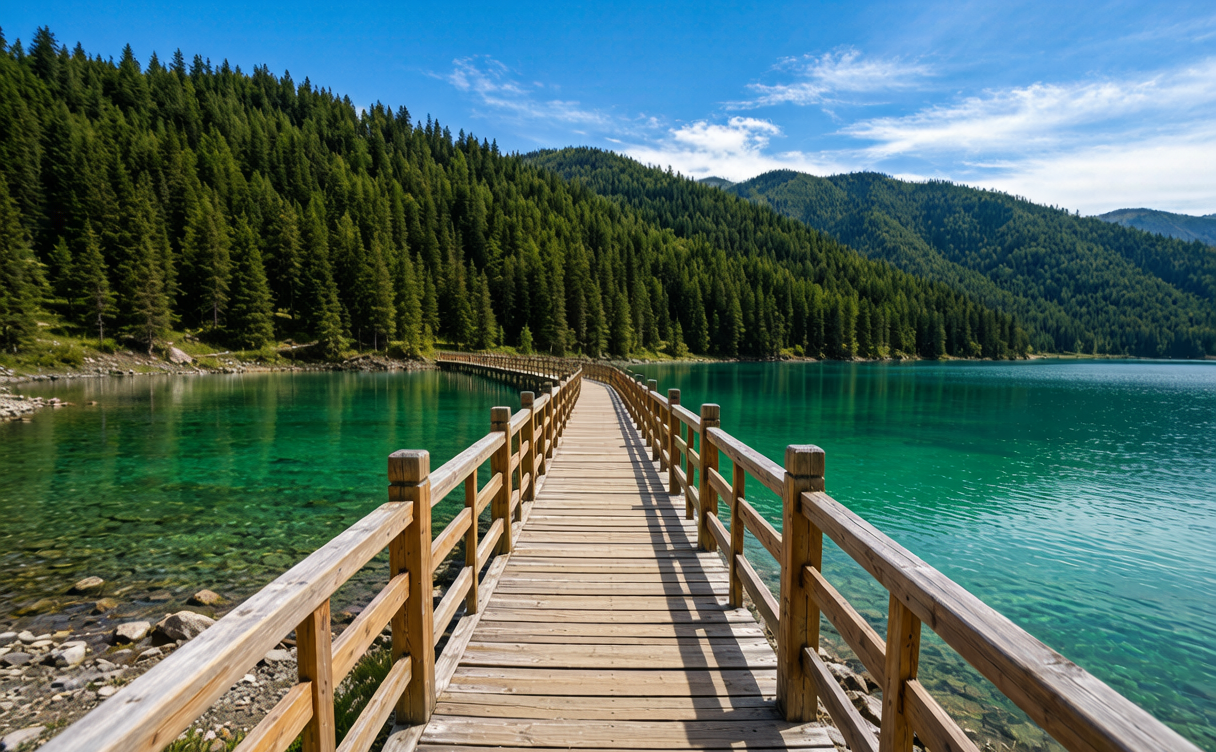
Lakeside boardwalk and the viewing pavilion
A paved path runs from the village up to the Guanyu (Fish-Watching) Pavilion — about 1,066 steps climbed for the classic aerial view of the lake’s bend. It’s a real workout, so allow 90 minutes round trip and start early.
The lake ferry
A diesel ferry crosses to the far shore where a short trail reaches Moon Bay and Wolong Bay, the two most photographed bends, where the river braids around a crescent of forest. The ferry (about RMB 120 extra) beats walking the road and gives you the quiet side.
Hemu sunrise and the wooden village
If you stay in or visit Hemu, the dawn smoke-over-rooftops scene is the postcard. A viewpoint platform 20 minutes’ walk above the village gives the wide shot that fills social feeds.
Baihaba border village
Only with a permit (arranged via your hotel or the park, bring your passport). Quiet, pastoral, and a rare chance to stand near the tri-border frontier with Kazakhstan and Mongolia.
Sample Itinerary
Two days (minimum worthwhile): Day 1 — arrive Jiadenyu, shuttle to Kanas Village, walk the boardwalk to Moon Bay and Wolong Bay, catch sunset from the lakeshore. Day 2 — early climb to Guanyu Pavilion for morning light, take the ferry across, then transfer to Hemu for the night and its sunrise.
Three days (relaxed): Add a full Hemu day — walk to the viewpoint, visit a Tuva family for milk tea, and let the October-gold meadows soak in. This is easily one of the best things to do in Kanas Lake country for slow travelers who hate being herded onto a bus.
Practical Tips (Kanas Lake Guide Tips)
- Altitude and cold. At 1,300–2,000 m it’s milder than Tibet, but October nights hit −5°C. Pack a real down jacket, not just a fleece.
- Book the combo ticket and shuttle online before you leave Urumqi; on-site queues are long in peak week.
- Cash and signal. Mobile pay works in the villages, but carry RMB 200–300 for small stalls and the border permit fee. Signal drops outside the main settlements.
- Border permit for Baihaba needs your passport and about a half-day lead time — don’t count on a same-morning walk-in.
- Drones are banned inside the reserve, and rangers do check.
- Food is simple and pricey — noodles, lagman (hand-pulled noodle soup), grilled lamb; a basic meal runs RMB 40–80 (US$6–11).
FAQ
Do I need a special permit to visit Kanas?
No Tibet-style permit, but Baihaba village requires a border permit (passport). The main park just needs the standard entry + shuttle combo ticket bought in advance.
Is Kanas worth it if I only have one day?
Barely. The lake rewards a two-day stay because the best light is at dawn and dusk and the ferry-and-boardwalk loop takes a full day. One day means a rushed drive-in, drive-out with none of the magic.
How cold does it get in October?
Dawn around −5 to 3°C, daytime 8–15°C. The golden larches easily justify the layers.
Can I visit independently or must I join a tour?
You can visit independently — shuttles, bilingual signage and tickets are self-service. Tours help only if you want the long Urumqi–Kanas drive handled for you.
Are there bears or dangerous wildlife?
Brown bears live in the Altai but are rarely seen near the villages. Standard trail caution applies; stay on the boardwalks.
What exactly is the “lake monster”?
It’s the giant taimen (Hucho taimen), a large trout-like fish, not a creature. The lookout platforms are built for “monster” watching, but no verified sightings of anything larger exist. For the background on the Altai ecosystem and lake formation, the Wikipedia entry on Kanas Lake is a solid reference.
Written by Karl Huang, updated August 2026.