

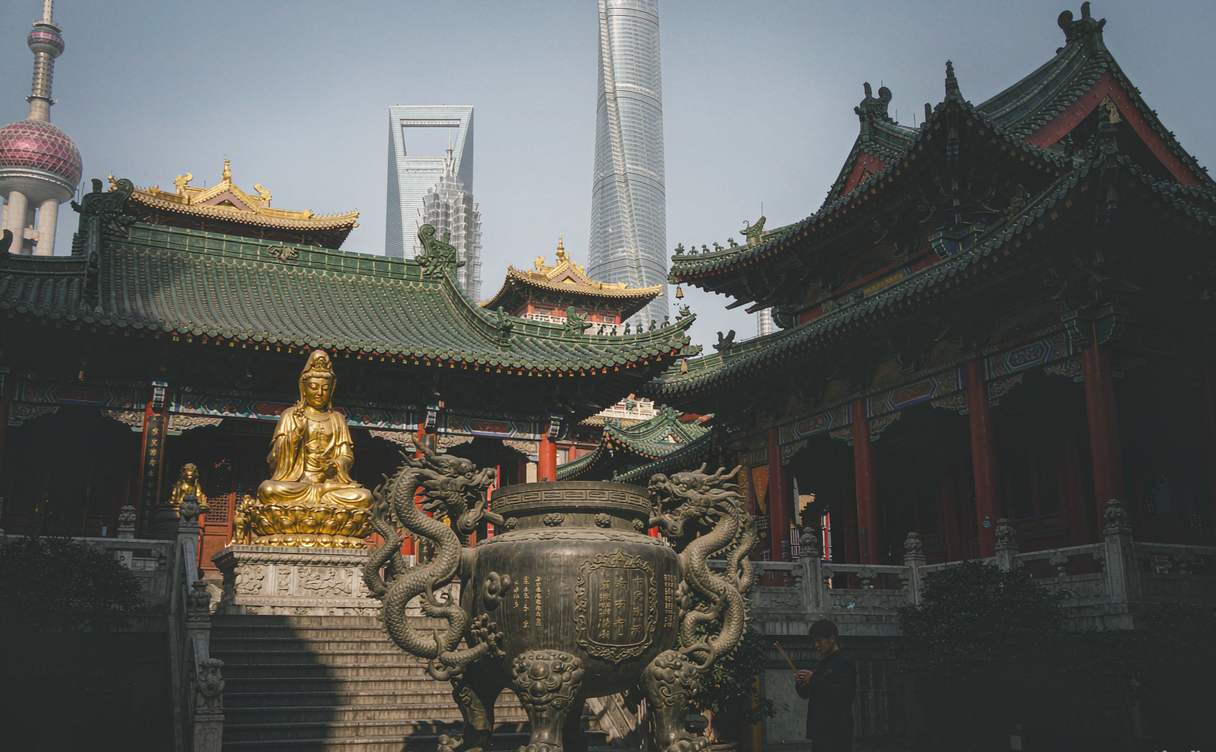
Jing’an Temple Shanghai is the city’s most surreal spiritual address: a blazing, gold-roofed Buddhist monastery sitting directly above one of the busiest metro interchanges in Shanghai, China, ringed by glass malls and the traffic of West Nanjing Road. We’ve sent first-time visitors there who expected a quiet back-street shrine and instead found a 1,700-year-old temple glowing against a skyline of LED billboards — and that collision of ancient and ultra-modern is exactly why it works. This guide covers the Jing’an Temple tickets, how to get to Jing’an Temple, the things to do inside and around it, and where it fits in a Shanghai itinerary.
Why Jing’an Stands Out Among Shanghai Temples
Jing’an Temple (静安寺, “Temple of Peace and Quiet”) was first built in 247 AD during the Three Kingdoms period on the banks of the Wusong River, then moved to its present site in 1216 under the Song dynasty. That makes it older than most of the city around it by a thousand years. What you see today is a faithful, lavish modern rebuilding in the Tang style — full of gilt, red lacquer and the smell of sandalwood — but the lineage is genuine, and the temple remains an active place of worship.
Among Shanghai temples it is the most central and the most theatrical. The Jade Buddha Temple has the famous reclining jade Buddha but sits in a quiet northern neighbourhood; Longhua Temple has the pagoda and the festivals; Jing’an has the location — you step off a subway car and into a courtyard of gold. In our experience it’s the easiest temple to add to any Shanghai day because it’s on the way to everywhere else.
How to Get to Jing’an Temple
This is the simplest logistics of any temple in the city:
- Metro. Lines 2, 7 and 14 all stop at Jing’an Temple station; take Exit 1 or 2 and you’re at the southern gate in two minutes. This is what we tell every client to do — cheap (¥3–6), fast, and you avoid the West Nanjing Road traffic.
- Taxi / Didi. Drop at “Jing’an Temple, West Nanjing Road”; the templeside set-down is tight at peak hours, so the metro is better.
- Walking. If you’re shopping the Nanjing Road or Transverse pedestrian street, the temple is a flat 15–20 minute walk west from the Peoples’ Square end.
The temple is in the Jing’an district, the city’s polished commercial core, so once you’re there everything — hotels, malls, the park — is within a few blocks. Our Shanghai first-time travel guide maps the whole centre and shows how Jing’an sits between the Bund and the French Concession.
Jing’an Temple Tickets
Entry is ¥50 per person (about US$7), paid at the gate; there’s no real online pre-book needed for foreign visitors, and mobile pay or cash both work. The ticket lets you into the main courtyards and halls. Go early — the temple opens around 7 am, and the first hour is quieter and far more atmospheric than midday, when tour groups and shoppers fill the square. Evening is a different draw: the gold roofs are lit and the temple glows against the dark, a favourite photo moment for our clients.
Things to Do at Jing’an Temple
The things to do Jing’an Temple visitors shouldn’t miss:
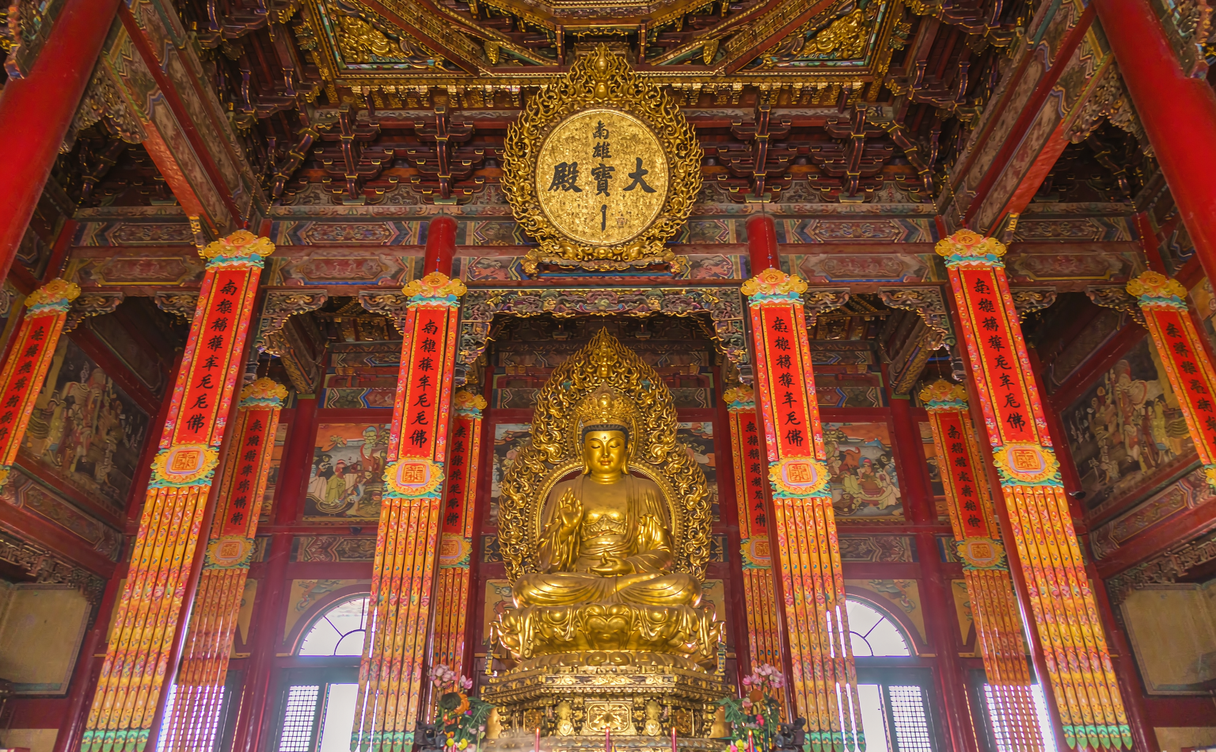
- The main halls. The Mahavira Hall (Da Xiong Bao Dian) holds a towering gilded Buddha, and the Dharma Hall behind it is one of the largest wooden halls in the city.
- The Burmese jade Buddha. A serene white-jade seated Buddha in a side hall — smaller than the Jade Buddha Temple’s famous piece but beautifully lit.
- The underground chambers. Below the complex are relic chambers and a 3,300 kg bronze bell and a giant drum; the descent is unexpected and cool on a hot day.
- Jing’an Park across the road — a small, calm green with lakeside teahouses, perfect for decompressing after the crowds.
- The surrounding malls. The temple plaza sits above a luxury mall; the contrast of gold eaves and Gucci windows is pure Shanghai.
If you want more temple-hopping, our Shanghai Yu Garden guide covers the old-town City God Temple complex, and the China temple stay guide explains monastic etiquette that applies here too.
Best Time to Visit Jing’an Temple
The best time to visit Jing’an Temple splits by mood. Early morning (7–9 am) gives you chanting, incense smoke and few people — the most “real” version. Evening (after 6 pm) gives you the lit gold roofs and a skyline backdrop, better for photos than for reflection. Seasonally, spring (March–May) and autumn (September–November) are the most comfortable for Shanghai’s weather; summer is hot and humid, winter is cold but crisp and uncrowded. The temple is indoors-outdoors, so rain doesn’t ruin it — just bring a small umbrella for the courtyards.
A Shanghai Itinerary That Includes Jing’an
A clean Shanghai itinerary might run:
- Morning: Jing’an Temple at opening, then coffee in Jing’an Park.
- Midday: West Nanjing Road shopping or the nearby museum.
- Afternoon: head east to the Shanghai Museum guide on Peoples’ Square, then the Bund night-view guide after dark.
- Another day: the former French Concession guide for tree-lined streets and brunch.
That loop covers the city’s spectrum — gold temple, grand museum, neon riverfront, leafy concession — without backtracking.
Festivals and the Living Temple
Jing’an is busiest and most atmospheric on the big Buddhist dates. The Buddha’s Birthday (roughly May, on the eighth day of the fourth lunar month) draws long lines of devotees and free vegetarian meals in the forecourt, and Lunar New Year sees the square thick with incense smoke and wish plaques. On ordinary days the rhythm is gentler: morning chanting around 7 am, a midday bell, and a steady trickle of locals who stop in from the office towers to light a stick of incense. Compared with the Jade Buddha Temple’s calmer north-side compound or Longhua’s riverside pagoda fairs, Jing’an trades serenity for spectacle — you’re as likely to hear a delivery scooter as a sutra. That’s the point: it’s a working temple squeezed into the most modern square kilometre of Shanghai, China, and the friction between the two is the story. If you want the quieter version, go midweek in winter; if you want the energy, hit a festival morning and arrive before the crowds swell after nine.
Practical Tips
Dress modestly inside the halls (cover shoulders and knees where you can), and keep your voice low — it’s an active temple, not a set. Photography is fine in the courtyards but usually restricted at the main altars; look for signs. Incense is sold at the gate for a few yuan if you want to join the offering. The nearby metro has luggage storage if you’re passing through with bags. Plan 60–90 minutes on site; it’s compact, and the real value is the atmosphere more than a long wander.
For solid background on the temple’s long history and architecture, the Wikipedia entry on Jing’an Temple is a reliable reference.