

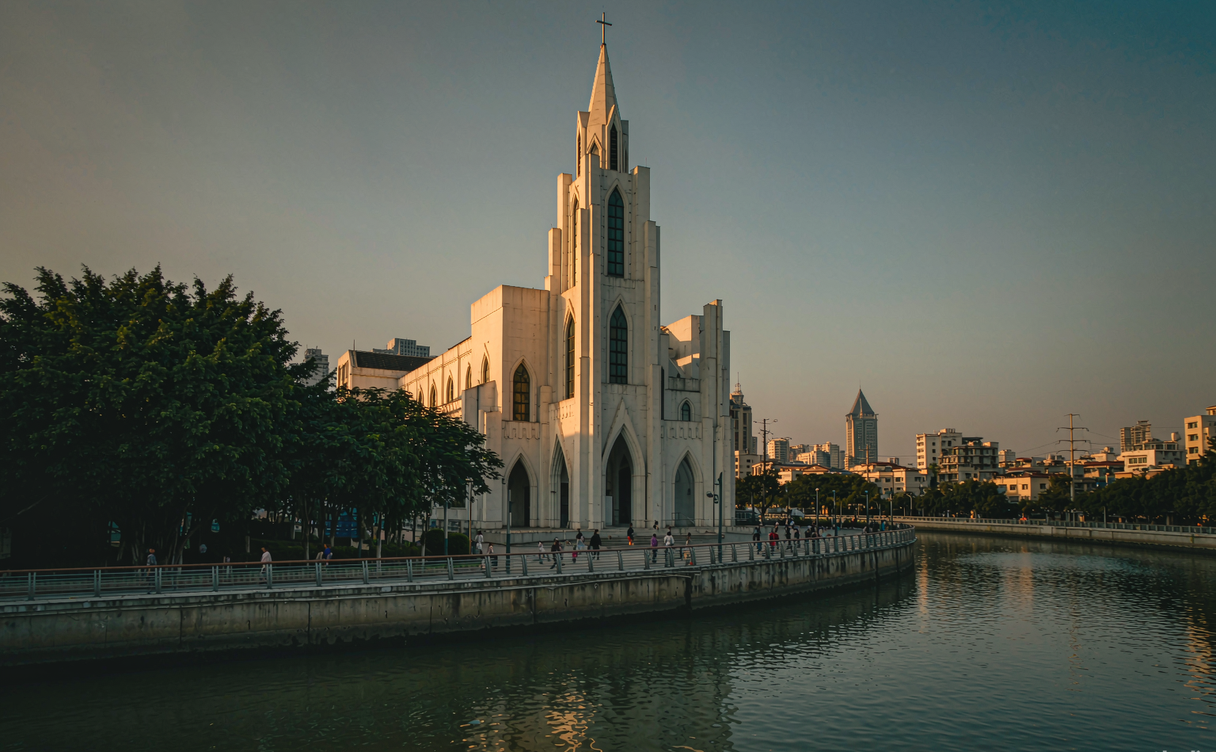
The Guangzhou Sacred Heart Cathedral is the most unexpected building in a city of surprises: a vast, twin-towered Gothic cathedral of grey granite rising on the north bank of the Pearl River in Guangzhou, China, built by French missionaries in the 1860s and modelled on the great churches of Europe. Locals call it the “Stone House” (石室) because almost every part of it — walls, pillars, even the vaulting — is cut from stone rather than brick or concrete. We’ve sent clients there who came for a quick photo and stayed for an hour, struck by how a slice of Reims ended up in the humid heart of Guangdong. This guide covers the Sacred Heart Cathedral Guangzhou tickets, how to get to Sacred Heart Cathedral, the things to do near Guangzhou cathedral, and where it sits in a Guangzhou itinerary.
Why the Stone House Matters
Construction began in 1863 and the cathedral was consecrated in 1888, a project of the French diocese on land granted after the Second Opium War. What makes it extraordinary is the material and the method: it is one of the only cathedrals in China built entirely of granite, with twin 58-metre spires and a Latin-cross plan, rose window and pointed arches all executed in French Gothic Revival style. For much of the 20th century it was damaged and repurposed; after a long restoration it reopened as a working church, and today it is both a landmark and an active place of worship.
Among Guangzhou churches it is in a league of its own — there is nothing else like it in the city, and few like it anywhere in Asia. The other notable Christian site, the small Our Lady of Lourdes Chapel on Shamian Island, is a pretty curiosity by comparison. If you want the full frame on the city, our Guangzhou travel guide lays out the districts and the logic of a visit.
How to Get to Sacred Heart Cathedral
The cathedral sits on Yide Road (一德路), in the old port district a few blocks north of the Pearl River:
- Metro. Line 6 to Yide Lu station (一德路) is the closest — about a 5-minute walk. Alternatively, Line 2 or 6 to Haizhu Square (海珠广场) is a 10-minute walk along the riverfront. Either is what we recommend; both are ¥2–5 and avoid Guangzhou’s notorious surface traffic.
- Taxi / Didi. Drop at “Saint Heart Cathedral” or “Yide Lu”; the surrounding streets are narrow and one-way, so the metro is easier.
- Walking. If you’re coming from Shamian Island or the river, it’s a flat 20–25 minute walk north through the old wholesale quarter.
The cathedral is wedged into a dense commercial block — Yide Road is the city’s wholesale market street for toys, seafood and dried goods — so the first glimpse of the spires between the shop awnings is genuinely theatrical.
Sacred Heart Cathedral Guangzhou Tickets
Entry is free — there is no ticket, which is rare for a major Chinese landmark and one reason it’s so easy to recommend. The cathedral asks visitors to register at the gate and to dress modestly (shoulders and knees covered), and it closes to tourists during Mass and certain services, so time your visit for the open touring windows (typically mid-morning to late afternoon on non-service days). Photography inside is generally allowed but be respectful during prayer. There’s no official online booking; just turn up. We tell clients to avoid Sunday morning, when the building is given over to worship.
Things to Do Near Guangzhou Cathedral
The things to do near Guangzhou cathedral are some of the city’s best:
- Shamian Island. A 20-minute walk (or short Didi) south: a quiet former foreign concession of colonial villas, banyan shade and riverside benches — the calmest corner of central Guangzhou.
- Pearl River waterfront. Stroll the embankment at Haizhu Square and watch the working river; evening light on the water is excellent.
- Beijing Road pedestrian street. A busy shopping artery 15 minutes north, built over the layers of old Guangzhou, with excavated Song-dynasty roadbed visible under glass.
- Chen Clan Academy. The city’s masterpiece of Cantonese decoration — carved wood, brick and ceramic. Our Guangzhou Chen Clan Academy guide explains what to look for, and it pairs perfectly with the cathedral as a morning-and-afternoon culture double.
- Yuexiu Park. The city’s green heart with the Five Rams statue and the remnants of the old city wall; our Guangzhou Yuexiu Park guide covers the walk.
Best Time to Visit Guangzhou
The best time to visit Guangzhou is October through April, when the subtropical humidity drops and days sit in the comfortable 18–26°C range — ideal for the walking the cathedral neighbourhood demands. Spring (March–April) can bring drizzle but few crowds; autumn (October–November) is the pick of the year. Summer (May–September) is hot, sticky and typhoon-prone, though the cathedral’s stone interior stays comparatively cool. Winters are short and mild. Whenever you come, aim for a weekday and a late-morning arrival to beat both the tour groups and the lunchtime market crush outside.
A Guangzhou Itinerary With the Cathedral
A natural Guangzhou itinerary runs:
- Morning: cathedral at opening, then wander Yide Road’s markets.
- Midday: Chen Clan Academy and a Cantonese lunch nearby.
- Afternoon: Yuexiu Park or Shamian Island, depending on your energy.
- Evening: Pearl River or Beijing Road.
If you’re extending across the Pearl River Delta, our Shenzhen travel guide is an easy high-speed add-on an hour south, good for a contrast of modern skyline after Guangzhou’s old stone.
The Building Itself: Stone, Light and Sound
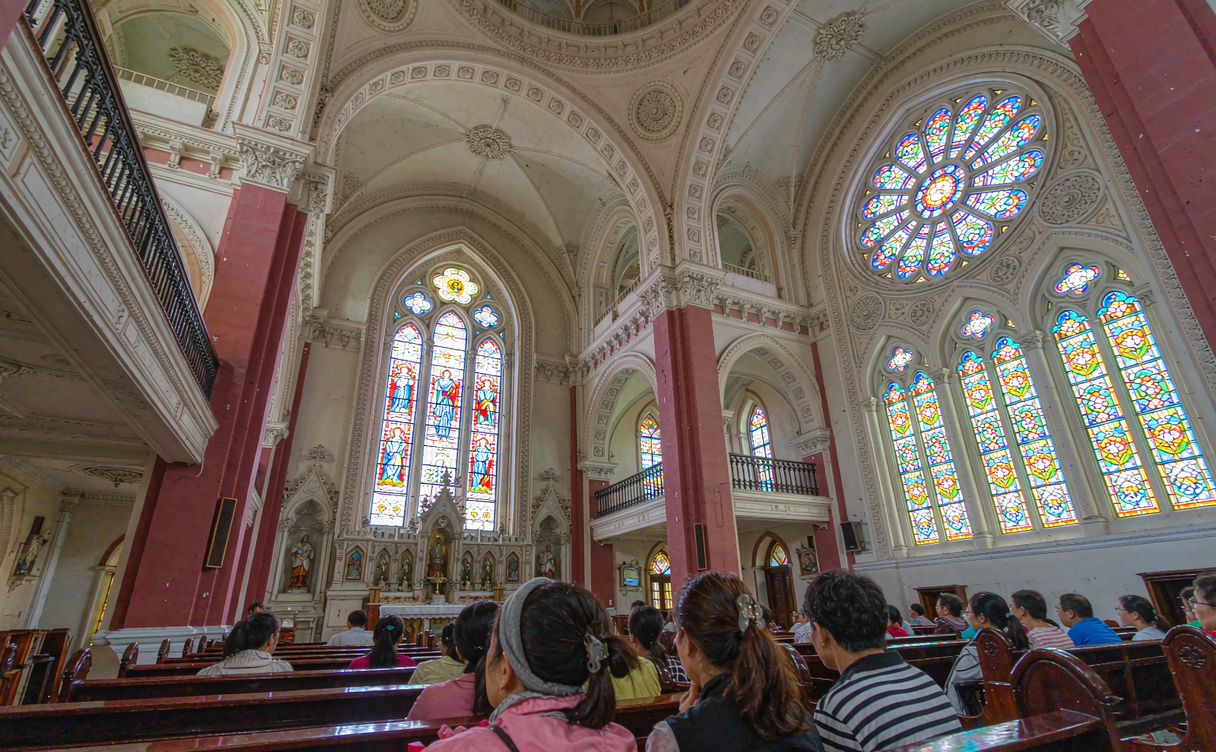
Even visitors with no interest in religion tend to be stopped by the craft. The entire cathedral is faced and structured in granite quarried locally, and the masons — many of them recruited from as far as France and China’s own stone-working regions — cut each block to a Gothic template, so the pointed arches and ribbed vaults read as authentic as any Rhine chapel. The west window is a rose of coloured glass that throws shifting reds and blues across the nave when the sun is right, usually mid-morning. Twin spires frame the main facade, each about 58 metres, and a rebuilt bell still calls the hours. Step inside during a quiet moment and the city noise drops away into a cool stone hush — a genuine shock given the market chaos five metres from the door. Non-Christian visitors are welcome to sit in the pews and simply take in the space; just stand or sit at the back during Mass and keep conversation to a whisper. The contrast — a 19th-century European sacred interior embedded in 21st-century Guangdong — is the whole reason the Stone House endures as the city’s most photographed anomaly.
Practical Tips
Carry a scarf or light layer to cover shoulders for entry; the gate staff do enforce modest dress. There are no ATMs at the church, but mobile pay and the surrounding shops cover basics. The area is one of Guangzhou’s best for food — dim sum houses and noodle stalls line the side streets — so eat before or after rather than hoping for a café inside. Plan 45–90 minutes: the building is compact but the detailing rewards a slow look, and the neighbourhood walk is the real bonus.
For reliable background on the building’s history and architecture, the Wikipedia entry on the Cathedral of the Sacred Heart of Jesus (Guangzhou)) is a solid reference.