

There are a lot of tombs in China and only one of them that people argue about. The Huangdi Mausoleum — the Yellow Emperor’s Mausoleum — sits on Qiaoshan hill in Huangling County, Shaanxi, China, about 180 kilometres south of Yan’an and 200 kilometres north of Xi’an. It is the burial mound of the Yellow Emperor, the figure Chinese tradition names as the first of the Five Emperors, and the site is treated as the ancestral centre of Chinese civilisation. We are not going to pretend that makes it a neutral sightseeing stop, but we can tell you what it is actually like to walk up there, which is the more useful thing.
What you get is a low green mound on a forested hill, a long processional axis of stone bridges and courtyards, somewhere over sixty thousand cypresses, and almost no crowd. The encyclopaedic entry on the mausoleum covers the archaeology and the contested location; this guide covers the visit.
What you will actually see
The site runs on one axis, from the south gate up to the mound, and the walk takes about forty minutes at an unhurried pace. You pass the imperial stele pavilion with the great Qianlong-era inscribed tablet, then cross the stone sacrifice square, a paved expanse large enough to hold a formal ceremony — which four times a year it does. Above that come the hall of the mausoleum, rebuilt in the 2000s in a broad, sober style with a glazed-tile roof and a row of columns, and then the terraces that climb to the mound itself, a rounded rise about 500 metres around the base, tall enough that the cypresses around it look small.
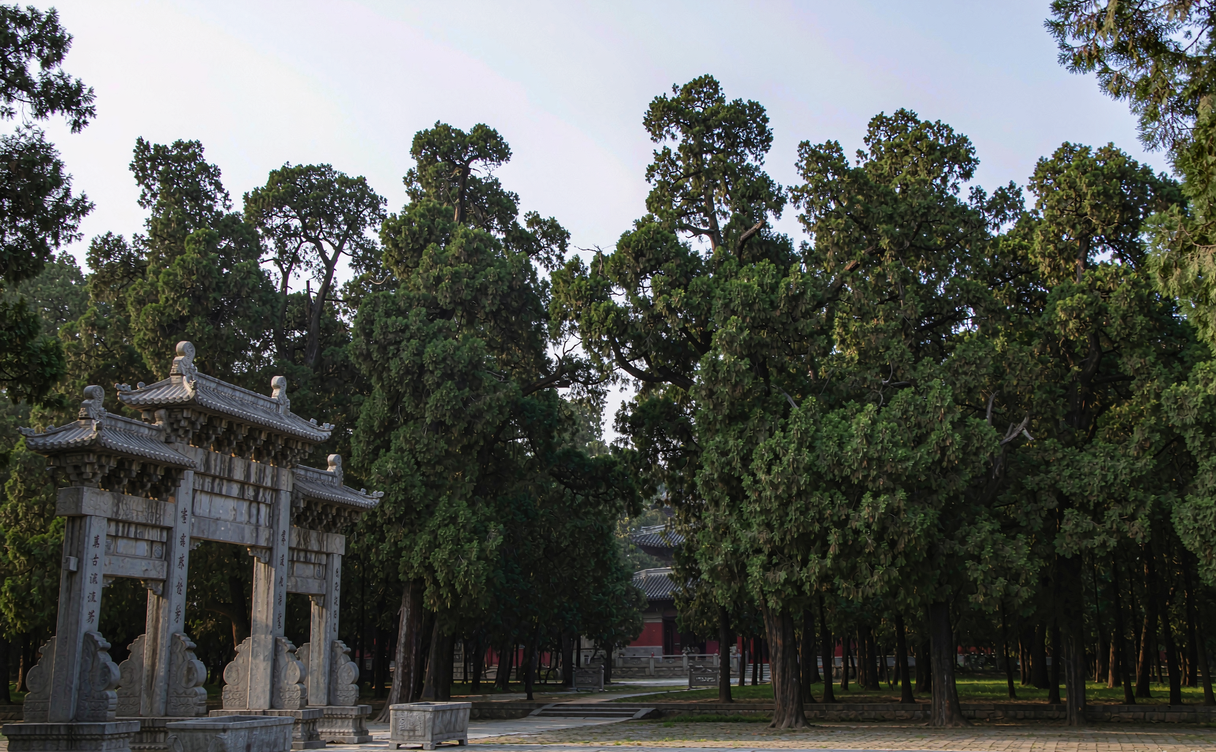
The second thing you notice is the trees. The Qiaoshan cypress forest covers several square kilometres of the hill and the surrounding ridge and is one of the largest stands of ancient cypress in the country. Some of the named trees are described in local lore as five thousand years old; the park guards will point out the “emperor’s own planted cypress” near the upper path. Whether or not you accept the numbers, the forest is the reason the mound looks the way it does — a green dome in a loess country that is otherwise mostly farmland and wheat.
Best time to visit the Huangdi Mausoleum
The best time to visit the Huangdi Mausoleum is May, June, September and October. The plateau sits around 1,000 metres, so it runs cooler than Xi’an and the air is usually clear enough for the distant view north toward the Yan’an escarpment. May and October average 14–25°C with the hills green or turning gold. September is our own favourite: warm, low humidity, and the cypress cones are on the ground.
July and August bring afternoon thunderstorms and the busiest domestic crowds, especially around the school holiday. Winter is cold — December nights near −10°C — but the mausoleum in snow, without another visitor on the axis, is a genuinely memorable hour. The mound is dark against white and the courtyards echo.
One date to know about: Qingming, around 4 April, when the official ancestral sacrifice is held and the square fills for the public ceremony. It is spectacular and it is also not a day for a quiet visit. If the ceremony is what you came for, plan for three days in the region rather than one.
Our best time to visit China guide maps the national seasons; the loess plateau has a noticeably shorter comfortable window than the coast.
How to get to the Huangdi Mausoleum
Two realistic routes, and a third that is a good idea if you can arrange it.
- Train to Yan’an, then bus or car: this is the standard route. High-speed services run from Xi’an North to Yan’an, and from Yan’an city a long-distance bus or hired car covers the 180 km south to Huangling in about two and a half hours. The China high-speed train guide for foreigners explains how to book the Xi’an–Yan’an leg as a foreigner. The Yan’an travel guide covers the onward bus.
- Self-drive from Xi’an: roughly 200 km via the G65 north, about 2.5–3 hours. The road is good and the exit is signposted. Parking at the site is large and free.
- Tourist coach from Xi’an: some operators run a combined Huangdi Mausoleum and Yan’an day trip. Cheap, fast, and you will spend the middle of the day in a coach.
Entry is around ¥50–80 per person including the shuttle bus that runs from the car park to the bottom of the axis, and hours are roughly 08:00 to 18:00 year-round with a shorter winter schedule. The shuttle is worth taking if you are short on time, but the upper walk to the mound is the point, so get out and do it.
Take the early bus out of Yan’an and be at the south gate by 8:30 — the axis is empty in the morning, the cypress mist has not lifted off the ridge, and you will have the mound to yourself before any coach arrives.
Things to do at Huangdi Mausoleum
Walk the full axis. That is the main thing to do at Huangdi Mausoleum, and taking it slowly (about 90 minutes end to end) rather than rushing to the top and back is what makes it work.
Go up to the mound. The terraces are wide and the last climb is a gentle ramp. From the top you can see the shape of the whole basin, the cypress canopy going off in every direction, and the road you came in on. There is a low railing and you can walk the north side for a better angle.
Walk the cypress ridge above the axis. Most visitors never leave the main path. Turn off at the upper loop and walk the wooded slope behind the hall, where the trees are thickest and the only sound is crows and the wind in the needles.
[IMAGE: The earthen Huangdi Mausoleum mound rising above a sea of ancient Qiaoshan cypresses on the hill in Shaanxi | alt=”Huangdi Mausoleum Qiaoshan cypress forest Shaanxi Yellow Emperor tomb mound”]
Do the lower ridge and the stele pavement at the south end, where a line of inscribed tablets records the sacrifice dates of the last two centuries. This is the part that finishes the picture for anyone interested in how memory is maintained.
Facts worth knowing before you climb
The mound is not an excavation. There has never been an open dig here, and local and national authorities have consistently held the site as a place of veneration rather than a target for archaeology. So do not come expecting tombs, chambers or artefacts — come for the hill, the trees, the axis and the atmosphere. Anyone who tells you they have seen inside is selling something.
Also: this is an active ritual site, not a ruin. Groups arrive to burn incense, lay wreaths and perform music. Stand aside at the Hall, keep your voice down on the upper terraces, and do not photograph the ceremonies unless you are invited to.
Where to stay and eat
Huangling county town is small and sits about 15 kilometres from the mausoleum. There are provincial-grade hotels at ¥200–320 a night and a scattering of guesthouses at ¥100–160, and the town is quiet after dark. Staying here means you can be at the gate at opening on a morning when the courtyards are empty.
If you would rather not change hotels, Yan’an has the full range from international-brand chains to budget rooms at ¥180–350, and it is only two hours away on the road that runs past the site. Xi’an is the obvious base if this is a day trip.
Food is northern Shaanxi. 黄陵饸饹 (hele noodles, buckwheat noodles pressed hot and served with a chilli dressing, ¥12–18) is the local bowl. 油旋 and 碗托 from Yan’an make good snacks, and a working dinner for two comes to ¥80–120.
Stay one night in Huangling rather than day-tripping from Xi’an — the courtyards empty after four in the afternoon and the last hour before the mound closes is the quietest you will get anywhere in Shaanxi.
Pairing the mausoleum with Yan’an and Xi’an
This is a route, not a stop. Yan’an is the natural base to the north and gives you the 宝塔山 and the revolutionary sites if that interests you; Xi’an to the south gives you the museums, the wall and the Terracotta Army. Our Xi’an travel guide handles the southern end of the loop, and the best things to do in China roundup explains where the mausoleum sits in a first trip.
If you are building a Shaanxi itinerary around this, our China travel guide for first-timers covers the rail booking, the payment apps and the two-hour transfer style that makes county stops like Huangling straightforward.
Practical tips before you go
Bring a layer even in September — the plateau cools fast after four. Comfortable shoes matter more than you would think, because the axis is stone and the upper ramps get slick when it rains. Buy the shuttle ticket at the gate if you arrive late in the day, but plan to walk the axis up and take the shuttle down, or the reverse.
Go on a weekday if you can. Thursdays and Fridays are markedly quieter than Saturdays. And do not try to combine this with the Terracotta Army in one day; the two are in opposite directions from Xi’an and the drive alone eats four hours.
Final thoughts
The Huangdi Mausoleum is the one site in Shaanxi where the history is deliberately partly imagined. That is not a defect — it is the reason the place works. A low hill in a plain, covered in sixty thousand old trees, with a formal road leading up to it and nothing whatsoever at the top but the view. We think it is the most quietly powerful hour in the province, and we send almost everyone who comes to Yan’an up here.
Put the mausoleum on a Shaanxi route as a full day between Xi’an and Yan’an, and spend the evening in Huangling county town eating buckwheat noodles while the last of the light goes off the cypress ridge.