

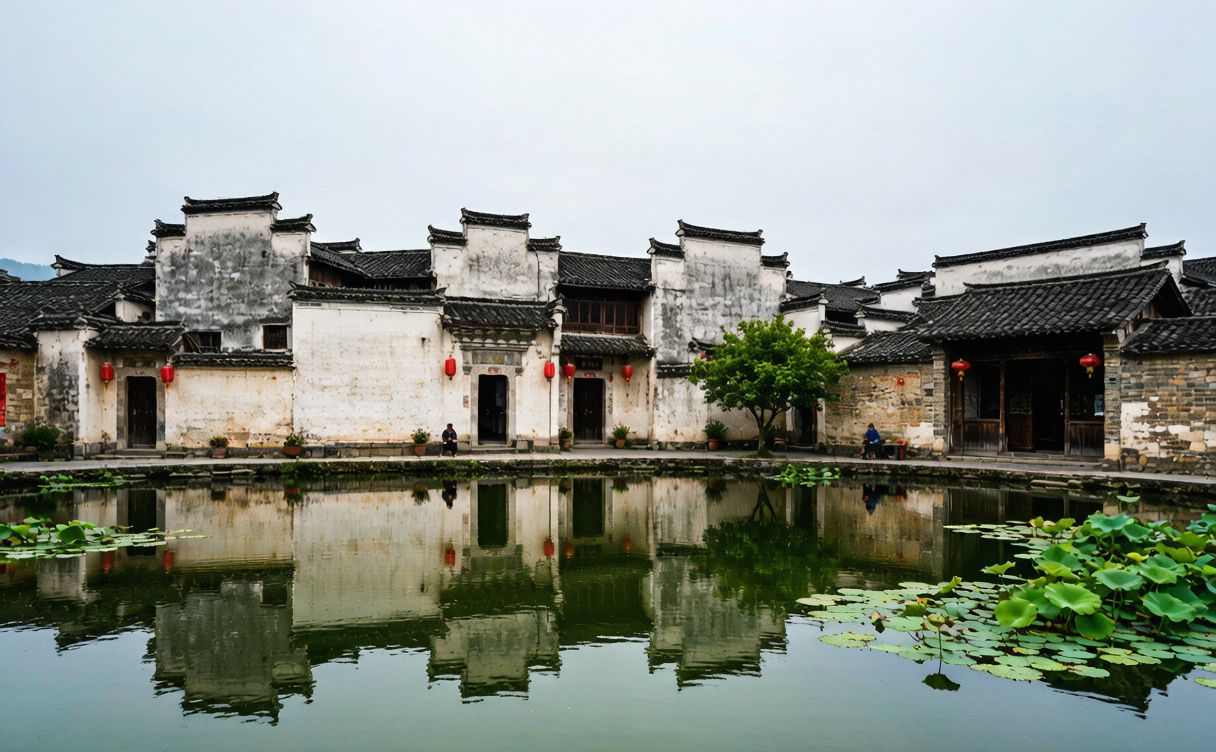
I arrived in Hongcun before sunrise, and the only sound was a wooden ladle dipping into still water. A woman in a blue apron was washing leafy greens at the edge of a crescent pond, and her reflection rippled beside a row of 400-year-old white walls topped with horse-head gables. Here is the surprising part: the entire village is built in the shape of an ox. Hongcun, tucked into the foothills of Huangshan in southern Anhui, is not a museum piece — it is a living, breathing Huizhou settlement where people still hang laundry and brew tea between the same courtyards their ancestors raised centuries ago.
Why Hongcun, and Why You Should Care
Most foreign travelers bolt straight for the Yellow Mountains and never learn that one of China’s most photogenic UNESCO sites sits barely an hour away. Hongcun ancient village earned its World Heritage listing in 2000, together with the nearby village of Xidi, as an exceptional surviving example of a Ming- and Qing-dynasty Huizhou settlement. What makes it special is not a single landmark but the whole organism: a water system engineered in the 1400s that still channels spring water through every home, and an architecture so distinctive that it shaped the look of old towns across the region.
When I wandered the lanes that first morning, I kept stopping to touch the walls. The lime-washed facades are purposely plain at street level — Huizhou merchants were forbidden (or cautious) to show off wealth — but step through a narrow gateway and the interiors open into carved-wood splendor: lattice screens, narrative relief panels, and bracket sets so fine they look embroidered. A villager told me his family had lived in the same house for eleven generations, and that the lotus pond in his courtyard was dug “by my great-great-grandfather, who liked the quiet.”
The Ox-Shaped Layout: A Village Built Like a Living Animal
This is the detail that makes Hongcun famous among architecture nerds, and it is genuinely fun to decode on foot. The 15th-century planner Hu Kongzhi and later the Wang family reworked the village’s water system into the shape of an ox:
- The head is the broad, calm sheet of water at the village entrance known as Moon Pond (月沼, Yuezhao), where the main clan hall, Jingtang, faces the water.
- The body is the cluster of homes and alleys inside the earthen embankment.
- The four legs are four stone bridges that step over the streams at the edges.
- The belly and intestines are the winding canals — over a kilometer of them — that carry spring water past nearly every kitchen.
- The horns are two old trees, a ginkgo and a red bayberry, still standing at the western end.
The system is not decorative. The upper stream feeds drinking and washing water; the lower carries it away for irrigation in the surrounding rice fields. It is low-tech, beautiful, and still working after 600 years — which is more than I can say for my own apartment’s plumbing.
Ming and Qing Architecture You Can Actually Walk Through
Huizhou buildings follow a tight formula, and once you see it you will spot it everywhere: horse-head gables (step-shaped firewall walls), blue-grey tile roofs, and deep, enclosed courtyards called “sky wells” (天井, tianjing) that pull light and rain into the center of the house. The enclosed courtyard is practical as much as spiritual — it keeps rooms cool, catches rainwater (a Huizhou pun on “wealth arrives”), and shields interiors from the lane.
The standout buildings worth your time:
- Jingtang (承志堂, the “Louvre of the common people”) — a 19th-century salt merchant’s mansion with seven courtyards and layered woodcarvings. The detail work here took master carvers years; look up at the gilded opera scenes on the beams.
- The Wang Clan Ancestral Hall (敬修堂 / 乐叙堂) — the spiritual anchor facing Moon Pond, still used for ceremonies.
- The homes turned guesthouses — many residents rent rooms, so your B&B may itself be a 200-year-old timber mansion, which is a strange and lovely thing to wake up inside.
How to Reach Hongcun from Huangshan
The logistical question every visitor asks, answered:
- Fly or train to Huangshan City (Tunxi). Huangshan Tunxi Airport has domestic connections; the high-speed station is Huangshan North (黄山北). From there it is roughly 1 to 1.5 hours by road to the village.
- From Huangshan Scenic Area (Tangkou): Buses and taxis cover the ~1-hour hop. Most people pair a Yellow Mountain hike with an overnight in Hongcun, and I strongly recommend doing both — the misty granite peaks and the soft water village are the yin and yang of the region.
- Tickets: Entry is controlled (it is a protected heritage site), and a through-ticket typically covers multiple days, so an early arrival lets you catch both dawn and dusk light.
If you are building a wider Anhui itinerary, our Huangshan Yellow Mountain travel guide lays out the cable cars, sunrise spots, and the logistics that actually matter once you are on the mountain.
Best Time to Visit Hongcun
Timing is everything for both comfort and photos. The short version: go in spring (March–May) or autumn (September–November).
Spring brings rapeseed flowers blazing yellow across the terraced fields ringing the village, and the canals run full and clear. Autumn gives you crisp light, harvest activity, and the least oppressive humidity. Summer is green and lush but hot and occasionally stormy; winter is cold, quieter, and occasionally dusted with snow that turns the rooftops into a ink-painting come to life — magical for photographers, miserable if you are under-packed. For a region-by-region breakdown of shoulder seasons, see our best time to visit China guide.
My single best tip: enter at the 6 a.m. opening. Tour buses from Huangshan and Hangzhou arrive mid-morning and the lanes fill fast. The first hour belongs to you, the washerwomen, and the mist.
Where to Stay in Hongcun
You have two smart options:
- Sleep inside the village. Numerous heritage homes operate as guesthouses. You trade a little plumbing modernity for the unbeatable experience of the village emptying out at night, leaving you alone with lantern-lit alleys and the sound of running water. Book ahead in peak season.
- Stay in nearby Tangkou or Huangshan City and day-trip in. Cheaper and more hotel-like, but you miss the dawn and dusk magic.
Either way, expect modest rooms by Western standards and wonderful hosts. A guesthouse owner in his sixties poured me a glass of homemade rice wine the night I arrived and, when I tried to pay, waved it off: “You walked all the way from the mountain. This one is free.”
Photography Tips From Someone Who Froze for the Shot
Hongcun is a favorite subject of art students (the central art academy keeps a sketching base here), and for good reason — it is basically a real-life ink painting. A few things I learned:
- Shoot Moon Pond at dawn for mirror-still reflections and zero crowds. The clan hall on the south side is the classic frame.
- Look up at the gables. The stepped horse-head walls against a pale sky make clean, graphic compositions.
- Use the canals as leading lines; crouch low so the water carries the eye into the scene.
- Embrace overcast days. Flat light kills harsh shadows and keeps the white walls from blowing out — exactly what the plein-air painters want.
For more on gear, golden-hour timing, and composition across the country, our China photography tour guide is worth a read before you pack.
How Hongcun Compares to Other Ancient Towns
If you are hunting China’s best old settlements, Hongcun is the most atmospheric of the “untouched-feeling” Huizhou pair (with Xidi close by). It is smaller and more water-centered than the walled merchant city of Pingyao in Shanxi, and far less commercialized than the canal towns near Shanghai. For a curated shortlist with honest pros and cons, our guide to the best ancient towns in China compares Hongcun with places like Pingyao ancient town so you can choose without wasting a train ticket.
Practical Notes and the Authority Link
A few closing logistics: wear shoes with grip (the lanes are slick stone), carry small cash for village snacks and the occasional homestay that is card-shy, and respect that people live here — ask before photographing faces. The village’s UNESCO status and conservation rules are documented by the official heritage body, and you can read the listing details directly at UNESCO’s World Heritage page for Ancient Villages in Southern Anhui.
Hongcun, in the end, is not a checklist attraction. It is a place to slow down, follow the water, and let 600 years of quiet engineering do the impressing. I left with cold feet, a full memory card, and a stubborn urge to come back when the snow falls.