

The first time I saw the Mount Emei Golden Summit, I was half-frozen, half-asleep, and entirely unprepared for what the cloud sea did at 6:42 a.m. The mist peeled back like a curtain, the 48-meter Samantabhadra statue caught the first orange light, and for about ninety seconds the whole mountain looked like it was floating. That moment is the reason I keep sending people to Emei — and the reason this Chengdu Mount Emei guide exists. It’s the one sacred mountain near Chengdu where a foreign visitor can ride a bullet train out of the city after breakfast, meet genuinely wild monkeys by lunch, and stand above the clouds by sunset without ever touching a tent.
I’ve now done Emei twice: once as a two-day hiker and once as a “get me to the top and back” cable-car day-tripper. Both were right. This guide tells you which version to pick, how the monkeys actually behave, and how to chain the mountain with the Leshan Giant Buddha so you’re not wasting a single train ticket.
Key takeaways
– Mount Emei sits ~1.5–2 hours by high-speed train from Chengdu; the station is at the foot of the mountain.
– The Golden Summit (3,079 m) is the payoff: a giant Samantabhadra statue, sea of clouds, and (some mornings) a Buddhist “glory” halo.
– Wild Tibetan macaques near the middle section will grab bags and snacks — keep distance, hide food, and never smile with your teeth (they read it as a threat).
– Hiking the full mountain is a rewarding 2-day trek; the cable car + bus combo gets you to the summit and back in a single long day.
– Pair Emei with the Leshan Giant Buddha — they’re the same UNESCO site and an easy one-day combo from Chengdu.
Why Mount Emei is worth the trip from Chengdu
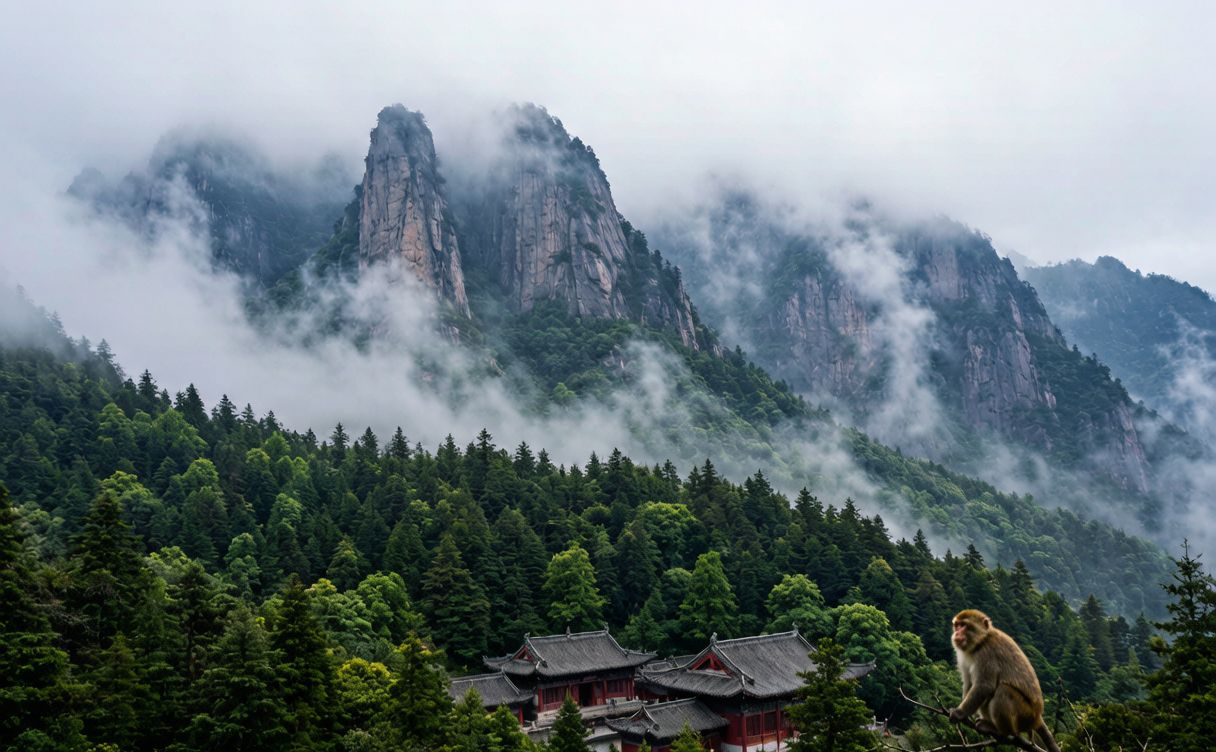
Most visitors to Sichuan stop at the pandas and the hotpot and call it a trip. They’re missing one of the four sacred Buddhist mountains of China, and the only one with a real, living monkey population you meet on the trail rather than behind glass. Mount Emei rises from a leafy lowland of temples to a cold, thin-air summit, so you get a rainforest, a monastery circuit, and an alpine sunrise in a single mountain.
What hooked me was the layering: a subtropical valley of banana trees and temple drums at the base, mossy stone staircases and incense smoke in the middle, and a parka-at-3,079-meters cloud sea up top. Few places compress that much landscape into one walk.
If Chengdu is your base, the logistics are almost silly-easy. The mountain’s own train station (Emeishan) is on the same network as the Chengdu high-speed lines, and from there it’s a short bus to the scenic-area entrance. For background on getting around the country by rail, our China high-speed train guide for foreigners covers what to expect on board and at the stations.
Getting from Chengdu to the mountain
Start at Chengdu East Railway Station. Trains to Emeishan leave throughout the day and the ride runs about 1 hour 20 minutes to 1 hour 50 minutes depending on whether you catch a G- or C-class service. Book in advance during holidays — seats sell out — and our how to book China train tickets on 12306 walks through the app that every local actually uses.
At Emeishan station, ignore the taxi touts and take the green tourist bus (or a metered cab) the 15 minutes to the Baoguo Temple area, where most people sleep the night before climbing. Baoguo Temple itself is worth an hour even if you’re not Buddhist — it’s the gateway monastery, and the evening drum-and-bell ceremony is oddly moving.
One practical note: the scenic area runs on a timed shuttle system. You buy one through-ticket that covers the park bus from the base up to the cable-car station and back. Hold onto it; they scan it at multiple checkpoints.
The wild monkeys: fun, then a little terrifying
I have to give the monkeys their own section because they are the single thing people underestimate. The Tibetan macaques around the Wannian and Qingyin Pavilion mid-mountain section are wild, bold, and smarter than most tourists. On my first visit a macaque untied my companion’s daypack while she was photographing a waterfall, pulled out a banana, and sat down to eat it ten feet away, watching her with what I can only describe as smugness.
Here’s what I learned the hard way:
- Hide all food. Zip it inside your main bag, not a side pocket. They open zippers.
- Don’t feed them. It’s forbidden, it makes them aggressive, and rangers will fine you.
- No eye contact, no big smiles. Showing teeth reads as a challenge; looking away and backing off is safest.
- Walking sticks attract them. The monkeys sometimes grab trekking poles thinking they’re food. Keep moving.
- Stay near the wardens. There are monkey-control staff with slingshots at the hot zones; being within earshot of them is the safe lane.
They’re not dangerous if you respect the rules, but they will absolutely ruin your picnic. Treat them like confident, furry pickpockets and you’ll be fine — and you’ll get photos no zoo could give you.
Route 1: The full hike (2 days, legs Optional but unforgettable)
If you’re reasonably fit and want the pilgrimage experience, hike from near the base to the summit over two days. Day one: bus to Wuxiangang, walk the Qingyin Pavilion and ecology monkey zone, then climb to stay overnight at one of the mid-mountain monasteries or the Jieyin Hall area. Day two: a pre-dawn push up to the Golden Summit for sunrise.
The trail is almost entirely stone steps — beautiful, relentless stone steps. Sleeping at altitude and reaching the summit on foot gave the place a weight the cable car can’t fake. Book your mountain guesthouse ahead; options are limited and the good ones fill up.
Route 2: Cable car + bus (1 long day, summit-focused)
Short on time? This is the version I did on trip two, and it’s the right call for most first-timers. From the base, the scenic bus climbs the switchbacks to Leidongping (around 2,400 m), then it’s a 1.5-hour walk (or shorter if you’re quick) up the final staircases to the Golden Summit cable car, which whiseps you the last few hundred meters to 3,079 m.
Total door-to-summit time from Chengdu is roughly 5–6 hours, and you can be back in the city for a late dinner. You still meet monkeys if you add the Wannian Temple loop on the way down, so you don’t lose the signature encounter.
The Golden Summit and what you’re actually looking at
The summit’s centerpiece is the ten-faced, four-sided gilded statue of Samantabhadra (Puxian) sitting on a lotus, 48 meters tall and visible from the parking area. Behind it, the cliff drops into the cloud sea. On a clear morning you may catch the “Buddhist glory” (fo guang) — your own shadow projected onto the mist with a rainbow ring, a phenomenon caused by sunlight behind you. I saw it once in two visits; it’s luck, not a guarantee, but the sea of clouds alone is worth the climb.
Temperatures at the top run 10–15°C colder than Chengdu, and in winter the summit can sit near freezing even when the city is mild. Pack a jacket no matter the season. The cable car and temples have food and water, but prices climb with altitude, so stock up at Leidongping.
Pairing Emei with the Leshan Giant Buddha
Here’s the combo I recommend to everyone: do Leshan in the morning, Emei in the afternoon and next morning, or vice versa. The Leshan Giant Buddha — a 71-meter cliff-carved statue and, with Emei, a joint UNESCO World Heritage Site — sits about an hour by bus or train from Emeishan. You can see the Buddha from a river cruise in under two hours, or walk the stairs beside it in half a day.
The two are linked by UNESCO as a single property, which tells you something: together they’re the cultural heart of this corner of Sichuan. If you only have one free day beyond Chengdu, the Leshan-half-day-plus-Emei-summit combo is the most efficient way to spend it. UNESCO’s own listing has the background and the official inscription details: Mount Emei Scenic Area, including Leshan Giant Buddha Scenic Area.
Where to stay and when to go
Base yourself in Chengdu and do Emei as an overnight, or stay at the mountain. Chengdu has the better food and nightlife; the mountain has the sunrise. If you want a city-base plan, our best hotels in Chengdu breaks down neighborhoods that keep you close to the East Railway Station for early trains.
Timing matters. Spring (April–May) and autumn (September–November) are the sweet spots: clear summit views, comfortable trails, and monkeys out but not heat-stressed. Summer brings lush green and the best chance of the cloud sea, but also the most domestic tourists and afternoon thunderstorms. Winter is cold and sometimes snow-closed at the very top, but the crowds thin out and the bare trees are striking.
A few things I wish I’d known
- Book the summit cable car early. On busy mornings the queue backs up; arriving at Leidongping by 7 a.m. beats it.
- Download offline maps. Signal disappears on the upper trail. Screenshots of the route saved my second trip.
- Carry cash. Small mountain vendors and some temple entries don’t take cards or Alipay reliably.
- Respect the monasteries. Several offer simple vegetarian meals (su shi) for a few yuan; it’s a genuine taste of monastic Sichuan food, not a tourist show.
Mount Emei isn’t a checkbox sight — it’s a climb, a temple visit, and a wildlife encounter bundled into one very vertical mountain. Give it a day if you must, two if you can, and let the monkeys steal a snack or two. You’ll leave talking about the cloud sea long after the train pulls back into Chengdu.
For a wider lens on the region, our Chengdu pandas and city guide covers the city side, and if you want to extend deeper into Sichuan, the Jiuzhaigou travel guide has the fairy-tale lakes a few hours further west. If you’re building a whole China route around this, start with our China travel guide for first-timers to stitch the cities together by train.