

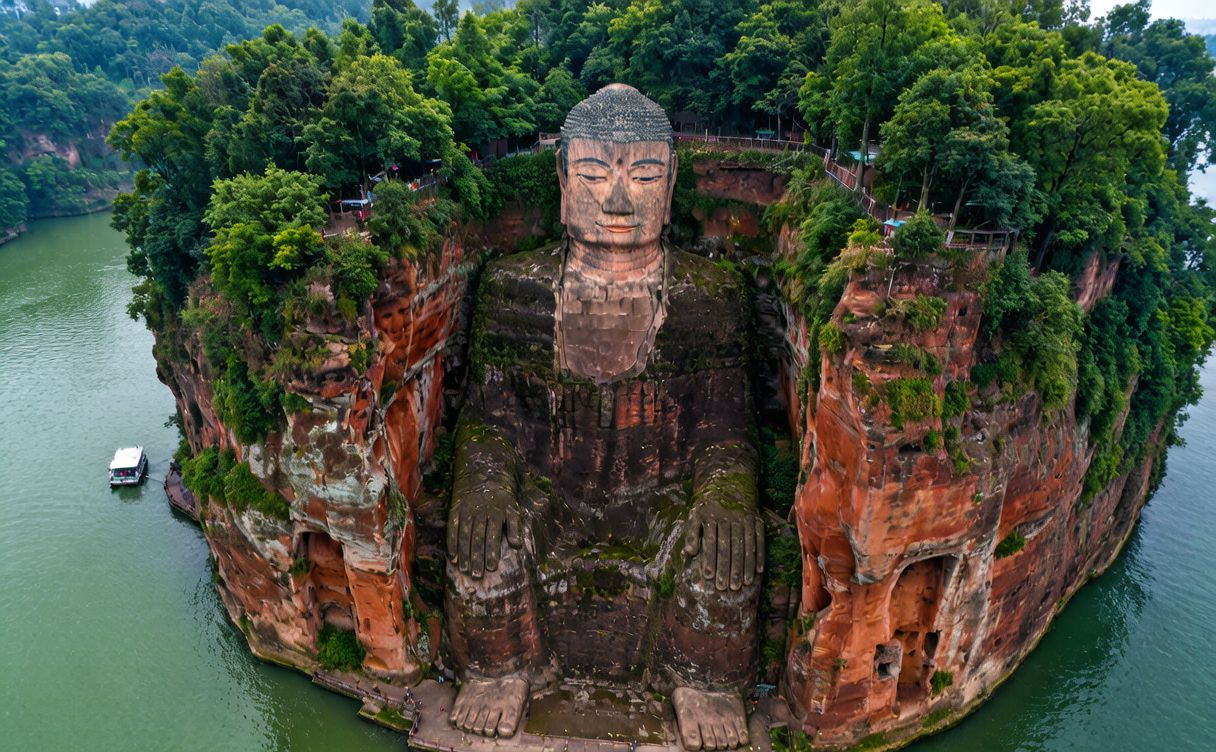
I’ll never forget the moment I tipped my head all the way back at the base of the cliff and realized the stone ear in front of me was taller than a city bus. The Leshan Giant Buddha — a 71-meter-tall Maitreya carved straight into a riverside cliff in Sichuan — is one of those sights that no photo prepares you for. I’d come down from Chengdu on a whim, expecting a big statue and a quick selfie, and left genuinely rattled by the scale of the thing. This guide is the one I wish I’d had before that trip: how to do it as a day trip from Chengdu, the two completely different ways to actually see the statue, and how to bolt on neighboring Mount Emei if you’ve got one more day.
A quick word on what you’re looking at, because it changes how you read the place. The Buddha was begun in 713 AD by a monk named Hai Tong, took roughly 90 years and three generations of carvers to finish, and was meant to calm the treacherous confluence of three rivers churning below. It’s been a UNESCO World Heritage site — listed together with Mount Emei — since 1996 (see the official UNESCO listing), and it remains the largest stone Buddha in the world.
Why bother leaving Chengdu for it
Chengdu is the obvious base: it’s where you’ll likely fly in or arrive by train, meet the pandas, and eat your body weight in hotpot. Leshan sits about 150 km south, and the Buddha is the single best reason to point your feet that direction for a day. Unlike a museum piece behind glass, here you walk down the cliff face beside the statue, stand on its toenails, and feel the river wind off the Min River at your back. For a first trip to China it’s an easy, rewarding half-day that balances big-city chaos with something ancient and quiet.
If you’re building a Sichuan route, anchor it with our Chengdu pandas and city guide and book a comfortable launch pad using our best hotels in Chengdu — both make the morning train feel effortless.
Getting from Chengdu to Leshan
The good news is this is one of the simplest day trips in the country, and China’s high-speed rail makes it almost foolproof.
By high-speed train (my pick). Trains leave Chengdu East (Chengdu Dong) or Chengdu South stations for Leshan Station roughly every 20–30 minutes from early morning. The ride is 40–50 minutes and costs about ¥50–65 in second class. From Leshan Station you’ve got two ways to the scenic area: a local bus (cheap, ~30 minutes, but slower and crowded) or a Didi/taxi (~20 minutes, ¥25–40). I caught the 8:10 train and was in the entry queue by 9:15. If you’ve never booked a Chinese train, our China high-speed train guide for foreigners walks through the 12306 app and scanning your passport at the gate — buying the ticket took me about four minutes, and it’s far less scary than it looks.
By bus or tour. Long-distance buses run from Chengdu’s Xinnanmen Bus Station, and plenty of day-tour packages pick you up at the hotel. Skip these unless you don’t want to think at all — the train is faster, cheaper, and drops you closer to the gate.
Timing. Aim to leave Chengdu before 9 a.m. The Buddha gets busy, and the cliff stairway has a one-way flow that bottlenecks badly after 11. More on that below.
Seeing the statue, option 1: the cliffside footpath (九曲栈道)
This is the classic experience, and the one I’d never skip. After you enter the east gate and stroll the cliff walkway, you join the famous Nine-Turn Stairway (九曲栈道) — a narrow, carved staircase that switchbacks down the cliff beside the Buddha’s right side, all the way to his feet. It’s roughly 200 steps, often damp, and at peak times the line moves at a snail’s pace because the steps are single-file and everybody stops to crane their neck.
The payoff is the close-up. You pass the knee, the giant hands resting on the knees, the chest, and finally you stand on the plinth with the toes — each toenail wider than a person — right at eye level. That’s the photo everyone takes, and yes, it earns it. The stairway is one-way (down only) and feeds you out at the riverbank.
Two practical warnings I learned the hard way:
- It’s steep and enclosed. If you’re afraid of heights or have bad knees, the descent is manageable, but the climb back up the other staircase to exit is a real workout in the humidity. Go slow.
- Go early or late. Mid-morning the stair line can mean 60–90 minutes of shuffling. Arriving right at opening (7:30 a.m.) or after 3 p.m. cuts that dramatically.
Entry to the scenic area is about ¥80 in peak season (a little less off-season). That single ticket covers the cliff walk, the stairway, and the surrounding park and temples — there’s no extra charge to descend.
Seeing the statue, option 2: the river cruise
If the stairway sounds like too much — or you simply want the postcard view — take the river ferry. Boats leave from a pier near the west gate and cruise out onto the Min River to the point where the three rivers meet, swinging around so the entire front of the Buddha fills your view. From the water you finally grasp the whole composition: the head tucked into the cliff, the shoulders carved to span the hillside, the calm face looking out over the current.
I did both in one day, and honestly the cruise gave me the “aha” the stairway didn’t. Standing on the toenail tells you it’s big; seeing the full figure from the river tells you it’s a masterpiece. The boat ride runs about 20–30 minutes and costs roughly ¥70 per person. You don’t get to touch anything and you can’t read the carved detail, but you also skip the stair queue entirely — a smart move on a hot holiday weekend.
My suggestion: do the stairway first (early, when it’s cool and empty), then take the afternoon cruise for the overview and some shade. If you only have time or energy for one, pick the stairway for the experience and the cruise for the photograph.
Add Mount Emei: the natural two-day combo
Here’s the thing most day-trippers miss — Leshan and Emei carry the same UNESCO listing, and Mount Emei is only about 30 km west. Emei is one of China’s four sacred Buddhist mountains, with a golden summit temple, mile after mile of misty forest, and troops of semi-tame macaques that will absolutely try to steal your snack bag.
A logical rhythm:
- Day 1: Chengdu → Leshan (Buddha + cruise), overnight in Leshan or train back to Chengdu.
- Day 2: Leshan → Emei (bus or short train to Emei Shan station), cable car to the Golden Summit, back to Chengdu in the evening.
I spent a night in Leshan and caught the first Emei cable car the next morning — worth it for the clear summit views before the cloud rolled in. It’s a fuller trip but not a harder one, and it turns a single statue into a real Sichuan story. If your appetite for mountains outruns your schedule, our Jiuzhaigou travel guide covers the other headline landscape in the province, and our Chongqing travel guide shows how to keep rolling east by train afterward.
Practical tips that save the day
- Book the train ahead during holidays. On a normal weekday you can buy at the station, but Golden Week and summer weekends sell out — same for the Emei cable car at peak.
- Wear real shoes. The stairway is worn stone, often slick. I watched two people in flip-flops regret life decisions.
- Bring water and a fan in summer. Leshan in July is hot and humid, and the stair queue has no shade.
- Carry your passport. Both the train gate and (sometimes) ticket pickup check it against your booking.
- Food at the site is mediocre and pricey. Eat a big Chengdu breakfast, or grab Leshan’s famous bo bo ji — cold poached chicken with a chili-lime dip — just outside the gates. It’s the local dish, and it’s excellent.
The bottom line
The Leshan Giant Buddha is the rare UNESCO heavyweight you can genuinely visit as a half-day hop from a major city. Train from Chengdu, descend the cliff stairway to stand on the toes, then float back on the river ferry for the full-face view — and if you’ve got one more day, Mount Emei is right there waiting. I went expecting a photo and came home with a story. Go early, wear good shoes, and let the scale do the rest.